
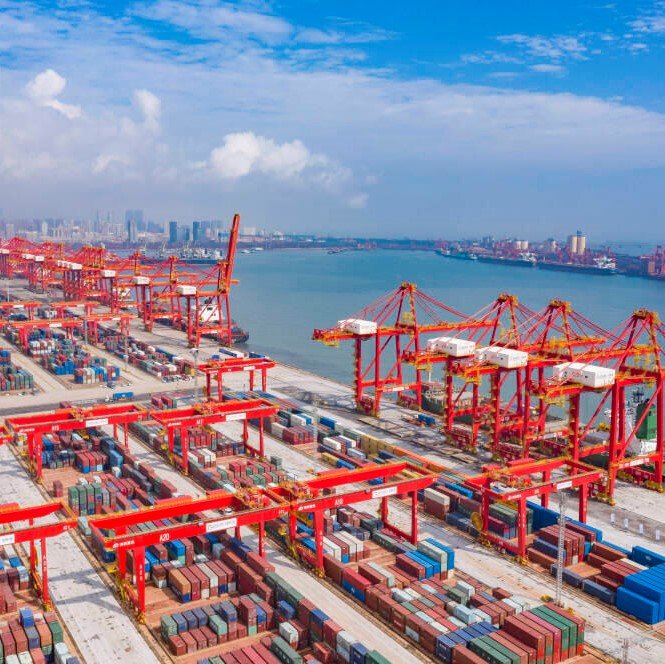
Application 1: Structural Health Monitoring at Rizhao Port Coal Terminal
Project Overview
The Rizhao Port Coal Terminal Structural Health Monitoring Project, under Shandong Port Group, aims to improve operational safety by establishing a structural health monitoring and early warning system for coal terminal facilities.
The system collects structural stress and strain data in real time. Through data analysis, it supports the assessment of structural health conditions and the generation of safety warnings, providing a technical basis for safe terminal operations, maintenance planning, and asset management.
Project Scope
The project focuses on the research and application of structural health monitoring technologies for a 100,000-ton-class dedicated coal terminal berth and its steel trestle.
The scope includes, but is not limited to:
- Development of terminal structural health monitoring technologies
- Digital twin development and structural mechanics simulation
- Structural health monitoring and early warning systems
- Structural condition assessment based on monitoring data
Structural Monitoring and Early Warning
Port structures operate under demanding conditions and require reliable monitoring to support safe operations throughout their service life.
A structural health monitoring system collects data from installed sensors and uses data analysis to help identify changes in structural behavior. These measurements support condition assessment, early identification of potential abnormalities, and informed maintenance decisions.
Reliable data acquisition equipment is an important part of this process, providing the interface between field sensors and the monitoring system.
Hu Entropy Tech provides data acquisition hardware, industrial RTUs, and customized monitoring equipment for infrastructure and engineering monitoring applications.
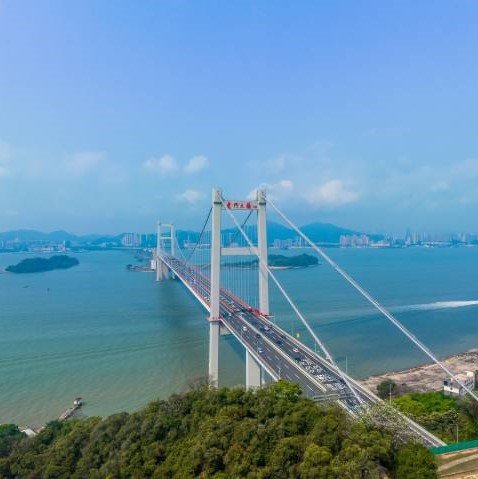
Application 2: Distributed Data Acquisition and Signal Processing for the Hong Kong–Zhuhai–Macao Bridge
Project Overview
The Hong Kong–Zhuhai–Macao Bridge requires all-weather monitoring of its major bridge and tunnel structures. Distributed data acquisition and signal processing systems installed throughout the structure form a critical part of the overall structural health monitoring infrastructure.
These systems acquire and process signals from different types of sensors installed across the main bridge and tunnel structures, providing essential data for the wider monitoring system.
Key Technical Requirements
1. Continuous Multi-Sensor Data Acquisition
The distributed systems must support continuous acquisition and signal processing for different sensor types using a common time base.
This enables consistent data collection across monitoring points and provides a reliable foundation for analyzing the structural behavior of the bridge and tunnel infrastructure.
2. High-Precision Time Synchronization
High-performance clock and trigger synchronization capabilities are required to coordinate data acquisition across different systems.
Accurate synchronization allows measurements from distributed acquisition units to be aligned in time, supporting the analysis of structural responses across multiple locations.
3. Real-Time Signal Processing
The systems must provide sufficient real-time computing capability to deploy and execute relevant signal-processing algorithms.
This capability supports timely processing of acquired signals and provides the monitoring platform with the data required for further analysis and structural condition assessment.
4. Environmental Robustness and Operational Stability
The marine environment presents demanding operating conditions, including challenging weather and environmental exposure. Traffic and roadway conditions on the bridge also impose additional requirements on monitoring equipment.
Distributed data acquisition and signal processing systems must therefore provide reliable operation, stability, flexibility, and environmental adaptability to support long-term monitoring.
5. Open and Flexible System Architecture
The systems must provide an open and flexible architecture to accommodate different sensor types, signal characteristics, and monitoring requirements.
This flexibility is important for integrating distributed acquisition units into a large-scale structural health monitoring system.
The Importance of Reliable Data Acquisition Infrastructure
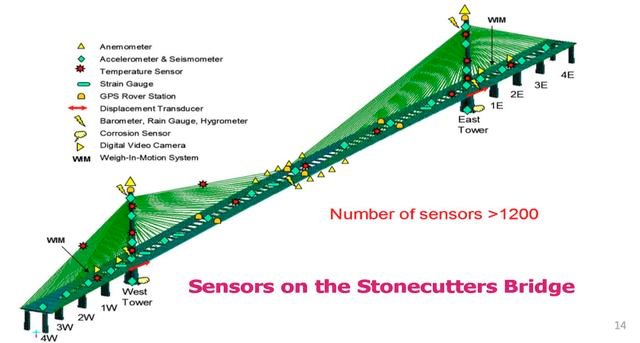
For large bridges and cross-sea infrastructure, distributed data acquisition is fundamental to effective structural health monitoring.
Reliable acquisition hardware must support the relevant sensor interfaces, communication requirements, measurement timing, and environmental conditions specified by the system design.
Hu Entropy Tech provides industrial data acquisition equipment, RTUs, and customized monitoring hardware for infrastructure and engineering applications. Our hardware capabilities can support sensor data collection and communication as part of integrated monitoring systems, subject to project-specific technical requirements.
Contact Hu Entropy Tech to discuss data acquisition hardware, industrial communication, and OEM/ODM requirements for structural health monitoring projects.