
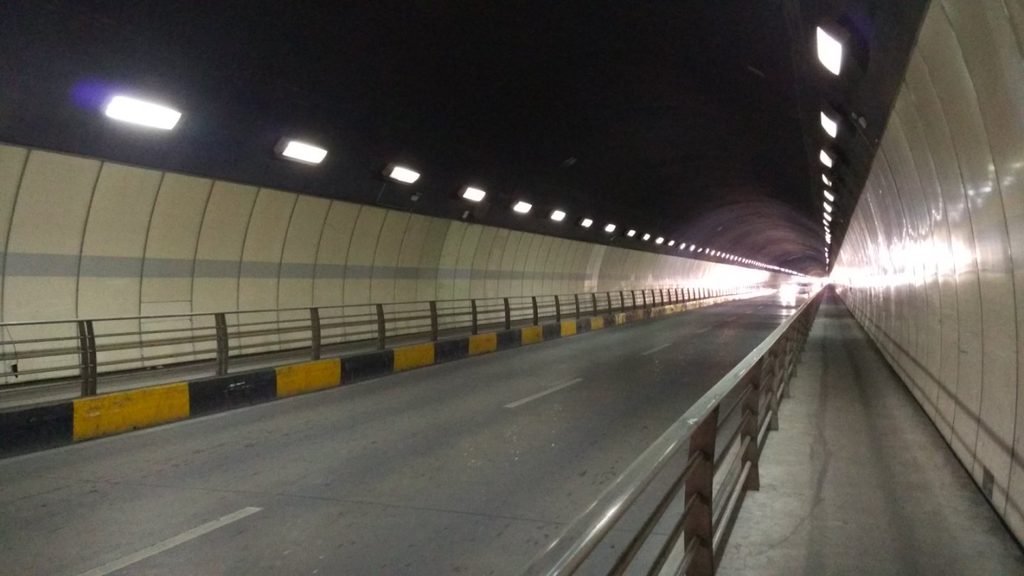
Highway Tunnel Structural Monitoring: Technical Guidelines and Monitoring Methods
Application: Highway Tunnel Monitoring | Structural Health Monitoring | Automated Data Acquisition | Remote Monitoring | Early Warning
1. Overview of Highway Tunnel Structural Monitoring
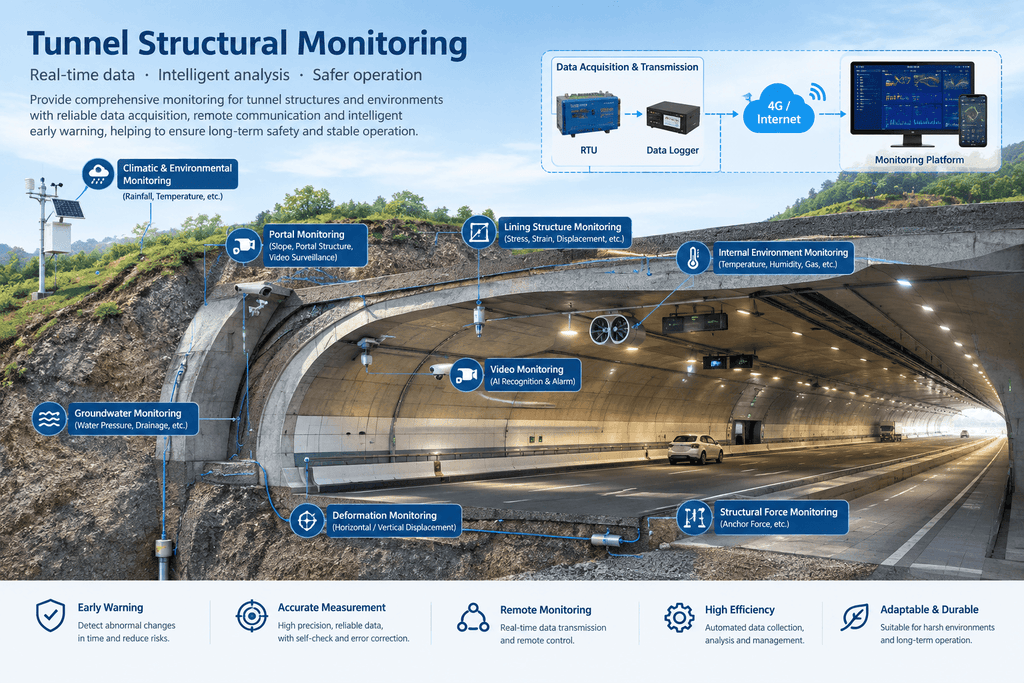
According to the Technical Guidelines for Highway Tunnel Structural Monitoring in Guangdong Province, highway tunnel structural monitoring covers four main areas:
- Climatic and environmental monitoring around the tunnel site
- Monitoring of tunnel portals
- Monitoring of tunnel lining structures
- Monitoring of the internal tunnel environment
Monitoring items should be selected according to site conditions, geological characteristics, environmental risks, structural conditions, and maintenance requirements.
2. Monitoring Requirements and Methods
2.1 Climatic and Environmental Monitoring Around the Tunnel Site
Rainfall monitoring is recommended for the climatic and environmental conditions surrounding highway tunnels. Additional monitoring items may be introduced according to actual project requirements.
Rainfall data can provide important context for assessing potential changes in slope stability, groundwater conditions, and other environmental factors affecting tunnel safety.
2.2 Tunnel Portal Monitoring
Monitoring at tunnel portals covers portal side slopes, upward-facing slopes above the portals, and portal structures.
The recommended monitoring measures include:
- Intelligent video monitoring: Video systems with intelligent recognition capabilities should be used where appropriate, with provision for nighttime monitoring.
- Adjacent gullies: Where a tunnel portal is close to a gully, video monitoring of the gully is recommended.
- Portal structures: For end-wall-type portal structures, horizontal displacement, vertical displacement, and inclination should be monitored.
- High portal slopes: Surface horizontal displacement monitoring should be added for high side slopes and upward-facing slopes. Where erosion or sliding risks are significant, additional monitoring of subsurface horizontal and vertical displacement should be installed.
These measurements help engineers assess portal stability and identify potential risks associated with slope movement, erosion, and structural deformation.
2.3 Tunnel Lining Structural Monitoring
Monitoring of tunnel lining structures should focus primarily on sections and locations with elevated risk.
For sections where geological conditions create particular risks, monitoring items should be selected according to the relevant risk characteristics and applicable technical requirements.
Depending on the site conditions and monitoring design, the system may incorporate displacement sensors, structural response measurements, and other instruments suitable for evaluating tunnel lining behavior.
2.4 Monitoring the Internal Tunnel Environment
Internal environmental monitoring should focus on key factors that may affect tunnel structural safety. Monitoring items should be selected according to geological conditions, climate, and the types of risks present.
The guidelines recommend the following considerations:
- Karst and water-rich tunnels: Monitoring may include drainage discharge and groundwater pressure.
- Cold regions: For tunnels in northern Guangdong and other cold areas, monitoring may include tunnel air temperature, humidity, and surrounding rock temperature.
- Drainage system blockage: Where drainage systems are susceptible to blockage, monitoring may be conducted in sections with elevated blockage risk.
Monitoring these factors helps operators understand environmental changes that may affect tunnel conditions and maintenance requirements.
2.5 Tunnel-Wide Video Monitoring
Video monitoring throughout the tunnel is recommended. The video monitoring system should be integrated with the existing tunnel operational video surveillance system.
Where video equipment is intended to identify sudden tunnel structural risk events and generate alarms, it should meet the requirements of Test Specification for Video Detection Systems for Highway Tunnel Traffic Events (T/GDHS 014).
If the existing tunnel operational system cannot provide adequate coverage of the entire tunnel, additional video monitoring equipment should be installed.
Monitoring requirements may be dynamically adjusted or expanded according to site implementation conditions, maintenance activities, and the needs of the operating authority.
3. Monitoring Methods and Equipment Selection
3.1 Selection of Monitoring Methods
Monitoring methods should be selected according to the type of parameter being measured and the environmental conditions of the monitoring site.
Priority should be given to methods that offer a high degree of automation, stable and reliable operation, and convenient remote data transmission and control.
3.2 Selection of Monitoring Instruments
Instrument selection should take into account:
- The type and number of monitoring points
- Site environmental conditions
- The importance of each monitoring parameter
- Required measurement accuracy and range
For the same monitoring parameter, the use of a consistent instrument type is recommended where appropriate. Instrument types may include vibrating wire, fiber-optic, resistive, and capacitive sensors.
3.3 Technical Requirements for Monitoring Equipment
Monitoring equipment should meet the following requirements.
Measurement performance
Equipment must satisfy the required measurement accuracy and measurement range. It should provide stable and reliable performance, good repeatability, and low drift and hysteresis errors.
Two-way communication and remote configuration
Monitoring equipment should support two-way communication and remote debugging. The monitoring frequency should be adjustable remotely.
Environmental protection and interference resistance
Equipment must be suitable for the environmental conditions of the monitoring area, with appropriate protection against water, moisture, dust, wind, rain, high and low temperatures, lightning, vibration, corrosion, and electromagnetic interference.
Dedicated lightning protection facilities should be installed where necessary.
Power supply
Mains power is recommended where appropriate, with electrical safety ensured. For solar-powered installations, the solar panel output should be matched to the battery capacity.
Communication in areas with limited network coverage
In areas with poor public mobile network coverage, a dual-mode communication approach combining terrestrial public networks and satellite communications is recommended.
The system should support local data processing and on-site alarm triggering when network connectivity is unavailable. Along expressways, existing dedicated fiber-optic networks may be used for data transmission.
3.4 Monitoring Frequency and Dynamic Adjustment
Monitoring methods and equipment for deformation, structural forces, characteristic signs of deterioration, climatic conditions around the tunnel, and the internal tunnel environment may be selected with reference to Table 4 of the guidelines.
Monitoring frequency may also be established with reference to the requirements in Table 4 and adjusted dynamically according to:
- Tunnel structural condition
- Development and rate of change of structural defects
- Nearby construction activities
- Engineering and environmental conditions
- Requirements of the tunnel management authority
4. Supporting Tunnel Monitoring with Reliable Data Acquisition Hardware
Automated tunnel monitoring requires reliable connections between field instruments, data acquisition equipment, communication networks, and monitoring platforms.
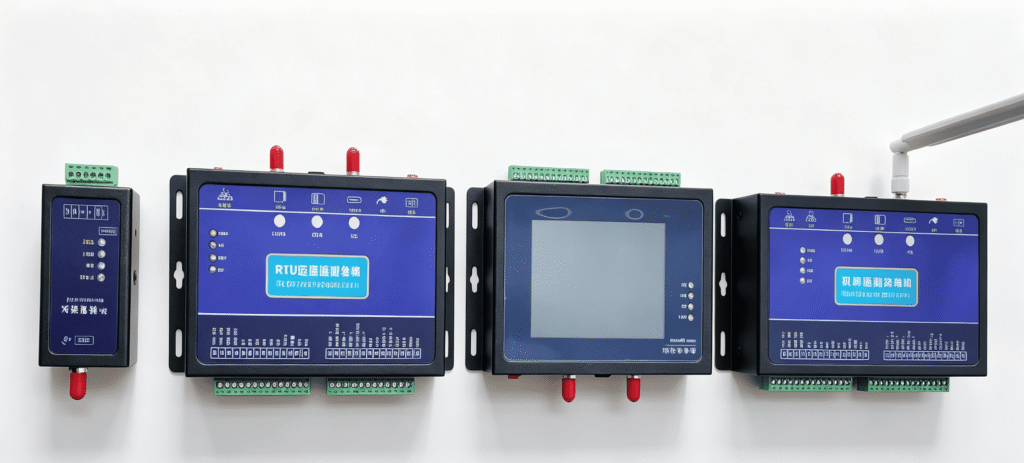
Hu Entropy Tech provides industrial RTUs, vibrating wire data acquisition units, and customized monitoring hardware for infrastructure and engineering monitoring applications.
Depending on the product model and system configuration, our hardware can support:
- Data acquisition from compatible monitoring instruments
- Multi-channel measurement and data collection
- RS485 and supported industrial communication protocols
- Remote data transmission through supported communication networks
- Integration with third-party monitoring platforms
- Customized hardware and communication protocol development
For highway tunnel projects, equipment selection should be based on the required sensor interfaces, measurement performance, environmental protection, communication coverage, power supply, and integration requirements.
Looking for data acquisition hardware for highway tunnel monitoring?
Contact Hu Entropy Tech to discuss your monitoring instruments, remote communication requirements, and OEM/ODM hardware needs.
Website: https://huentropytech.com/