
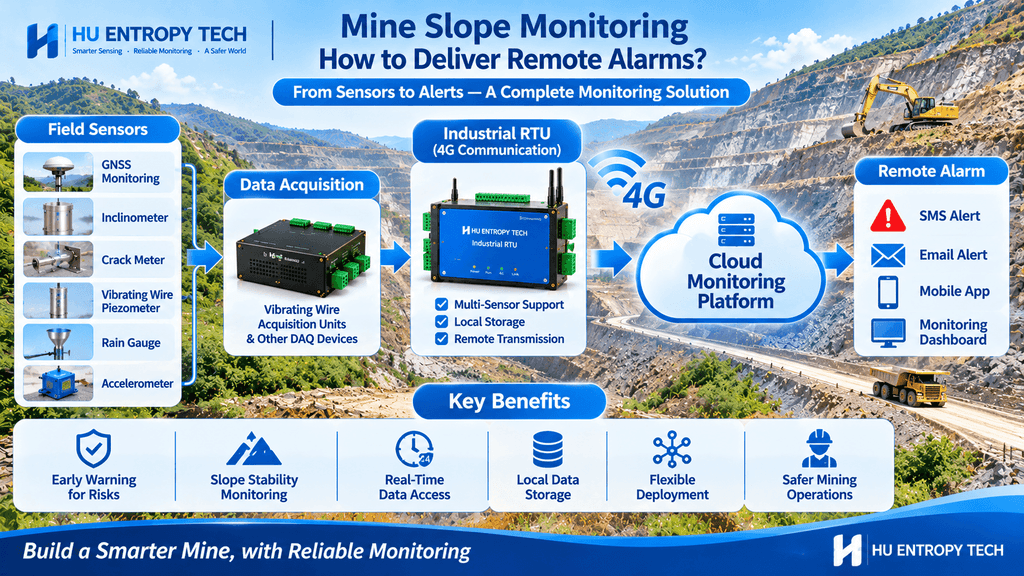
From Field Sensors and Data Acquisition to 4G Communication and Early Warning
Slope stability is a major safety concern in mining operations.
Open-pit mines often involve large slopes, changing geological conditions, excavation activities, groundwater variations, and weather-related influences. These factors can contribute to slope deformation and, in some cases, increase the risk of landslides or slope failure.
Traditional inspection methods remain important, but periodic manual measurements alone may not provide sufficient information about continuously changing slope conditions.
This is why more mining operators are adopting online slope monitoring systems.
These systems collect measurements from instruments installed across the slope, transmit the data to a central platform, and generate alarms when predefined conditions are detected.
But how does the complete process work?
How can a monitoring system detect abnormal changes and send warnings to personnel who may be far away from the monitoring site?
Let’s examine the architecture step by step.
1. Why Do Mine Slopes Need Online Monitoring?
Mine slopes are affected by several interacting factors.
Common influences include:
- Geological structure and rock mass conditions
- Excavation and blasting activities
- Groundwater levels and pore-water pressure
- Rainfall and surface water infiltration
- Changes in slope geometry
- Long-term deformation and material deterioration
A slope may show gradual movement before a more serious instability event. However, not every movement indicates imminent failure, and some slope failures can develop rapidly.
Online monitoring helps engineers observe changes over time and identify conditions that require further investigation.
Typical monitoring objectives include:
- Detecting surface displacement
- Measuring internal deformation
- Monitoring cracks and structural movement
- Observing groundwater and pore-water pressure
- Tracking rainfall and environmental conditions
- Identifying abnormal changes in measurement trends
The purpose is not simply to collect more data. It is to provide timely and reliable information for engineering assessment and mine safety management.
2. What Sensors Are Used in Mine Slope Monitoring?
A complete slope monitoring system may combine several types of sensors.
The selection depends on geological conditions, slope geometry, monitoring objectives, and the expected failure mechanisms.
GNSS Monitoring Stations
GNSS equipment can be used to measure the three-dimensional position of selected points on the slope.
Repeated measurements help engineers identify surface displacement and movement trends.
Inclinometers
Inclinometers are used to monitor changes in inclination or subsurface deformation, depending on the instrument configuration and installation method.
Borehole inclinometer systems can help identify deformation at different depths.
Crack Meters and Displacement Sensors
These instruments measure changes in crack width, relative displacement, or movement between selected structural points.
Piezometers
Piezometers monitor groundwater pressure or pore-water pressure.
Changes in pore-water pressure can be important when assessing slope stability.
Rain Gauges
Rainfall monitoring provides environmental information that can be considered alongside displacement and groundwater measurements.
Vibrating Wire Sensors
Vibrating wire piezometers and other compatible vibrating wire instruments can be used for long-term geotechnical monitoring.
They require suitable vibrating wire data acquisition equipment.
Different sensors provide different types of information. Combining them can give engineers a more complete understanding of slope behavior.
3. How Does the Complete Online Monitoring Architecture Work?
A typical mine slope monitoring system contains five functional layers.
Layer 1: Field Sensors
Sensors are installed at selected surface and subsurface locations to measure displacement, inclination, pore-water pressure, rainfall, and other parameters.
Layer 2: Data Acquisition Equipment
Acquisition units collect signals from connected sensors and convert them into usable measurement records.
Different sensor types may require different acquisition devices.
For example, compatible vibrating wire sensors require dedicated vibrating wire measurement circuits, while GNSS stations and digital instruments use their own communication interfaces.
Layer 3: Industrial RTU or IoT Gateway
The industrial RTU or gateway connects field acquisition equipment to the remote communication network.
Depending on the model and configuration, it may collect data, manage communication, perform basic processing, and support local data storage.
Layer 4: Communication Network
Data can be transmitted through 4G, Ethernet, LoRa, or other communication methods selected according to site conditions.
Layer 5: Monitoring Platform
The platform receives and stores measurement data, displays trends, evaluates configured alarm rules, and sends notifications to authorized personnel.
A simplified system architecture is:
Slope Sensors → Data Acquisition Units → Industrial RTU / IoT Gateway → 4G / Ethernet → Cloud Monitoring Platform → Alarm Notifications
This architecture allows remote mine monitoring stations to become part of a centralized safety monitoring network.
4. How Does the System Detect Abnormal Slope Movement?
Remote alarms depend on reliable measurement data and clearly defined monitoring rules.
A monitoring platform may evaluate several types of conditions.
Threshold-Based Alarms
An alarm can be configured when a measurement exceeds a predefined limit.
For example:
- Surface displacement exceeds a specified value.
- Crack width reaches a defined threshold.
- Pore-water pressure rises above a project-defined limit.
- Rainfall exceeds a configured threshold.
Rate-of-Change Alarms
In some applications, the rate of movement is more informative than the absolute displacement.
For example, a monitoring platform may compare displacement over a defined time window and generate an alert when the movement rate exceeds an engineering-defined limit.
Trend-Based Monitoring
The platform can analyze historical measurement trends to identify unusual changes.
For example, a gradual increase in displacement combined with rising pore-water pressure may require additional engineering investigation.
Multi-Parameter Assessment
Slope stability is influenced by multiple factors.
Combining displacement, groundwater, rainfall, and other measurements can provide more useful information than relying on a single sensor.
However, alarm thresholds and assessment rules must be established by qualified geotechnical professionals based on site-specific conditions, engineering analysis, and applicable safety standards.
An RTU or monitoring platform can execute configured rules, but it does not independently establish the geological safety of a mine slope.
5. How Are Remote Alarms Delivered to Mine Personnel?
Once an alarm condition is detected, the monitoring platform can send notifications through configured communication channels.
Common options include:
- SMS notifications
- Email alerts
- Mobile application notifications
- Web-based monitoring dashboards
- Control room alarm displays
- Integration with existing mine management systems
A typical remote alarm workflow is:
- A sensor detects a change in the monitored parameter.
- The acquisition device collects and records the measurement.
- The RTU or gateway transmits the data.
- The monitoring platform receives the measurement.
- The platform evaluates the configured alarm conditions.
- An alarm is generated when a condition is met.
- Authorized personnel receive the notification.
- The responsible team investigates and follows the site’s emergency response procedures.
The notification mechanism should include clear information about the monitoring point, parameter, measurement value, timestamp, alarm level, and recommended response procedure where defined by the project.
For critical applications, alarm delivery should be tested under realistic network and power conditions.
6. Why Are 4G RTUs Important for Remote Mine Monitoring?
Open-pit mines can cover large areas.
Some monitoring stations are installed on remote slopes, elevated benches, or locations without convenient access to wired communication infrastructure.
Installing dedicated communication cables at every monitoring point may be expensive and difficult to maintain.
Where cellular coverage is available, a 4G RTU provides a practical way to connect remote monitoring stations to a central platform.
Potential advantages include:
- Flexible deployment of remote monitoring points
- Reduced dependence on dedicated communication cables
- Centralized access to field measurement data
- Remote configuration and monitoring
- Easier expansion of distributed monitoring stations
For example, several monitoring stations can transmit their measurements through cellular networks to the same monitoring platform.
However, 4G availability and signal quality must be assessed at the actual installation locations. Mines with weak cellular coverage may require external antennas, local wireless networks, radio links, or alternative communication solutions.
7. How Can Local Data Storage Prevent Missing Records?
Communication interruptions are common challenges in remote mining environments.
A monitoring station may temporarily lose connectivity because of weak signals, network maintenance, equipment problems, or power interruptions.
If measurement data is not stored locally, communication failures may result in missing records.
An RTU or acquisition device with suitable local storage and data recovery capabilities can help reduce this risk.
A typical Store-and-Forward process is:
- The device collects measurement data.
- Records are stored locally with timestamps.
- The communication network becomes unavailable.
- Data continues to be recorded, subject to available power and storage.
- The network connection is restored.
- Stored records are transmitted to the monitoring platform.
This helps maintain more complete historical datasets.
For long-term mine slope monitoring, engineers should verify storage capacity, retention time, retransmission behavior, and power backup arrangements.
8. Power Supply and Environmental Conditions Matter
Mining environments can be demanding.
Monitoring equipment may be exposed to:
- Wide temperature variations
- Dust and moisture
- Mechanical vibration
- Electrical interference
- Remote installation conditions
- Limited access to mains power
Some monitoring stations may use solar panels and batteries.
When selecting an RTU or acquisition device, engineers should consider:
Power consumption: Evaluate standby consumption, acquisition requirements, and cellular transmission current.
Power supply range: Confirm compatibility with the available power system.
Environmental specifications: Check the operating temperature range, enclosure protection, and relevant electrical protection features.
Installation: Consider mounting arrangements, cable protection, grounding, and lightning protection.
Maintenance: Evaluate whether the device can be diagnosed and configured remotely.
The complete monitoring station should be designed for the actual environmental conditions of the mine, rather than relying only on the nominal specifications of individual devices.
9. Why Is Multi-Channel Acquisition Useful?
A mine slope monitoring project may involve multiple compatible sensors distributed across different monitoring locations.
Using a suitable multi-channel acquisition architecture can help consolidate sensor connections and simplify equipment management.
For vibrating wire applications, HU ENTROPY TECH offers several channel configurations:
- VW-401: 4-channel vibrating wire data acquisition unit
- VW-801: 8-channel vibrating wire data acquisition unit
- VW-1601: 16-channel vibrating wire data acquisition unit
For applications requiring 4G connectivity, corresponding hybrid acquisition RTU options include:
- VW-402: 4-channel
- VW-802: 8-channel
- VW-1602: 16-channel
These devices are intended for compatible vibrating wire sensor measurements.
For other instruments, such as GNSS stations, digital inclinometers, and analog displacement sensors, engineers should select acquisition equipment with the appropriate interfaces and protocols.
The objective is to integrate different sensor subsystems into a coordinated monitoring architecture while preserving their individual measurement requirements.
10. A Practical Example: Remote Alarm System for an Open-Pit Mine
Consider an open-pit mine that needs to monitor a potentially unstable slope.
The project includes:
- GNSS surface displacement monitoring
- Borehole inclinometer measurements
- Vibrating wire piezometers
- Rainfall monitoring
- Remote alarm notifications
A possible system design could be:
Step 1: Install monitoring instruments
Select appropriate monitoring points based on geological investigation and the slope monitoring plan.
Step 2: Organize sensor acquisition
Use compatible acquisition devices for each sensor type.
Vibrating wire piezometers, for example, require suitable vibrating wire acquisition equipment.
Step 3: Deploy industrial RTUs or gateways
Connect compatible field instruments and acquisition devices to the remote communication architecture.
Step 4: Establish remote communication
Use 4G or another suitable communication method to transmit data to the monitoring platform.
Step 5: Configure monitoring dashboards
Display measurement values, historical trends, device status, and monitoring locations.
Step 6: Define alarm conditions
Qualified engineers establish project-specific thresholds, rate-of-change criteria, and multi-parameter alarm rules.
Step 7: Test the complete alarm chain
Verify sensor acquisition, data transmission, platform processing, notification delivery, and the response procedure.
This final step is essential. A monitoring system is not complete simply because its sensors are reporting data. The alarm process must also work reliably.
11. HU ENTROPY TECH Solutions for Remote Engineering Monitoring
At HU ENTROPY TECH, we provide vibrating wire data acquisition hardware, industrial RTUs, and OEM/ODM services for engineering monitoring applications.
Our product portfolio includes options for different acquisition and communication requirements.
Vibrating Wire Data Acquisition Units
- VW-401: 4 channels
- VW-801: 8 channels
- VW-1601: 16 channels
4G Hybrid Vibrating Wire Acquisition RTUs
- VW-402: 4 channels
- VW-802: 8 channels
- VW-1602: 16 channels
Industrial RTUs
- RTU-800H-4G
- RTU-900H
- RTU-900H-TFT
- RTU-901H
These products can be considered for different field data acquisition, remote communication, and monitoring integration requirements.
The specific sensor compatibility, interfaces, communication protocols, storage functions, and other capabilities vary by model and configuration.
For mine slope monitoring projects, the appropriate architecture should be determined according to the selected sensors, site communication conditions, power requirements, and monitoring platform.
We also support OEM/ODM cooperation for international monitoring companies, equipment brands, and system integrators.
Explore our products and services:
Conclusion: Remote Alarms Depend on the Entire Monitoring Chain
An effective mine slope monitoring system is not just a collection of sensors connected to the internet.
It requires a coordinated architecture involving:
- Appropriate monitoring instruments
- Compatible data acquisition equipment
- Reliable industrial RTUs or gateways
- Stable communication networks
- Local data storage and recovery
- Well-designed monitoring and alarm rules
- Clear procedures for personnel response
When these components work together, mine operators can gain better visibility into slope conditions and receive timely notifications when predefined monitoring conditions are detected.
The real value of online monitoring is not simply remote data access.
It is the ability to turn field measurements into actionable information for engineering assessment and mine safety management.
At HU ENTROPY TECH, we believe reliable monitoring starts with reliable data acquisition.
Smarter Sensing. Reliable Monitoring. A Safer World.
Question for mining engineers and monitoring system integrators:
What is the biggest challenge in your mine slope monitoring projects: sensor deployment, communication coverage, power supply, alarm reliability, or integrating multiple monitoring instruments?
#MineSlopeMonitoring #SlopeStability #MiningSafety #RemoteMonitoring #IndustrialRTU #VibratingWire #GeotechnicalMonitoring #IndustrialIoT #DataAcquisition
