
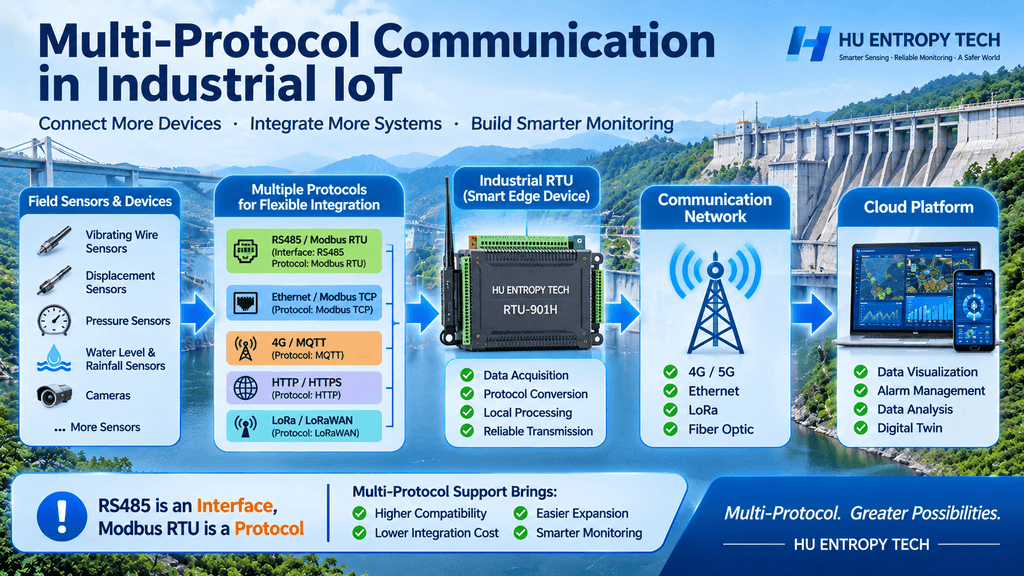
In modern engineering monitoring projects, connecting field devices to a monitoring platform is not always straightforward.
A typical system may include vibrating wire sensors, displacement transducers, pressure sensors, data acquisition units, industrial RTUs, wireless communication modules, and cloud-based software platforms.
These devices often come from different manufacturers and use different communication methods.
This creates a critical challenge: How can all these devices communicate and work together reliably?
One important solution is multi-protocol support.
For industrial IoT devices, including data acquisition units, RTUs, and communication gateways, supporting multiple communication protocols can significantly improve system compatibility, integration flexibility, and long-term scalability.
Let’s explore why it matters.
1. Engineering Monitoring Systems Use Different Types of Equipment
Unlike simple consumer IoT applications, engineering monitoring systems often involve multiple generations of equipment and instruments from different suppliers.
For example, a dam safety monitoring project may include:
- Vibrating wire piezometers and strain gauges.
- Displacement and crack monitoring sensors.
- Water level and rainfall monitoring instruments.
- GNSS monitoring equipment.
- Data acquisition units.
- Industrial RTUs and communication gateways.
- Centralized monitoring software.
These devices may use different electrical interfaces and communication protocols.
Some sensors provide analog signals, while others communicate digitally. Some acquisition units use serial communication, while cloud platforms may require data through MQTT or HTTP APIs.
Without suitable protocol compatibility, connecting these devices may require additional converters, gateways, or customized software.
This increases system complexity and makes future expansion more difficult.
2. Different Communication Protocols Serve Different Purposes
Not all communication protocols are designed for the same task.
Understanding their differences is essential when selecting industrial IoT equipment.
Modbus RTU
Modbus RTU is widely used in industrial automation and monitoring systems.
It commonly operates over serial interfaces such as RS485 and is suitable for communication between RTUs, data acquisition units, sensors, and other industrial devices.
Typical applications include:
- Reading measurement registers.
- Collecting data from multiple field devices.
- Connecting industrial instruments to RTUs.
- Communicating over multidrop RS485 networks.
Modbus TCP
Modbus TCP is the Ethernet-based implementation of the Modbus protocol.
It is commonly used for communication between industrial controllers, gateways, SCADA systems, and monitoring software over IP networks.
MQTT
MQTT is a lightweight messaging protocol designed for communication between IoT devices and platforms.
It is particularly useful for remote monitoring applications where devices need to publish measurement data, receive configuration messages, or communicate with cloud-based services.
Typical applications include:
- Uploading sensor measurements.
- Reporting device status.
- Publishing alarm events.
- Supporting remote device management.
HTTP / HTTPS
HTTP and HTTPS are commonly used for communication between devices, servers, and web-based applications.
They are often used for API-based integration, configuration services, and data exchange with cloud platforms.
HTTPS adds encryption to protect data during transmission.
LoRaWAN
LoRaWAN is a communication protocol designed for low-power, wide-area wireless networks.
It is useful for certain distributed monitoring applications where devices need to transmit relatively small amounts of data over long distances with low power consumption.
However, LoRaWAN is not a direct replacement for industrial serial protocols or high-bandwidth communication technologies. Its suitability depends on the monitoring requirements and network architecture.
3. Multi-Protocol Support Connects Different Layers of a Monitoring System
A complete engineering monitoring system usually contains several communication layers.
For example:
Field Instrument Layer
Sensors may provide vibrating wire frequency, analog signals, pulse outputs, or digital communication.
Data Acquisition Layer
Data acquisition units read and process sensor signals. Some devices communicate with an RTU through RS485 using Modbus RTU or a manufacturer-specific protocol.
Communication Gateway Layer
An industrial RTU or gateway collects data from field equipment and forwards it through an available network connection.
Cloud Platform Layer
The monitoring platform receives structured data through MQTT, HTTP APIs, or other supported integration methods.
A simplified architecture may look like this:
Sensors → Data Acquisition Unit → RS485 / Modbus RTU → Industrial RTU → 4G / Ethernet → MQTT / HTTP → Cloud Platform
In this architecture, different protocols are used for different communication tasks.
A device that supports multiple protocols can help bridge these layers and reduce the need for separate communication equipment.
However, protocol support must exist at the appropriate interface. A device supporting MQTT does not automatically support Modbus RTU, and an RS485 port does not guarantee compatibility with every serial protocol.
4. Multi-Protocol Compatibility Reduces Integration Costs
One of the biggest challenges in engineering monitoring projects is integrating equipment from different manufacturers.
For example, a monitoring system integrator may already have:
- Existing sensors using Modbus RTU.
- A data acquisition unit using a proprietary serial protocol.
- An Ethernet-based monitoring controller.
- A cloud platform requiring MQTT messages.
If the new RTU only supports one communication method, additional converters or custom development may be necessary.
Multi-protocol devices can help reduce these integration barriers.
Potential benefits include:
- Fewer external protocol converters.
- Simpler system architecture.
- Reduced wiring and configuration complexity.
- Easier integration with existing equipment.
- Lower engineering and commissioning effort.
The actual cost savings depend on the number of devices, protocol compatibility, and the complexity of the project.
5. Multi-Protocol Support Makes Future System Expansion Easier
Engineering monitoring projects often operate for many years.
During this period, monitoring requirements may change. New sensors may be installed, additional monitoring stations may be added, or the original cloud platform may be upgraded.
A system designed around only one communication method can become difficult to expand.
Multi-protocol compatibility provides more flexibility.
For example:
- A new sensor can be integrated through a supported serial or analog interface.
- Additional RTUs can communicate through Ethernet.
- Remote monitoring stations can upload data through 4G.
- A cloud platform can receive measurement data through MQTT or an API.
- Existing equipment can remain in service while new devices are introduced.
This is particularly important for large infrastructure projects, where replacing the entire monitoring system is often impractical.
6. Multi-Protocol Does Not Mean Supporting Every Protocol
It is important to understand that more protocols do not automatically mean a better product.
The key is selecting the right protocols for the actual application.
Before choosing an industrial RTU or IoT gateway, engineers should consider:
1. Sensor Compatibility
Does the device support the electrical interfaces and measurement methods required by the sensors?
2. Field Communication
Does it support the protocols used by existing data acquisition units and instruments?
3. Network Communication
Does it provide the required communication options, such as 4G LTE, Ethernet, or LoRa?
4. Cloud Integration
Can it communicate with the target platform through MQTT, HTTP APIs, or another required method?
5. Data Mapping
Can measurement values, timestamps, device IDs, units, and alarm information be organized in the format expected by the platform?
6. Configuration and Customization
Can communication parameters, register mappings, upload intervals, and data formats be configured or customized?
7. Security and Reliability
Does the solution provide appropriate authentication, encrypted communication where required, local storage, and recovery mechanisms?
A practical device should support the protocols needed by the project, rather than simply advertising a long list of protocol names.
7. The Difference Between Interfaces and Protocols
This distinction is especially important when evaluating industrial IoT hardware.
An interface defines how devices are physically or electrically connected.
Examples include:
- RS485
- RS232
- Ethernet
- Analog input
- Digital input / output
A communication protocol defines how information is structured and exchanged.
Examples include:
- Modbus RTU
- Modbus TCP
- MQTT
- HTTP / HTTPS
- OPC UA
For example, RS485 is not a communication protocol. It is an electrical interface commonly used to carry Modbus RTU messages.
Similarly, Ethernet is a network interface, while Modbus TCP and MQTT are communication protocols that can operate over IP networks.
Understanding this difference helps engineers avoid compatibility problems during system design.
8. How HU ENTROPY TECH Supports Flexible Engineering Monitoring Integration
At HU ENTROPY TECH, we focus on vibrating wire data acquisition hardware, industrial RTUs, and OEM/ODM solutions for engineering monitoring applications.
Our product portfolio includes:
Vibrating Wire Data Acquisition Units
- VW-401 / VW-801 / VW-1601: 4-channel, 8-channel, and 16-channel RS485 acquisition units.
- VW-402 / VW-802 / VW-1602: 4-channel, 8-channel, and 16-channel 4G hybrid vibrating wire acquisition RTUs.
Industrial RTUs
- RTU-800H-4G
- RTU-900H
- RTU-900H-TFT
- RTU-901H
Different models are designed for different acquisition and communication requirements. Available interfaces, protocols, and functions vary by model and should be confirmed against the relevant technical documentation.
For projects requiring specific communication protocols, data formats, or platform integration, we can also discuss OEM/ODM customization requirements.
Our goal is to help monitoring system integrators and equipment manufacturers build solutions that are easier to integrate, expand, and maintain.
Conclusion
Multi-protocol support is becoming increasingly important in industrial IoT and engineering monitoring.
It helps connect different field instruments, acquisition devices, RTUs, communication networks, and cloud platforms within a unified monitoring architecture.
More importantly, it gives engineers and system integrators greater flexibility when working with existing equipment and planning future system expansion.
A reliable intelligent monitoring system is not just about collecting data. It is about making different devices communicate effectively.
HU ENTROPY TECH
Engineering Monitoring Hardware | Industrial RTUs | OEM / ODM Solutions
Website: https://huentropytech.com/
