
A practical guide to RS485 communication, data acquisition, industrial RTUs, and reliable field integration
In engineering monitoring, collecting data is only half the job.
The other half is getting that data from field instruments to the monitoring platform reliably, consistently, and cost-effectively.
Whether you are monitoring a dam, bridge, tunnel, slope, foundation pit, or industrial facility, communication between field devices and the data acquisition system can significantly affect the performance of the entire monitoring solution.
That is one reason Modbus RTU remains widely used in industrial automation and engineering monitoring systems.
But why does this protocol continue to play such an important role, even as IoT platforms, cloud computing, and wireless technologies continue to evolve?
Let’s look at it from an engineering perspective.
1. What Is Modbus RTU?
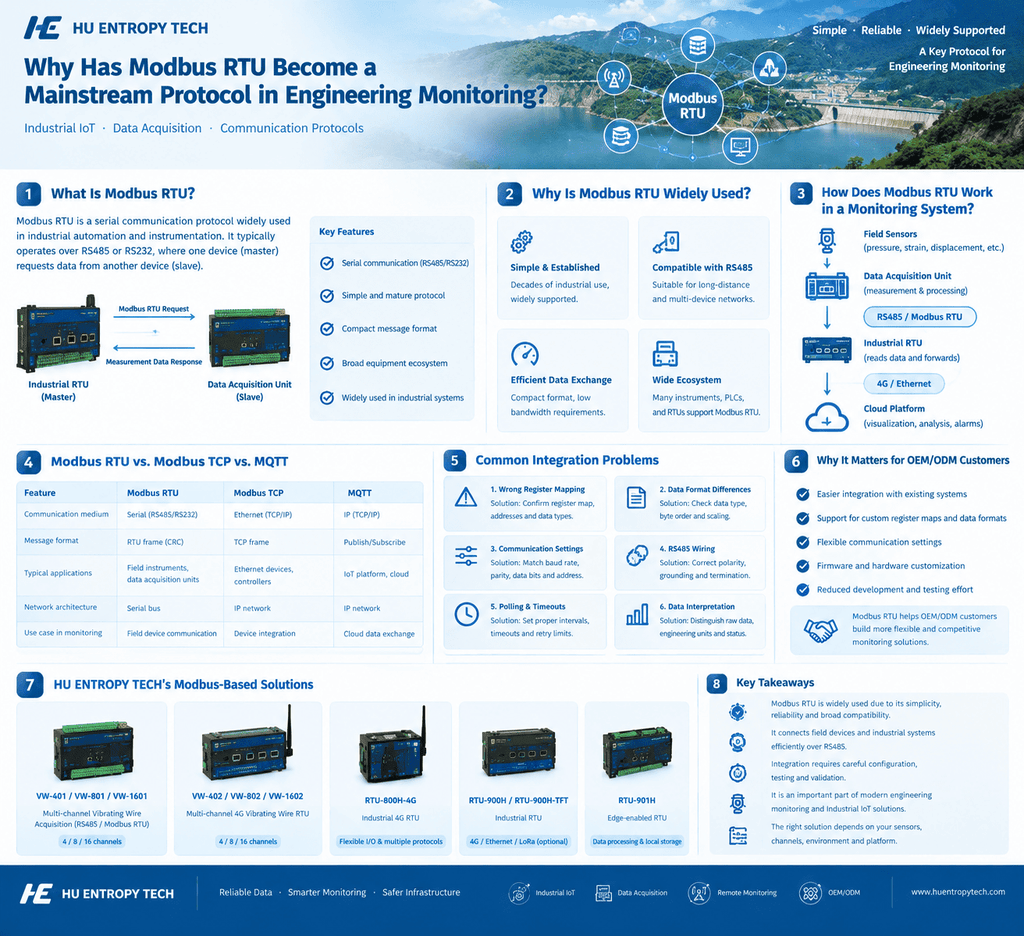
Modbus RTU is a serial communication protocol widely used to exchange data between industrial devices.
It commonly operates over RS485 or RS232, with RS485 frequently used for field applications because it supports multi-device communication and is suitable for relatively long cable runs when the network is properly designed.
In a typical monitoring system, a master device requests data from a slave device. The slave responds with the requested measurements or status information.
For example:
- A vibrating wire data acquisition unit measures readings from vibrating wire sensors.
- An industrial RTU collects data from the acquisition unit.
- A gateway or RTU forwards the data to a remote monitoring platform.
- Engineers access the readings for analysis, visualization, and alarm management.
The actual architecture depends on the instruments, communication interfaces, and monitoring requirements of the project.
The key point: Modbus RTU provides a practical way for different industrial devices to exchange structured data.
2. Why Do Engineers Continue to Choose Modbus RTU?
Simple and well established
Modbus RTU has a long history in industrial automation. Many PLCs, meters, data acquisition units, and industrial RTUs support it.
This established ecosystem can reduce integration complexity when designing a monitoring system.
Suitable for RS485 field networks
RS485 is commonly used to connect multiple devices over a shared communication bus.
With appropriate cable selection, grounding, termination, addressing, and baud-rate configuration, it can provide reliable communication for distributed field equipment.
Efficient for measurement data
Modbus RTU uses a compact binary message format with error checking. It is well suited to polling registers that contain measurements, operating states, and device parameters.
Practical for system integration
Engineers can often integrate compatible devices without designing a completely new communication protocol for every project.
For monitoring system integrators and equipment manufacturers, this can help reduce engineering effort and simplify maintenance.
3. How Does Modbus RTU Work in an Engineering Monitoring System?
Consider a slope monitoring project.
The system may include sensors for displacement, strain, pressure, groundwater level, or other geotechnical parameters. Depending on the sensor type, measurements may be collected by dedicated data acquisition units or other compatible instruments.
A typical data flow looks like this:
Field Sensors → Data Acquisition Units → RS485 / Modbus RTU → Industrial RTU or Gateway → 4G / Ethernet → Monitoring Platform
Each layer has a different responsibility:
Field sensors
Measure physical parameters such as displacement, pressure, strain, or water level.
Data acquisition units
Read the sensors and convert their signals into usable measurement data.
Modbus RTU communication
Transfers data between compatible devices using defined registers and communication settings.
Industrial RTU or gateway
Collects, processes, or forwards data according to the system design. Depending on the model, it may also provide local storage, remote communication, or edge functions.
Monitoring platform
Displays measurements, supports trend analysis, and enables alarm management according to the project’s software configuration.
This architecture can also be adapted for dam safety monitoring, bridge structural health monitoring, tunnel monitoring, foundation monitoring, and industrial remote monitoring.
The important consideration is not simply whether a device supports Modbus RTU. It is whether all the components work together as a complete system.
4. Modbus RTU vs. Modbus TCP vs. MQTT: What Is the Difference?
These technologies are often mentioned together, but they serve different communication needs.
| Feature | Modbus RTU | Modbus TCP | MQTT |
|---|---|---|---|
| Typical communication | Serial | TCP/IP network | IP network |
| Common interface | RS485 / RS232 | Ethernet or IP network | Ethernet / cellular / Wi-Fi |
| Communication model | Master requests, slave responds | Client requests, server responds | Publisher / subscriber |
| Typical role | Field-device communication | Network-based device integration | IoT messaging and platform connectivity |
| Common applications | Sensors, meters, acquisition units | PLCs, controllers, networked devices | Remote monitoring platforms and cloud applications |
These technologies are not necessarily competitors.
In many systems, they complement one another.
For example, an industrial RTU may collect measurement data from field instruments using Modbus RTU over RS485, then transmit the data to a remote platform through a cellular or Ethernet connection.
The appropriate protocol depends on the device interfaces, network architecture, software platform, and project requirements.
5. Common Modbus RTU Integration Problems
A device may advertise Modbus RTU support and still fail to communicate correctly with another device.
In real projects, the difficulty is often in the implementation details.
Problem 1: Incorrect register mapping
The master device reads the wrong register address or interprets a register incorrectly.
What to check: Register addresses, function codes, data types, and the device’s register map.
Problem 2: Different data formats
Two devices may handle 16-bit integers, 32-bit values, floating-point numbers, or byte order differently.
What to check: Data types, byte order, word order, scaling factors, and engineering units.
Problem 3: Communication parameter mismatch
Devices may use different baud rates, parity settings, stop bits, or slave addresses.
What to check: Confirm that both sides use compatible serial communication settings and unique device addresses where required.
Problem 4: RS485 wiring issues
Incorrect A/B connections, poor grounding, unsuitable cable routing, or improper termination can lead to intermittent communication.
What to check: Wiring polarity, cable quality, grounding practices, bus topology, and termination according to the network design.
Problem 5: Polling and timeout problems
If polling intervals are too short, devices respond slowly, or the network contains too many devices for the chosen settings, communication may become unreliable.
What to check: Response time, polling interval, timeout settings, retry strategy, and total bus loading.
Problem 6: Data collection is mistaken for data interpretation
A system may successfully read registers but still display incorrect engineering values because scaling, units, or conversion formulas are wrong.
What to check: Validate the complete data path, from the original measurement to the value displayed on the monitoring platform.
Engineering lesson: Successful communication does not automatically guarantee correct monitoring data. Both communication and measurement interpretation must be validated.
6. Why Modbus RTU Matters to OEM/ODM Equipment Manufacturers
For companies developing their own monitoring instruments, controllers, gateways, or IoT platforms, communication compatibility can be a significant product-design consideration.
A device that integrates smoothly with commonly used industrial systems may be easier for customers to evaluate and deploy.
Depending on the application, OEM/ODM development may involve:
- Custom hardware configurations and communication interfaces.
- Integration with existing sensors and data acquisition equipment.
- Register mapping and data-format customization.
- Firmware adjustments for specific communication requirements.
- Integration between field devices, industrial RTUs, and remote platforms.
- Product configurations designed for particular monitoring applications.
Not every project requires custom development. Sometimes, a standard product with the correct interfaces and configuration is sufficient.
The goal is to identify the most practical solution for the customer’s system, rather than adding unnecessary complexity.
7. How HU ENTROPY TECH Supports Engineering Monitoring Applications
At HU ENTROPY TECH, we provide industrial IoT hardware and data acquisition solutions for engineering monitoring and remote measurement applications.
Our product portfolio includes:
- Vibrating wire data acquisition units: VW-401, VW-801, and VW-1601 RS485 models for 4-, 8-, and 16-channel acquisition.
- Vibrating wire hybrid acquisition RTUs: VW-402, VW-802, and VW-1602 4G models for 4-, 8-, and 16-channel applications.
- Industrial RTUs: Including RTU-800H-4G, RTU-900H series, and RTU-901H, with capabilities depending on the model and configuration.
These products can be considered for applications such as:
- Dam safety monitoring.
- Slope stability monitoring.
- Bridge and tunnel monitoring.
- Foundation and geotechnical monitoring.
- Remote industrial measurement.
- Distributed sensor data acquisition.
For system integrators and equipment manufacturers, we also support OEM/ODM cooperation according to project requirements.
The appropriate configuration depends on the sensor types, number of channels, communication interfaces, power supply, field conditions, and data transmission requirements.
Learn more about our company and solutions:
Website: https://huentropytech.com/
8. Key Takeaways for Monitoring Engineers
When selecting communication technology for an engineering monitoring system, consider the entire data path—not just the protocol name on a product specification sheet.
Ask these questions:
- Are the field instruments and acquisition devices compatible?
- Is the register map clearly documented?
- Are data types, scaling factors, and engineering units correct?
- Is the RS485 network designed and configured properly?
- Can the RTU or gateway reliably forward data to the monitoring platform?
- Can the system be maintained and expanded as the project grows?
Modbus RTU remains useful because it offers a practical, established approach to industrial field communication.
Its real value, however, comes from correct implementation, compatible equipment, and a well-designed monitoring architecture.

A Question for Monitoring Engineers
When integrating field instruments into a remote monitoring system, which challenge takes the most time in your projects?
A. Modbus register mapping and data formats
B. RS485 wiring and communication stability
C. Connecting field devices to 4G or cloud platforms
D. Integrating equipment from different manufacturers
Share your experience in the comments. Real-world engineering lessons are valuable to the entire monitoring community.
#EngineeringMonitoring #IndustrialIoT #ModbusRTU #DataAcquisition #IndustrialRTU #StructuralHealthMonitoring #DamSafety #GeotechnicalMonitoring #OEMODM
