
Industrial IoT · Data Acquisition · Communication Protocols
Industrial IoT · Data Acquisition · Communication Proto…
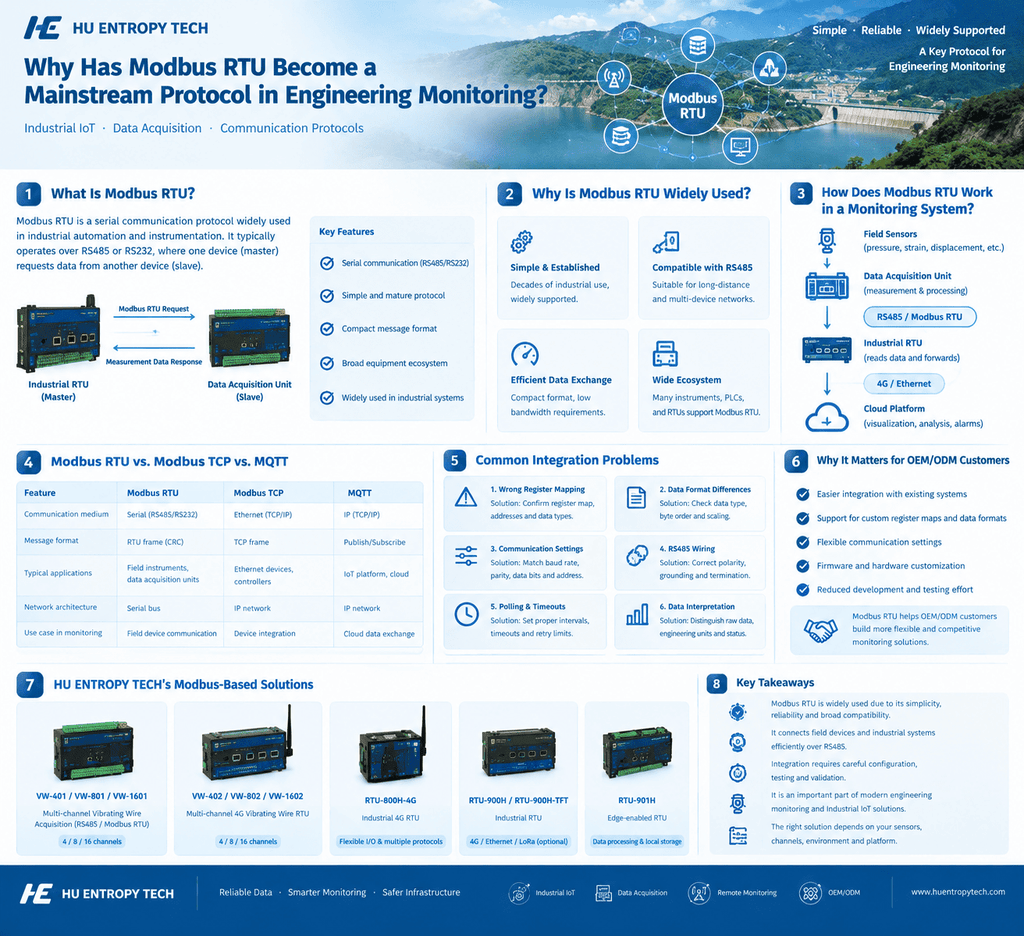
Introduction
In engineering monitoring projects, reliable communication between sensors, data acquisition devices, RTUs, and monitoring platforms is just as important as accurate measurement.
A monitoring system may contain vibrating wire sensors, pressure transmitters, displacement instruments, data loggers, industrial RTUs, and cloud software. These components often come from different manufacturers, and each may have its own communication requirements.
Without a common communication protocol, integrating these devices can become complicated and expensive.
This is one reason Modbus RTU remains widely used in industrial data acquisition and engineering monitoring systems.
Its relatively simple communication structure, broad ecosystem support, and compatibility with serial interfaces such as RS485 make it a practical choice for many field applications.
For equipment manufacturers and system integrators, understanding Modbus RTU can help simplify system integration, reduce development effort, and improve interoperability.
1. What Is Modbus RTU?
Modbus RTU is a serial communication protocol widely used in industrial automation and instrumentation.
It typically operates over serial interfaces such as RS485 or RS232, depending on the equipment.
In a common Modbus RTU arrangement, one device acts as the client (traditionally called the master), requesting data from another device acting as the server (traditionally called the slave).
For example, an RTU may request a measurement value from a data acquisition unit, which responds with the requested data.
A simplified communication sequence looks like this:
Industrial RTU
      │
      │ Modbus RTU Request
      ▼
Data Acquisition Unit
      │
      │ Measurement Data Response
      ▼
Industrial RTU
      │
      ▼
4G / Ethernet / Other Network
      │
      ▼
Monitoring Platform
The protocol defines how devices exchange messages, including device addresses, function codes, data fields, and error checking.
It does not, by itself, define how a sensor measures a physical quantity or how a cloud platform displays the resulting data.
Those functions belong to other parts of the monitoring system.
2. Why Is Modbus RTU So Widely Used in Engineering Monitoring?
Several practical characteristics make Modbus RTU attractive for field applications.
2.1 Simple and Well-Established Communication
Modbus RTU has been used in industrial systems for decades.
Many PLCs, RTUs, data loggers, meters, and other instruments support it, making it easier to connect compatible equipment from different manufacturers.
For engineering monitoring companies, using an established protocol can reduce the need to develop a completely proprietary communication method.
2.2 Compatibility with RS485
RS485 is widely used for serial communication in industrial environments.
It supports differential signaling and is suitable for many applications involving relatively long cable runs and multiple connected devices.
When combined with Modbus RTU, RS485 provides a practical communication option for field monitoring stations.
A typical arrangement is:
                  RS485 Bus
      ┌──────────────┼──────────────┐
      │              │              │
      ▼              ▼              ▼
 Data Logger A   Data Logger B   Data Logger C
      │              │              │
      └──────────────┴──────────────┘
                     │
                     ▼
                Industrial RTU
The actual network topology, cable length, baud rate, termination, addressing, and number of connected devices must follow the relevant hardware specifications and installation requirements.
2.3 Efficient Data Exchange
Modbus RTU uses a compact binary message format, which is useful for exchanging measurement values and device status over serial links.
A monitoring platform may need to retrieve only a defined set of values at each polling interval.
For example, an RTU might read several registers containing sensor measurements, temperature values, device status, and diagnostic information.
This approach can be suitable for remote monitoring stations where communication bandwidth and power consumption need to be managed carefully.
2.4 Broad Equipment Ecosystem
Many industrial devices already support Modbus RTU.
This makes it easier for system integrators to combine compatible equipment without relying entirely on a single manufacturer’s proprietary software.
However, support for Modbus RTU does not guarantee that two devices will work together automatically.
The register map, data format, communication settings, scaling rules, and supported function codes must still be compatible.
3. How Does Modbus RTU Work in a Monitoring System?
Consider a dam safety monitoring station that uses vibrating wire sensors.
The vibrating wire acquisition device measures sensor frequencies and makes the resulting data available through Modbus RTU.
An Industrial RTU then retrieves the measurements and transmits them to the monitoring platform.
Vibrating Wire Sensors
Measure pressure, strain, or other parameters supported by the sensor
Vibrating Wire Data Acquisition Unit
Measures sensor signals and exposes data through a supported interface
RS485 · Modbus RTU
HU ENTROPY TECH Industrial RTU
Reads compatible registers and forwards data through a supported network
4G / Ethernet
Monitoring Platform
Visualization, historical records, analysis, and alarms
The process can be divided into four stages:
- The sensor responds to a physical condition.
- The acquisition unit measures the sensor signal.
- The RTU requests the required data through Modbus RTU.
- The RTU forwards the measurements to the monitoring platform through a supported communication method.
The protocol connects the acquisition and communication layers. It does not replace the need for appropriate sensor measurement hardware or a correctly configured monitoring platform.
4. Modbus RTU vs. Modbus TCP: What’s the Difference?
Modbus RTU and Modbus TCP share the Modbus application protocol, but they use different communication transports.
| Feature | Modbus RTU | Modbus TCP |
|---|---|---|
| Typical communication medium | Serial communication | Ethernet networks |
| Common interfaces | RS485, RS232 | Ethernet |
| Message framing | Serial frame with CRC error checking | TCP/IP-based framing |
| Common applications | Field instruments, meters, data acquisition units | Ethernet-connected controllers and devices |
| Network architecture | Often a serial bus | IP-based network |
| Integration considerations | Serial settings, addressing, wiring | IP addressing, network configuration, device compatibility |
Modbus RTU is often convenient for field devices connected through RS485.
Modbus TCP can be appropriate when equipment communicates over an Ethernet network.
The two are not interchangeable simply because both use Modbus. A system may need a gateway or protocol conversion function to connect devices that use different transport methods.
5. Modbus RTU vs. MQTT: Why Do They Serve Different Roles?
Modbus RTU and MQTT are often used within the same Industrial IoT system, but they address different communication needs.
Modbus RTU is commonly used to retrieve data from field instruments and controllers over serial communication.
MQTT is a lightweight messaging protocol commonly used to exchange data between connected devices and IoT platforms.
A system may therefore use both:
Field Sensors
     ↓
Data Acquisition Unit
     │
     │ Modbus RTU over RS485
     ▼
Industrial RTU / IoT Gateway
     │
     │ MQTT over IP
     ▼
Cloud IoT Platform
     ↓
Monitoring Dashboard
In this architecture, the RTU reads measurements from compatible field devices and publishes the data to a remote platform.
The exact arrangement depends on the device’s supported protocols, the platform’s interface, and the project’s communication requirements.
Supporting both field-level and cloud-level communication can make a monitoring architecture more flexible.

6. Common Problems When Integrating Modbus RTU Devices
Although Modbus RTU is widely used, integration problems can still occur.
Problem 1: Incorrect Register Mapping
The RTU may successfully communicate with a data acquisition unit but display incorrect measurements because it reads the wrong registers.
Solution: Confirm the register map, register addresses, data types, and supported function codes against the device documentation.
Problem 2: Different Data Formats
A measurement may be represented as a 16-bit integer, a 32-bit integer, or a floating-point value.
Devices may also differ in byte order or word order.
Solution: Verify how each value is encoded and decoded. Apply the correct scaling and conversion rules.
Problem 3: Communication Parameter Mismatch
Devices connected to the same serial network must use compatible communication settings.
Typical settings include:
- Baud rate
- Data bits
- Parity
- Stop bits
- Device address
Solution: Configure both ends consistently and check the physical wiring.
Problem 4: RS485 Wiring and Termination
Incorrect polarity, poor grounding, electrical interference, unsuitable cable, or improper termination can cause intermittent communication.
Solution: Follow the hardware manufacturer’s wiring recommendations, check signal polarity, and use appropriate cable and termination practices for the network topology.
Problem 5: Excessive Polling or Timeouts
Polling too frequently, connecting too many devices to an unsuitable bus configuration, or using inappropriate timeout settings can lead to communication failures.
Solution: Set polling intervals, timeouts, retry limits, and device counts according to the actual network performance and device specifications.
Problem 6: Data Arrives but Is Misinterpreted
A communication link may work correctly even though the displayed engineering value is wrong.
For example, a raw frequency value may be confused with a converted physical measurement.
Solution: Clearly define whether each register represents raw sensor data, a calculated value, temperature, device status, or an engineering unit.
Successful communication is not the same as correct measurement interpretation.
7. Why Does Modbus RTU Matter for OEM/ODM Customers?
For monitoring equipment manufacturers and system integrators, protocol compatibility can significantly influence product development and deployment.
A customer may already have its own:
- Monitoring platform
- RTU or gateway
- Sensor network
- SCADA software
- Field wiring standards
- Data format requirements
If a new acquisition device supports a compatible Modbus RTU interface, it may be easier to integrate into the existing system.
OEM/ODM projects may also require adjustments to register maps, data formats, communication settings, firmware, or hardware interfaces.
These requirements should be agreed upon and validated during development.
A practical integration process usually includes:
- Defining the required sensor measurements and data fields.
- Confirming the communication interface and protocol.
- Mapping register addresses and data types.
- Testing communication with the target RTU or gateway.
- Verifying the displayed engineering values.
- Testing recovery behavior and long-term communication stability.
This helps reduce the risk of discovering compatibility problems only after the equipment has been installed in the field.
8. How HU ENTROPY TECH Supports Modbus-Based Monitoring Architectures
HU ENTROPY TECH develops hardware for engineering monitoring and Industrial IoT applications, including vibrating wire acquisition devices, multi-channel data acquisition units, and Industrial RTUs.
Our product architecture addresses two complementary requirements:
- Field data acquisition: Reading measurements from compatible sensors and making the data available through supported interfaces.
- Remote communication: Connecting field equipment to monitoring platforms through supported communication methods.
For example, the current product portfolio includes multi-channel vibrating wire acquisition options and 4G RTU products. Depending on the selected model and configuration, these can be considered for systems that use serial communication, Modbus-based integration, and remote telemetry.
For customers developing their own monitoring equipment or platforms, OEM/ODM cooperation may also be explored for project-specific integration requirements.
Before selecting a product, confirm the actual model’s supported interfaces, protocol implementation, register map, channel configuration, and communication options.
Website: https://huentropytech.com/

Conclusion
Modbus RTU remains an important communication protocol in engineering monitoring because it offers a well-established way to exchange data between compatible industrial devices.
Its widespread adoption, compatibility with serial interfaces, and relatively straightforward message structure make it useful for many applications involving field instruments, data acquisition units, and Industrial RTUs.
However, a successful monitoring system requires more than protocol support alone.
Engineers and system integrators should also verify:
- Hardware and interface compatibility
- Register maps and data formats
- Serial communication settings
- Measurement scaling and interpretation
- Network reliability and fault recovery
- Integration with the remote monitoring platform
When these elements are designed and tested correctly, Modbus RTU can help reduce integration complexity and make engineering monitoring systems easier to maintain and expand.
A reliable monitoring system starts with accurate measurement, but it depends on reliable communication to make that data useful.
For HU ENTROPY TECH and its integration partners, standard communication protocols are an important part of building flexible hardware solutions for engineering monitoring and Industrial IoT applications.
