
From field instrumentation to remote data acquisition: how Industrial IoT supports smarter dam safety monitoring
Dams are critical infrastructure assets. Their safety depends on effective engineering design, regular inspections, reliable instrumentation, and continuous assessment of changing conditions.
But monitoring a dam is not simply a matter of installing sensors and collecting readings.
Engineers also need to obtain data from multiple locations, identify changes over time, maintain reliable communication with remote monitoring points, and make measurement information available to the people responsible for assessing dam safety.
This is where Industrial Internet of Things (IIoT) technology can make a practical difference.
By connecting field instruments, data acquisition equipment, communication networks, and monitoring platforms, an IoT-based architecture can help make dam monitoring more automated, accessible, and scalable.
In this article, we explore why IoT matters in dam safety monitoring, how the technology works, and what engineers should consider when designing a reliable monitoring system.
1. Why Is Dam Safety Monitoring So Challenging?
Dam monitoring projects often involve multiple measurement points distributed across large and sometimes difficult-to-access areas.
Depending on the dam type, site conditions, and monitoring objectives, instrumentation may be used to observe parameters such as:
- Pore-water pressure: To understand water pressure conditions within the dam body or foundation.
- Seepage and leakage: To monitor relevant seepage measurements and changes in water flow.
- Displacement and deformation: To track movement of the dam, foundation, or associated structures.
- Strain and stress-related parameters: To observe changes measured by appropriate instruments.
- Water level: To record reservoir or other relevant water levels.
- Temperature and environmental conditions: To support interpretation of measurements where relevant.
Each measurement provides only part of the overall picture.
Engineers need to understand how measurements change over time, how different parameters relate to one another, and whether observed changes require further investigation.
Traditional manual measurement can remain useful, particularly for inspections, verification, and selected instruments. However, depending on the project, manual collection alone may not provide the data frequency or remote accessibility needed for every monitoring objective.
Other challenges may include:
- Long distances between monitoring points.
- Limited access to field equipment.
- High labour requirements for repeated site visits.
- Delays in transferring measurement records.
- Difficulty consolidating data from different instruments.
- Communication and power constraints at remote locations.
An appropriately designed IoT monitoring system can help address some of these challenges by automating data collection and transmission.
2. What Is IoT-Based Dam Safety Monitoring?
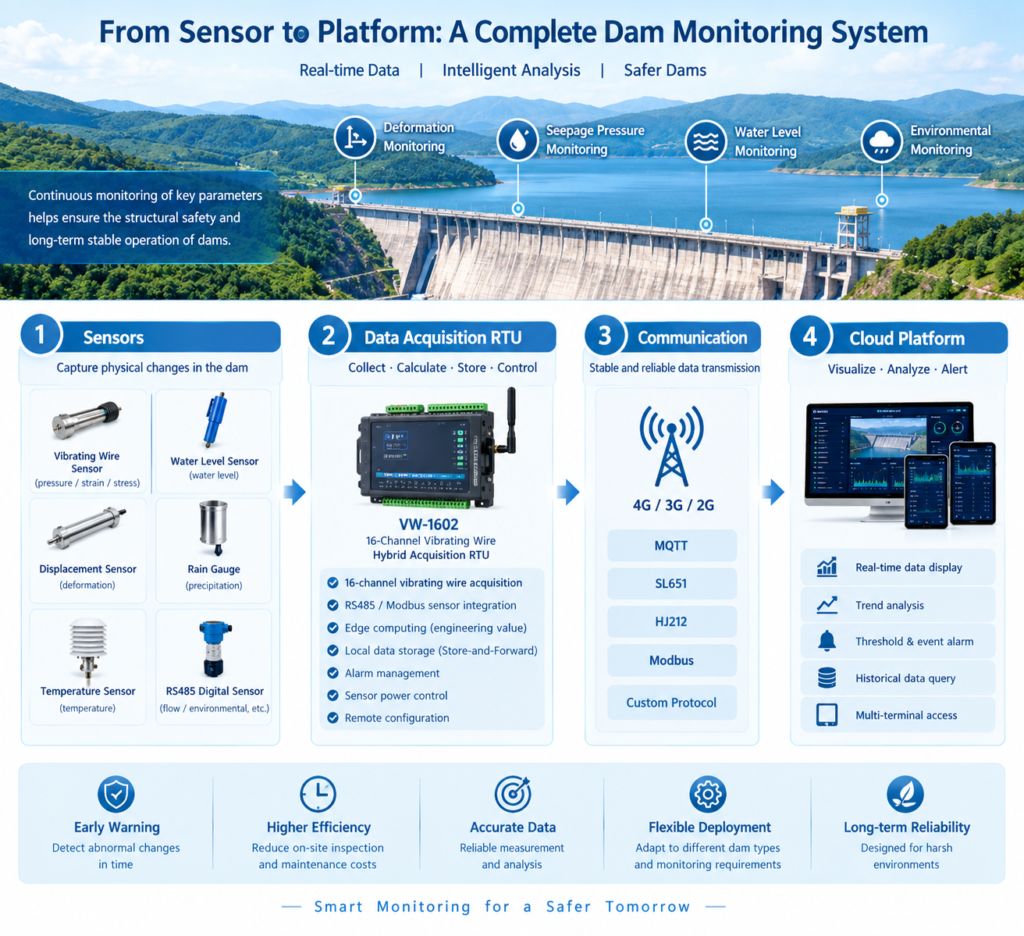
IoT-based dam monitoring connects field instruments and data acquisition equipment to a communication network and a monitoring platform.
Instead of relying entirely on manual collection and separate records, compatible devices can collect measurements automatically and transmit data to a central system.
A typical architecture is:
Field Sensors → Data Acquisition Units → Industrial RTU / IoT Gateway → 4G or Ethernet → Monitoring Platform → Engineers
Each component has a distinct role.
Field sensors
Measure physical parameters such as pressure, strain, displacement, or water level, depending on the instrumentation installed.
Data acquisition units
Read compatible sensor signals and convert them into measurement data.
Industrial RTUs or IoT gateways
Collect or forward data from field equipment and provide communication with the remote system, depending on the selected device and system design.
Communication networks
Transfer data through supported technologies such as cellular networks or Ethernet.
Monitoring platform
Stores and displays measurements, supports historical analysis, and can provide configured alarms and notifications.
Engineers and operators
Review the data, investigate relevant changes, and make decisions using engineering procedures and site-specific criteria.
The exact configuration varies by project. Some systems can connect acquisition equipment directly to a server or platform without a separate RTU. In other applications, an RTU or gateway may be useful for remote communication, data aggregation, or local processing.
The objective is not to add as many devices as possible. It is to create a monitoring architecture that meets the project’s requirements.
3. Five Practical Benefits of IoT in Dam Monitoring
3.1 Automated Data Collection
Automated acquisition can reduce the need for repeated manual readings at every monitoring point.
Compatible data acquisition units can collect measurements according to configured schedules or operating requirements.
This can help improve the consistency of data collection and reduce routine fieldwork, although periodic inspections and instrument maintenance remain necessary.
3.2 Remote Access to Monitoring Data
With a suitable communication connection, measurement data can be transmitted to a central platform for authorized personnel to review remotely.
This is particularly useful when monitoring points are distributed across a large site or when travelling to every instrument is time-consuming.
Remote access can also help engineering teams coordinate their work when project personnel are located in different places.
3.3 Better Understanding of Long-Term Trends
Dam safety assessment often requires more than looking at an individual reading.
Historical measurements can help engineers compare current conditions with previous observations and examine trends over time.
For example, engineers may review pore-water pressure measurements alongside reservoir levels, seepage observations, or other relevant parameters.
An IoT-enabled system can make it easier to organize and access these datasets, provided that the instruments, timestamps, data quality, and platform integration are properly managed.
3.4 Configurable Alarms and Notifications
A monitoring platform can be configured to notify designated personnel when a measurement crosses a defined threshold or when a device stops reporting data.
Such notifications can help teams identify conditions that require review.
However, an alarm is not automatically a diagnosis of structural safety. Thresholds, alarm logic, escalation procedures, and response actions should be established by qualified personnel based on the specific dam, instrumentation, and applicable engineering requirements.
3.5 Centralized Monitoring and Integration
Large projects may use instruments from different manufacturers and employ several communication interfaces.
A properly designed monitoring architecture can help consolidate compatible data into a common platform.
Protocols such as Modbus RTU, Modbus TCP, and MQTT may be relevant at different layers of the system, depending on the equipment and software.
The main objective is to ensure that data can be collected, interpreted, transmitted, and managed consistently.
4. Why Vibrating Wire Data Acquisition Matters
Vibrating wire instruments are widely used in geotechnical and civil engineering monitoring.
Depending on the instrument, this technology can support measurements such as pore-water pressure, strain, and other engineering parameters.
Because vibrating wire sensors provide frequency-based signals, the acquisition equipment must be designed to read the relevant sensor signals correctly.
A suitable vibrating wire data acquisition unit can provide functions such as:
- Reading measurements from compatible vibrating wire sensors.
- Supporting multiple measurement channels, depending on the model.
- Organizing measurement data for communication to other equipment.
- Providing an appropriate communication interface for system integration.
- Supporting automated monitoring when configured as part of a suitable system.
For dam monitoring projects with multiple vibrating wire instruments, channel capacity is an important selection factor.
A smaller acquisition unit may be sufficient for a limited number of sensors. A larger installation may benefit from multi-channel equipment or a distributed acquisition architecture.
Engineers should verify the sensor specifications, measurement requirements, channel count, communication interface, and operating conditions before selecting the equipment.
The quality of the monitoring system depends not only on communication technology, but also on correct sensor measurement and data interpretation.
5. What Role Does an Industrial RTU Play?
An industrial RTU, or Remote Terminal Unit, can help connect field measurement equipment to a remote monitoring system.
In an IoT-based dam monitoring architecture, an RTU may be used to:
- Collect data from compatible instruments.
- Communicate with acquisition equipment over supported interfaces.
- Transmit measurements through a cellular or wired network.
- Forward data to a remote server or platform.
- Support local data handling or edge functions on selected models.
The available functions depend on the specific RTU and its configuration.
For example, an RTU with a suitable 4G interface may be considered when a monitoring site lacks a convenient wired connection to the central platform.
Before deployment, engineers should confirm cellular coverage, antenna placement, power requirements, network configuration, and compatibility with the intended receiving platform.
It is also important to distinguish between field communication and remote communication.
RS485 with Modbus RTU may connect instruments locally, while 4G or Ethernet may carry the collected data to a remote system. MQTT may be used for platform messaging when supported.
These technologies can complement one another within a single monitoring architecture.
6. How Should Engineers Design a Reliable IoT Monitoring System?
Connectivity alone does not guarantee a reliable monitoring solution.
A system should be designed around the monitoring objectives and the conditions at the actual site.
Sensor and instrument compatibility
Confirm that the acquisition equipment supports the installed sensors and their output interfaces.
Check channel requirements, measurement specifications, conversion rules, and engineering units.
Communication architecture
Determine how instruments communicate locally and how data reaches the monitoring platform.
Check protocol compatibility, device addressing, register mapping, communication parameters, and network coverage.
Power supply
Assess whether grid power is available at each monitoring point.
Where necessary, evaluate battery or solar-powered configurations, taking into account equipment consumption, transmission frequency, environmental conditions, and maintenance requirements.
Data continuity
Remote sites may experience temporary network interruptions.
Depending on the project requirements, local storage and Store-and-Forward capabilities may help retain data during a communication outage and transmit stored records after the connection is restored.
These capabilities must be confirmed for the selected equipment and system design. Data retention, storage capacity, timestamps, and recovery behaviour should be tested before deployment.
Environmental protection
Field equipment may be exposed to moisture, temperature variation, dust, electrical interference, and other site-specific conditions.
Enclosures, cable connections, grounding, surge protection, and installation practices should be selected according to the actual environment and applicable requirements.
Maintenance and verification
Automated monitoring does not eliminate the need for instrument inspection, calibration where applicable, communication checks, and periodic verification of measurement quality.
A long-term monitoring plan should include procedures for identifying failed devices, reviewing suspicious readings, and maintaining the system throughout its service life.
7. Example: An IoT Architecture for Dam Safety Monitoring
Consider a dam where engineers need to collect measurements from multiple vibrating wire instruments and other compatible monitoring devices.
One possible architecture is:
Vibrating Wire Sensors and Other Field Instruments
↓
Compatible Data Acquisition Units
↓
RS485 / Modbus RTU, Where Supported
↓
Industrial RTU or IoT Gateway
↓
4G / Ethernet
↓
Central Monitoring Platform
↓
Engineering Review, Trend Analysis, and Configured Notifications
In this arrangement, the acquisition units read the relevant sensor signals, the RTU or gateway provides the required data handling and remote communication, and the platform organizes the measurements for review.
Other architectures may be more appropriate where the acquisition equipment already has built-in remote connectivity or where the instruments connect directly to a data management system.
The choice depends on the number and types of sensors, communication requirements, power availability, site layout, software compatibility, and the required level of redundancy.
The system should be evaluated as a complete solution rather than as a collection of individual product specifications.
8. How HU ENTROPY TECH Supports Dam Monitoring Applications
At HU ENTROPY TECH, we provide vibrating wire data acquisition hardware, industrial RTUs, and OEM/ODM services for engineering monitoring applications.
Our portfolio includes products that may be relevant to the acquisition and remote communication layers of an automated monitoring system.
Vibrating wire data acquisition units
The VW-401, VW-801, and VW-1601 are RS485 vibrating wire acquisition models for 4-, 8-, and 16-channel applications, respectively.
They can be considered for projects using compatible vibrating wire sensors where multi-channel data acquisition is required.
4G vibrating wire hybrid acquisition RTUs
The VW-402, VW-802, and VW-1602 provide 4G hybrid acquisition options for 4-, 8-, and 16-channel applications, respectively.
Their suitability depends on the sensor configuration, required interfaces, and system requirements.
Industrial RTUs
Our industrial RTU portfolio includes the RTU-800H-4G, RTU-900H series, and RTU-901H.
Depending on the model and configuration, these devices may support field data collection, communication, or integration with remote monitoring systems.
For system integrators and equipment manufacturers, we also support OEM/ODM cooperation based on project requirements.
The right product configuration should be determined by reviewing the complete application, including sensor compatibility, channel count, communication methods, power supply, operating environment, and platform integration.
Learn more about HU ENTROPY TECH:
9. Is IoT a Replacement for Traditional Dam Safety Engineering?
No.
IoT technology improves the way monitoring data can be collected, transmitted, organized, and accessed. It does not replace professional inspections, engineering analysis, established safety procedures, or the judgement of qualified dam safety professionals.
A reliable dam safety program combines appropriate instrumentation with sound engineering practice.
Automated monitoring can support this program by making relevant measurements more accessible and helping teams identify changes that warrant attention.
The value comes from integrating technology into a well-designed monitoring process—not from automation alone.
Conclusion: Better Data Supports Better Engineering Decisions
Dam safety monitoring involves multiple instruments, distributed measurement points, and long-term observation.
IoT technology can help connect these elements through automated data acquisition, remote communication, centralized data management, and configurable notifications.
However, a successful system still depends on correct sensor selection, compatible acquisition equipment, reliable communication, appropriate installation, and careful interpretation of the measurements.
For dam owners, engineering consultants, and monitoring system integrators, the goal should be to build a solution that is practical to deploy, reliable to operate, and maintainable over the long term.
At HU ENTROPY TECH, we support engineering monitoring applications with vibrating wire data acquisition hardware, industrial RTUs, and OEM/ODM services.
Reliable monitoring begins with reliable measurements—and a system designed to get the right data to the right people.
A Question for Dam Safety Engineers
What is the biggest challenge in your dam monitoring projects?
A. Collecting data from distributed instruments
B. Maintaining reliable communication at remote sites
C. Integrating instruments from different manufacturers
D. Managing long-term data quality and alarm systems
Share your experience in the comments. Practical insights from real projects help the entire engineering community.
#DamSafety #DamMonitoring #EngineeringMonitoring #IndustrialIoT #DataAcquisition #VibratingWire #IndustrialRTU #Hydropower #GeotechnicalEngineering
