
The real engineering challenges behind reliable, unattended dam monitoring systems
Remote dam monitoring is becoming increasingly important for dam owners, hydropower operators, engineering consultants, and monitoring system integrators.
By combining sensors, automated data acquisition, industrial RTUs, and remote monitoring platforms, engineers can collect measurements without having to visit every monitoring point for every routine reading.
However, there is a critical difference between installing a remote monitoring system and keeping it running reliably for years.
A system may work perfectly during commissioning but begin to experience problems after several months of operation.
Data may stop arriving. A cellular connection may become unstable. Batteries may discharge faster than expected. A field device may stop responding. Or the monitoring platform may display incomplete records without making the cause immediately obvious.
These are not unusual concerns in remote engineering projects.
The real challenge is not simply collecting data. It is ensuring that data remains available, traceable, and trustworthy throughout the system’s service life.
In this article, we examine six common challenges in remote dam monitoring and discuss practical ways to address them.
1. Problem One: Network Outages and Unstable 4G Connections
Many remote monitoring sites use cellular communication because installing a dedicated wired network may be difficult or expensive.
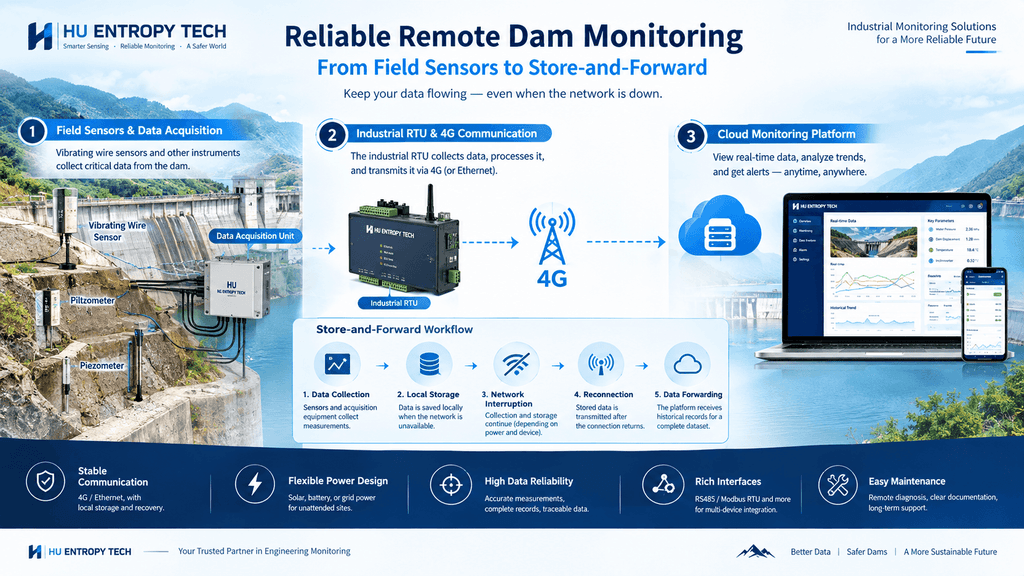
A typical architecture might be:
Field Sensors → Data Acquisition Unit → Industrial RTU → 4G Network → Monitoring Platform
This arrangement can simplify remote access, but cellular communication is not always stable.
Potential causes of communication interruptions include:
- Weak signal strength in valleys or mountainous terrain.
- Antenna placement or installation problems.
- Temporary cellular network outages.
- Unstable power supplied to communication equipment.
- SIM card, network configuration, or service-related issues.
- Environmental conditions affecting field installations.
When the connection fails, the immediate symptom may be simple: the platform stops receiving new data.
But the underlying cause may be much harder to identify.
What can engineers do?
First, evaluate connectivity before deployment.
Check cellular coverage at the actual installation location rather than relying only on general coverage maps. Antenna placement, cable losses, enclosure design, and local terrain may affect performance.
Second, monitor device communication status.
The system should distinguish between a stable measurement and a device that has stopped reporting.
A missing reading should not automatically be interpreted as an unchanged physical condition.
Third, plan for temporary outages.
Even a well-designed communication system may experience interruptions. The monitoring architecture should account for what happens when the network is unavailable.
This leads to one of the most important design considerations in remote monitoring: local data storage.
2. Problem Two: Data Loss During Network Interruptions
Imagine a dam monitoring system that collects measurements every 30 minutes.
If the cellular connection is interrupted for six hours, the system may miss 12 scheduled transmissions.
Without suitable local storage, these measurements may never reach the monitoring platform.
For long-term monitoring, missing records can make trend analysis more difficult and reduce the completeness of the monitoring history.
The solution may involve a mechanism known as Store-and-Forward.
How does Store-and-Forward work?
Store-and-Forward allows a system to retain data locally when communication is unavailable and transmit the stored records after the connection is restored.
A simplified workflow is:
- Data Collection: Sensors and data acquisition equipment collect measurements according to the configured schedule.
- Local Storage: When the network connection is unavailable, the system stores measurement records locally, provided that the equipment supports this function.
- Network Interruption: Data collection and local storage continue during the outage, subject to the system’s power supply and device capabilities.
- Connection Recovery: Once communication is restored, the system begins transmitting the stored records.
- Data Synchronization: The monitoring platform receives the historical records, helping maintain a more complete measurement history.
Important: Store-and-Forward capabilities vary by device. Local storage capacity, timestamp handling, retransmission behaviour, and duplicate-record management should be verified before deployment.
However, not every RTU or data acquisition unit supports Store-and-Forward in the same way.
Before selecting equipment, engineers should verify:
- Whether data can be stored locally.
- The available storage capacity.
- How long data can be retained at the expected sampling rate.
- Whether stored records include timestamps and relevant status information.
- How data is retransmitted after reconnection.
- How duplicate records, transmission failures, and incomplete synchronization are handled.
Local storage is valuable only when the entire data recovery process is properly designed and tested.
A reliable remote monitoring system should be designed to handle communication failures—not merely assume that they will never happen.
3. Problem Three: Insufficient Power at Remote Sites
Power supply is another major challenge for unattended monitoring systems.
Some monitoring points have access to grid power. Others depend on batteries, solar panels, or a combination of power sources.
If the power system is undersized, field equipment may shut down unexpectedly or operate inconsistently.
This can interrupt both data acquisition and remote communication.
Why can power consumption be higher than expected?
Engineers sometimes focus on the nominal power consumption of a single device and overlook the total system.
A remote monitoring installation may include:
- Sensors and data acquisition equipment.
- An industrial RTU or communication gateway.
- A cellular modem and antenna-related equipment.
- Heating, ventilation, or other auxiliary equipment where required.
- Status indicators or additional peripherals.
Cellular communication can consume a meaningful amount of energy, particularly when signal conditions are poor or the device frequently reconnects.
Actual consumption depends on the equipment, operating mode, transmission frequency, network conditions, and environmental temperature.
How should the power system be designed?
Estimate the energy budget.
Calculate the expected consumption of all devices over a complete operating cycle, not just their average consumption under ideal conditions.
Consider worst-case conditions.
Solar generation may decline during prolonged cloudy weather, while battery performance can change with temperature and age.
Choose an appropriate operating strategy.
Sampling frequency, transmission intervals, and communication modes may be configured to balance monitoring requirements with energy consumption, where the equipment supports such adjustments.
Plan for maintenance.
Battery health, solar panel condition, cable connections, and power supply performance should be included in the maintenance plan.
The objective is to ensure that the monitoring system can operate through realistic environmental and power conditions.
4. Problem Four: Reliable Data Transmission Does Not Guarantee Reliable Measurements
A monitoring platform may receive data successfully while the measurements themselves are incorrect.
This distinction is especially important in engineering monitoring.
For example, a system may communicate correctly with a vibrating wire data acquisition unit but interpret the returned values incorrectly because of an unsuitable conversion formula or incorrect engineering units.
Other possible issues include:
- Incorrect sensor configuration.
- Wrong register addresses or data types.
- Incorrect scaling factors.
- Inconsistent timestamps.
- Wiring or installation problems.
- Sensor drift, damage, or measurement anomalies.
- Incorrect handling of missing or invalid readings.
These problems can be difficult to detect if the system checks only whether communication is working.
What should a robust monitoring system verify?
Engineers should evaluate several different aspects of data quality:
Communication status: Is the device responding as expected?
Data completeness: Are scheduled measurements arriving, or are there gaps?
Measurement validity: Are values within plausible ranges for the instrument and application?
Time consistency: Are timestamps correct, and can historical readings be placed in the right sequence?
Conversion accuracy: Are raw readings converted into engineering values using the correct rules?
Sensor condition: Are unusual changes caused by a real physical event, an instrument issue, or another factor?
Automated checks can help identify suspicious data, but they do not replace engineering review.
For dam safety monitoring, the interpretation of unusual measurements should follow the project’s established procedures and involve qualified personnel when necessary.
5. Problem Five: Too Many Devices, Too Many Interfaces
A large monitoring project may contain instruments from several manufacturers.
Some devices communicate through RS485 and Modbus RTU. Others may use analog signals, digital interfaces, or manufacturer-specific protocols.
The result can be a complex integration environment.
Common difficulties include:
- Inconsistent communication settings.
- Different register maps and data formats.
- Incompatible acquisition interfaces.
- Multiple software systems that do not share data easily.
- Unclear responsibility for troubleshooting.
- Higher maintenance costs when every component requires a different integration method.
How can engineers simplify the architecture?
Start with a clear system design.
Identify which devices need to communicate directly, which measurements should be collected together, and which interfaces are supported by the target monitoring platform.
Where appropriate, standardized interfaces such as RS485 with Modbus RTU can simplify communication between compatible field devices.
An industrial RTU or gateway may help aggregate data and connect the field network to a remote system, provided that it supports the required interfaces and protocols.
However, adding a gateway does not automatically solve every compatibility problem. Register mapping, data conversion, timing, and platform integration still need to be validated.
For equipment manufacturers and system integrators, OEM/ODM cooperation may also help address specific interface or product configuration requirements.
The goal is to reduce unnecessary complexity while maintaining the functionality required by the project.
6. Problem Six: A System That Works at Commissioning but Becomes Difficult to Maintain
Initial commissioning usually takes place under controlled conditions.
The devices are accessible, engineers are present, and communication problems can be investigated directly.
Several months or years later, the situation may be very different.
A monitoring site may be difficult to reach. Field technicians may change. Documentation may be incomplete. A replacement device may use different configuration settings.
These factors can make long-term maintenance more difficult than expected.
What should be prepared from the beginning?
Clear documentation
Record device models, sensor connections, communication settings, register maps, power configurations, and installation details.
Remote diagnostics
Where supported, remote access to device status and communication information can help engineers identify problems before arranging a site visit.
A practical replacement strategy
Consider whether devices can be replaced without redesigning the entire system and whether replacement equipment can use compatible interfaces and configurations.
Routine health checks
Monitor device availability, missing data, communication interruptions, storage capacity, and power status where those indicators are available.
A defined maintenance process
Establish who reviews alarms, who investigates communication failures, and how measurement anomalies are escalated.
A system should not be evaluated only by how easily it can be installed. It should also be evaluated by how easily it can be maintained throughout its service life.
7. A Practical Architecture for Remote Dam Monitoring
Consider a remote dam monitoring project using multiple vibrating wire instruments and other compatible sensors.
One possible architecture is:
Vibrating Wire Sensors and Other Field Instruments
↓
Compatible Data Acquisition Units
↓
RS485 / Modbus RTU, Where Supported
↓
Industrial RTU or IoT Gateway
↓
4G Cellular Network or Ethernet
↓
Monitoring Platform
↓
Data Review, Trend Analysis, and Configured Notifications
For a site with unstable connectivity, the design may also include local data storage and Store-and-Forward functionality where supported.
For a site with limited power, the design may require an energy budget, battery monitoring, solar power, or lower-power operating configurations.
For a project with multiple instrument types, the architecture may need additional interfaces or data integration components.
The important point is that each layer should be designed with the failure modes of the complete system in mind.
A well-designed architecture does not eliminate every failure. It helps prevent avoidable failures, preserve data where possible, and make problems easier to detect and investigate.
8. How HU ENTROPY TECH Supports Remote Monitoring Applications
At HU ENTROPY TECH, we provide vibrating wire data acquisition hardware, industrial RTUs, and OEM/ODM services for engineering monitoring applications.
Our product portfolio includes:
Vibrating wire data acquisition units
The VW-401, VW-801, and VW-1601 are RS485 vibrating wire acquisition models for 4-, 8-, and 16-channel applications, respectively.
They can be considered for projects using compatible vibrating wire sensors that require multi-channel data acquisition.
4G vibrating wire hybrid acquisition RTUs
The VW-402, VW-802, and VW-1602 provide 4G hybrid acquisition options for 4-, 8-, and 16-channel applications, respectively.
These may be suitable for applications that require compatible vibrating wire acquisition and remote communication, subject to the product specifications and system requirements.
Industrial RTUs
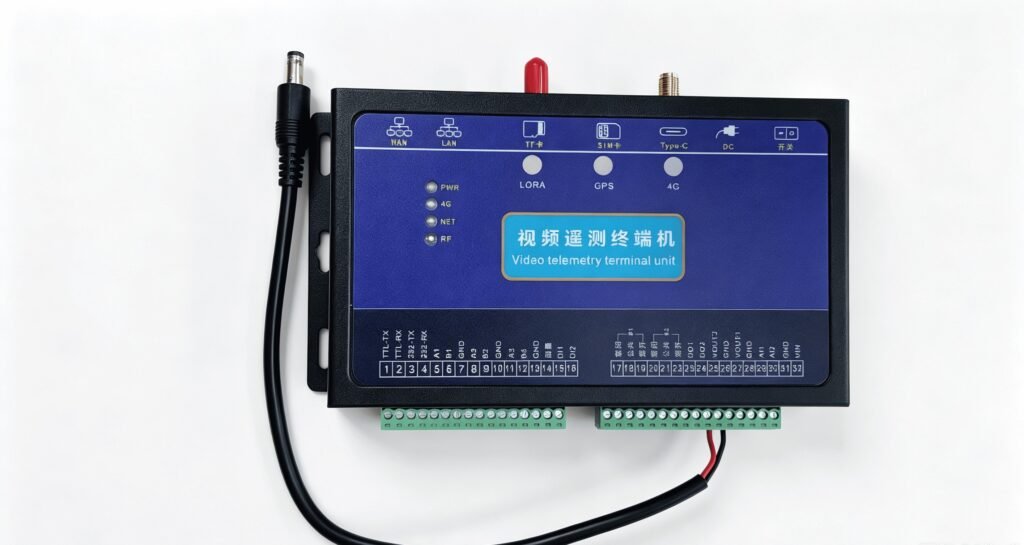
Our industrial RTU portfolio includes the RTU-800H-4G, RTU-900H series, and RTU-901H.
Depending on the selected model and configuration, these devices may support field data collection, communication, and integration with remote monitoring systems.
For OEMs and system integrators, we also support OEM/ODM cooperation based on project requirements.
When evaluating equipment for an unattended monitoring site, we recommend checking the complete application:
- Sensor compatibility and channel count.
- Required communication interfaces and protocols.
- Power consumption and operating conditions.
- Local data storage and recovery requirements.
- Cellular connectivity and platform compatibility.
- Long-term maintenance and replacement considerations.
Not every product provides every function. Capabilities such as local storage, Store-and-Forward, and specific communication protocols should be confirmed against the selected model and configuration before deployment.
Learn more about HU ENTROPY TECH:
9. A Checklist Before Deploying an Unattended Monitoring System
Before commissioning a remote dam monitoring installation, consider the following questions.
Communication
- Has cellular coverage been checked at the actual site?
- What happens if the network is unavailable for several hours or days?
- Can communication failures be detected remotely?
Data reliability
- Are measurements stored locally when required?
- Has the data recovery process been tested?
- Are timestamps, missing records, and duplicate records handled correctly?
Power
- Has the energy budget been calculated for the entire system?
- Can the power design accommodate realistic weather and battery conditions?
- Are low-power modes available and appropriate for the monitoring objectives?
Measurement quality
- Are sensor configuration and conversion rules correct?
- Are data values and units validated?
- Can the system distinguish missing data from a valid measurement?
Maintenance
- Are configuration records and wiring diagrams available?
- Can faults be diagnosed without immediately visiting the site?
- Is there a practical process for device replacement and routine inspection?
Integration
- Are field interfaces and protocols compatible?
- Has the complete path from sensor to platform been tested?
- Are responsibilities for troubleshooting clearly defined?
Testing these points before deployment can help reveal problems that would otherwise appear only after the system has been operating for some time.
Conclusion: Design for the Conditions You Will Actually Face
Remote dam monitoring is not just a connectivity problem.
It is a system engineering challenge involving measurement accuracy, communication reliability, power management, data continuity, equipment compatibility, and long-term maintenance.
A system that performs well under ideal conditions may still struggle when communication becomes unstable, power is limited, or field equipment is difficult to access.
That is why reliable monitoring systems should be designed not only for normal operation, but also for the interruptions and maintenance challenges that may occur throughout their service life.
Local data storage, Store-and-Forward functionality, appropriate power design, clear communication architecture, and effective diagnostics can all contribute to a more resilient solution—when correctly implemented and verified.
At HU ENTROPY TECH, we support engineering monitoring applications with vibrating wire data acquisition hardware, industrial RTUs, and OEM/ODM services.
The best remote monitoring system is not simply one that works today. It is one designed to keep collecting trustworthy data when field conditions become difficult.
A Question for Monitoring Engineers
What is the most difficult challenge in your remote monitoring projects?
A. Unstable cellular communication
B. Power supply at unattended sites
C. Missing data during network outages
D. Long-term maintenance and troubleshooting
Share your experience in the comments. Practical lessons from real projects can help the entire engineering community.
#DamMonitoring #DamSafety #RemoteMonitoring #IndustrialIoT #StoreAndForward #DataAcquisition #IndustrialRTU #EngineeringMonitoring #GeotechnicalEngineering
