
Choosing the right RTU is not just about communication. It is about building a reliable connection between field instruments, data acquisition equipment, and the monitoring platform.
In dam safety monitoring, slope stability monitoring, tunnel engineering, water resources management, and industrial IoT applications, remote monitoring systems must operate reliably under a wide range of field conditions.
An Industrial RTU (Remote Terminal Unit) plays an important role in these systems. Depending on its design, it can collect data from field devices, communicate with sensors and acquisition units, transmit information to remote platforms, and support local monitoring functions.
However, not all RTUs are designed for the same applications.
A device that works well in a conventional industrial automation system may not be the best choice for a remote engineering monitoring station. Before selecting an RTU, engineers should evaluate the complete monitoring architecture rather than focus on a single specification.
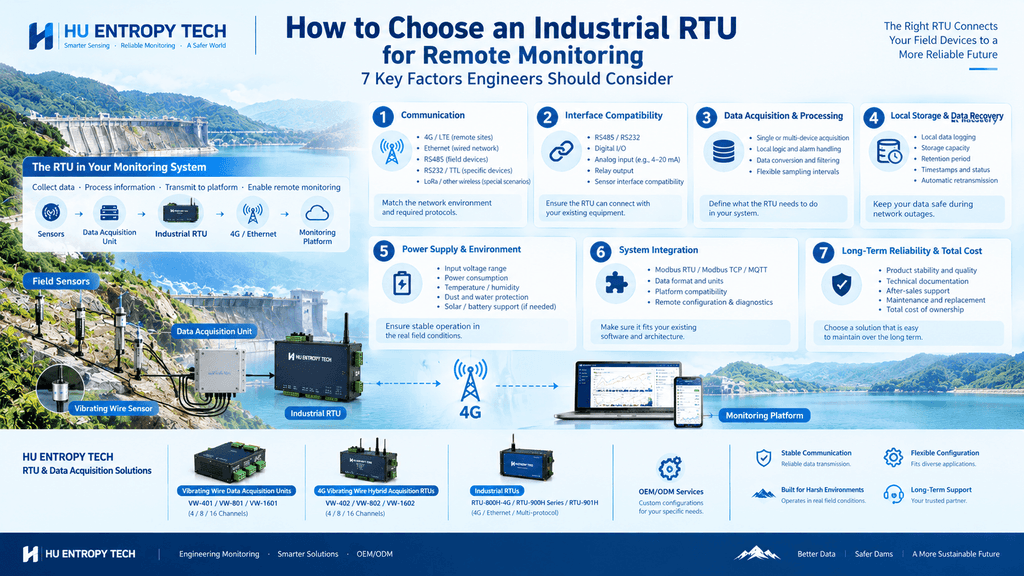
Here are seven important factors to consider.
1. Communication: Does the RTU Match Your Network Environment?
Communication is often the first consideration when selecting an RTU.
Different projects have different network requirements.
- 4G LTE: Suitable for remote stations where cellular coverage is available but wired networking is impractical.
- Ethernet: Useful for sites with an existing wired network or a local industrial network.
- RS485: Commonly used for communication between field instruments, data acquisition units, and industrial devices.
- RS232 or TTL: May be required for specific equipment and integration scenarios.
- LoRa or other wireless technologies: May be appropriate for certain sensor networks or applications requiring low-power, longer-range communication.
These interfaces are not interchangeable. Their suitability depends on the distance, network topology, environmental conditions, data volume, and equipment compatibility.
For example, a remote dam monitoring station may use RS485 to communicate with a vibrating wire data acquisition unit and 4G to send measurements to a central platform.
A simplified architecture is:
Vibrating Wire Sensors → Data Acquisition Unit → Industrial RTU → 4G Network → Monitoring Platform
This architecture is only an example. Some acquisition units already integrate RTU and communication functions, while other projects use separate devices.
Engineering tip: Identify the communication requirements at every connection point before choosing the RTU. Confirm both the physical interface and the communication protocol.
2. Interface Compatibility: Can It Connect to Your Existing Equipment?
A monitoring system may include multiple sensor types, data acquisition units, PLCs, gateways, and third-party platforms.
The RTU must fit into this existing environment.
When evaluating an RTU, check the interfaces and signal types required by your project.
Typical considerations include:
- RS485 and RS232 serial interfaces
- Digital inputs and outputs
- Analog inputs, such as 4–20 mA, when required
- Relay outputs for specific control or alarm functions
- Compatibility with the required sensor interfaces
- Support for the necessary communication protocols
For vibrating wire monitoring applications, one distinction is particularly important: a conventional industrial RTU does not necessarily read vibrating wire sensors directly.
A dedicated vibrating wire acquisition unit may be required to excite and measure the sensor correctly and convert the measurement into usable data.
In such cases, the RTU communicates with the acquisition unit rather than replacing it.
Engineers should also verify the supported Modbus RTU register map, data format, addressing, baud rate, parity, and other serial communication parameters where applicable.
A device can have the correct connector and still be incompatible with the system.
3. Data Acquisition and Processing: What Does the RTU Actually Need to Do?
Not every monitoring station requires the same level of processing.
Some applications simply transmit measurements collected by another device. Others require local logic, alarm handling, data conversion, or interaction with several types of field equipment.
Before selecting an RTU, clarify its responsibilities.
Ask the following questions:
- Will it communicate with a dedicated data acquisition unit?
- Does it need to collect data from multiple devices?
- Is local data processing required?
- Must it support threshold-based alarms or event reporting?
- Does the system need to handle different measurement intervals?
- Will it operate independently for extended periods?
For example, a slope monitoring station might collect displacement-related measurements, rainfall data, and pore-water pressure readings through different instruments.
The system architecture must define which device acquires each measurement, which device processes the data, and which device transmits it to the monitoring platform.
Clear responsibility boundaries reduce integration complexity and make troubleshooting easier.
4. Local Storage and Data Recovery: What Happens When Communication Fails?
Remote monitoring equipment often operates in locations where network connectivity is less than ideal.
Temporary outages may occur because of weak cellular signals, network maintenance, power interruptions, or environmental conditions.
If every measurement must be transmitted immediately, communication failures can create gaps in the historical dataset.
For applications requiring data continuity, engineers should investigate whether the selected RTU or acquisition unit supports local data logging and Store-and-Forward.
Important questions include:
- Can the device continue recording when the network is unavailable?
- How much local storage is available?
- How long can records be retained?
- Are original timestamps preserved?
- Can stored records be forwarded automatically after reconnection?
- How does the system handle duplicate records and storage limits?
Remember that local storage, Store-and-Forward, and automatic retransmission are related but distinct capabilities. Their availability and behavior must be confirmed for the specific model and configuration.
If continuous measurement is critical, also verify that data acquisition can continue during a communication outage and that the power supply can sustain the equipment.
5. Power Supply and Environmental Conditions: Is the RTU Suitable for the Field?
A monitoring station installed in a control room faces different challenges from one installed on a remote slope or near a reservoir.
Field conditions may include temperature fluctuations, humidity, vibration, electrical interference, limited maintenance access, and unstable power availability.
Before selecting an RTU, check:
- Supported input voltage range
- Typical and peak power consumption
- Operating temperature range
- Enclosure and installation requirements
- Protection against moisture and dust, where applicable
- Electrical isolation and surge protection requirements
- Compatibility with batteries, solar power, or other power systems
For solar-powered stations, power consumption deserves particular attention.
The total energy budget must account for the RTU, communication module, acquisition equipment, sensors, and other connected devices.
A 4G module may consume substantially more power during transmission than during idle operation. Therefore, average power consumption alone may not be sufficient for battery and solar panel sizing.
Engineers should calculate the expected power budget under realistic operating conditions.
Environmental ratings and power specifications should always be checked against the selected model’s documentation rather than assumed from the product category.
6. System Integration: Can the RTU Work with Your Platform?
An RTU is only one component of a monitoring system.
Its value depends partly on how easily it integrates with the customer’s existing software, communication infrastructure, and data management processes.
Common integration considerations include:
Communication protocols
- Modbus RTU for supported serial-device communication
- Modbus TCP for compatible Ethernet-based systems
- MQTT for applications where the device and platform support the required messaging configuration
These protocols serve different purposes. An RTU that supports one protocol should not automatically be assumed to support the others.
Data structure
Engineers should confirm register addresses, data types, scaling factors, timestamps, units, and alarm status fields.
Platform compatibility
Verify whether the RTU can communicate with the target SCADA system, IoT platform, cloud service, or customer-developed application.
Configuration and maintenance
Remote configuration, diagnostics, firmware management, and event logs can simplify operation, but availability varies by product.
For OEMs and system integrators, integration flexibility can be especially important. A device that fits an established architecture may reduce development time and simplify deployment across multiple projects.
7. Long-Term Reliability and Total Cost of Ownership
The lowest initial purchase price does not always result in the lowest overall project cost.
For remote monitoring systems, the total cost of ownership may include:
- Hardware acquisition
- Engineering integration
- Installation and commissioning
- Communication service fees
- Power system design
- On-site maintenance
- Troubleshooting and replacement
- Software adaptation and future expansion
A device that is inexpensive but difficult to integrate may increase engineering costs. A system that requires frequent site visits may also become expensive when monitoring stations are spread across a large geographic area.
When evaluating suppliers, consider more than the product quotation.
Ask whether the supplier can provide technical documentation, configuration support, interface information, customization options, and a clear process for resolving technical issues.
For engineering integrators and equipment manufacturers, stable long-term cooperation with a hardware supplier can be just as important as the initial specification.
How HU ENTROPY TECH Supports Different Monitoring Requirements
At HU ENTROPY TECH, we provide vibrating wire data acquisition hardware, industrial RTUs, and OEM/ODM services for engineering monitoring applications.
Our portfolio includes several product families designed for different acquisition and telemetry requirements.
Vibrating Wire Data Acquisition Units
- VW-401: 4-channel vibrating wire data acquisition unit
- VW-801: 8-channel vibrating wire data acquisition unit
- VW-1601: 16-channel vibrating wire data acquisition unit
These models are RS485 versions intended for applications requiring vibrating wire data acquisition.
4G Hybrid Acquisition RTUs
- VW-402: 4-channel 4G hybrid acquisition RTU
- VW-802: 8-channel 4G hybrid acquisition RTU
- VW-1602: 16-channel 4G hybrid acquisition RTU
These models combine vibrating wire acquisition with 4G-oriented remote monitoring functionality, subject to the specific model’s supported features and configuration.
Industrial RTUs
Our broader industrial RTU portfolio includes:
- RTU-800H-4G
- RTU-900H
- RTU-900H-TFT
- RTU-901H
The appropriate choice depends on the required interfaces, communication methods, data processing functions, and project architecture.
We also support OEM/ODM cooperation for customers who need hardware adapted to their own product designs, monitoring systems, or project requirements.
Our approach is straightforward: understand the application first, identify the actual technical requirements, and then select or customize suitable hardware.
Explore our products and company information:
Final Checklist: Before You Order an Industrial RTU
Use this checklist when comparing devices or discussing requirements with a supplier.
- Communication method matches the installation environment.
- Physical interfaces and protocols are compatible with existing equipment.
- Sensor acquisition responsibilities are clearly defined.
- Local storage and data recovery meet project requirements.
- Power consumption and environmental ratings are suitable for field conditions.
- The device can integrate with the intended monitoring platform.
- Documentation, technical support, and customization requirements are addressed.
- Future expansion and long-term maintenance have been considered.
Conclusion
Selecting an Industrial RTU is not simply a matter of choosing a device with 4G, RS485, or a particular number of interfaces.
The right choice depends on the entire monitoring application: what needs to be measured, how measurements are acquired, how data is transmitted, what happens during a network outage, and how the system will be maintained over time.
For remote engineering monitoring, the best RTU is the one that fits the system architecture, meets the actual field requirements, and supports reliable long-term operation.
A well-designed monitoring system starts with the right questions—not just the right hardware specifications.
Question for engineers and system integrators:
When selecting an Industrial RTU for a remote monitoring project, which factor has the greatest influence on your decision: communication reliability, interface compatibility, local data storage, power consumption, or total cost of ownership?
I’d be interested to hear your experience.
#IndustrialRTU #IndustrialIoT #EngineeringMonitoring #RemoteMonitoring #DataAcquisition #DamSafety #StructuralHealthMonitoring #VibratingWire #OEM #ODM #HuEntropyTech
