
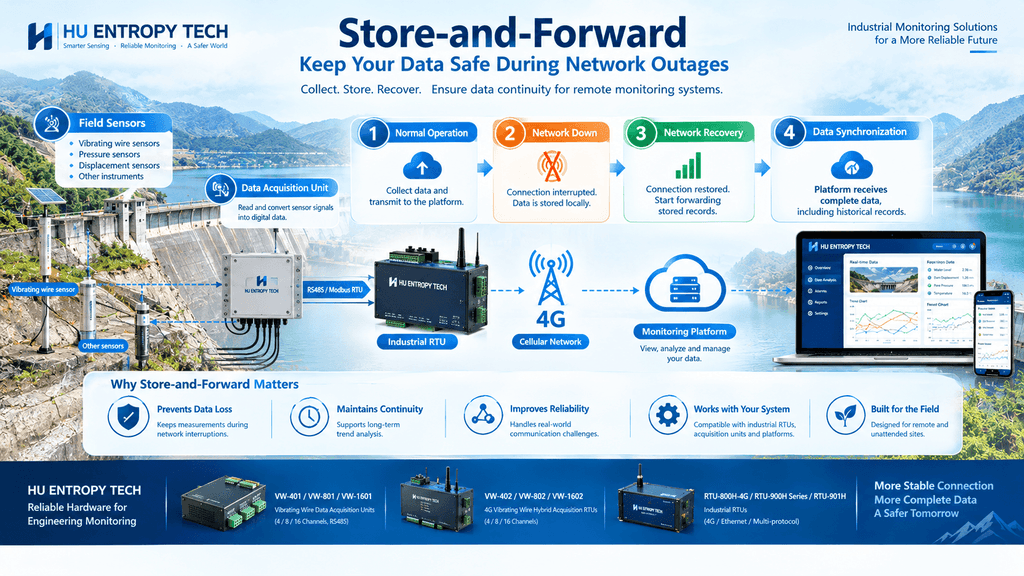
A reliable monitoring system should do more than collect data. It should protect data when communication fails.
In dam safety monitoring, slope stability monitoring, tunnel monitoring, and other remote engineering applications, data continuity is essential.
However, field monitoring equipment often operates in locations where network coverage is unstable. A 4G connection may drop because of terrain, weather, power interruptions, or telecommunications issues. Even a well-designed monitoring system cannot guarantee that its communication network will always remain available.
So, what happens to the data when the network goes down?
If the system depends entirely on real-time transmission, measurements may be lost or become unavailable during the outage. This can create gaps in historical records and make long-term trend analysis more difficult.
One important technology for addressing this challenge is Store-and-Forward.
1. What Is Store-and-Forward?
Store-and-Forward is a data-handling mechanism in which a device stores data locally when the communication link is unavailable and forwards the stored records when communication is restored.
Instead of requiring every measurement to reach the cloud immediately, the system separates data collection from data transmission.
The basic principle is simple:
Collect data → Store locally → Detect network recovery → Forward stored records → Restore data continuity
This approach is particularly valuable for remote monitoring stations, unattended field equipment, and engineering projects where continuous communication cannot be guaranteed.
However, Store-and-Forward is not automatically available on every data logger or RTU. Its actual behavior depends on the device hardware, firmware, storage capacity, and system configuration.
2. What Happens When a Monitoring System Loses Its Network Connection?
Consider a dam monitoring station that collects measurements every 10 minutes.
Under normal conditions, the system sends the measurements to a remote monitoring platform through a 4G connection.
Now imagine that the network becomes unavailable for six hours.
Without appropriate local storage and recovery mechanisms, the platform may receive no new measurements during that period. Depending on the equipment and configuration, some records may be permanently lost.
With a properly configured Store-and-Forward mechanism, the process can work differently:
- Normal operation: The device collects measurements and transmits them to the monitoring platform.
- Network interruption: New measurements continue to be collected, provided the field equipment remains powered and operational.
- Local storage: The device saves the records in its local memory.
- Network recovery: The communication connection becomes available again.
- Data forwarding: The device transmits the stored records according to its recovery logic.
- Platform synchronization: The monitoring platform integrates the recovered records into the historical dataset.
The key benefit is that a temporary communication failure does not necessarily have to become a permanent data gap.
Remember that local storage protects against communication interruptions only when the device is designed and configured to continue collecting and saving data during the outage. It cannot, by itself, protect against every power failure, hardware fault, or sensor malfunction.
3. Why Is Store-and-Forward Important in Engineering Monitoring?
A. Dam Safety Monitoring
Dam monitoring systems may collect data from vibrating wire piezometers, pressure sensors, strain-related instruments, and other monitoring equipment.
These measurements help engineers evaluate changing conditions and identify trends that require further investigation.
If communication interruptions create gaps in the historical record, engineers may have less information available when reviewing changes over time.
Store-and-Forward can help preserve measurements collected during temporary network outages, supporting more complete historical records.
B. Slope Stability Monitoring
Remote slopes and landslide-prone areas may have limited cellular coverage, particularly in mountainous terrain.
Monitoring stations may operate for long periods without on-site maintenance.
Local data storage and automatic recovery can reduce the impact of temporary communication failures and help preserve measurements for subsequent analysis.
C. Tunnel and Underground Engineering
Underground environments can present communication challenges because of their physical structure and changing site conditions.
Where a monitoring architecture uses a communication gateway or RTU with suitable local storage, Store-and-Forward can help maintain the continuity of recorded data during temporary transmission interruptions.
The exact solution depends on the sensors, acquisition equipment, network design, and project requirements.
D. Remote Industrial Monitoring
The same principle applies to water resources, mining, industrial facilities, and other remote assets.
Whenever field equipment must operate with limited access and intermittent connectivity, the ability to collect data independently of immediate network availability becomes an important design consideration.
4. Five Technical Questions to Ask Before Selecting a Device
Store-and-Forward is more than a checkbox on a product specification. Engineers should evaluate how it actually works.
1. How much local storage is available?
Storage requirements depend on the number of measurement channels, sampling interval, record size, and expected outage duration.
For example, a monitoring station that records 16 channels every 10 minutes generates:
16 × 6 × 24 = 2,304 channel readings per day.
Over seven days, that becomes 16,128 channel readings, before accounting for timestamps, metadata, status information, and storage overhead.
This example illustrates why storage capacity should be calculated using the actual data format and retention requirements, rather than simply counting channels.
2. How long can the device continue recording?
Ask whether the equipment can continue collecting and storing measurements during a network outage.
Also verify whether data acquisition operates independently of the communication module and whether the device has sufficient power to keep recording.
Local storage is useful only if the measurement process remains operational.
3. What happens when the network returns?
Different devices may use different recovery mechanisms.
Some may transmit records in batches, while others may use a configurable recovery strategy. Engineers should confirm whether historical records are forwarded automatically, how transmission priorities are handled, and whether a long outage can overwhelm the available bandwidth.
4. How are timestamps and duplicate records handled?
A recovered dataset should preserve the original measurement times.
The monitoring platform should distinguish historical records from newly collected measurements and handle retransmissions appropriately.
Useful questions include:
- Are timestamps generated consistently?
- Can the platform identify duplicate records?
- Are missing records distinguishable from delayed records?
- Can engineers determine when a measurement was taken and when it was received?
These details matter when data is used for engineering analysis and long-term reporting.
5. What happens if the storage capacity is exceeded?
No storage system has unlimited capacity.
If an outage lasts longer than the device’s configured retention period, the system needs a defined policy for handling new and historical records.
Ask whether the device overwrites old data, stops recording, raises an alarm, or follows another documented policy.
The correct behavior depends on the project’s data-retention and risk-management requirements.
5. Store-and-Forward Is Only One Part of System Reliability
A common mistake is to assume that local data storage alone makes a monitoring system reliable.
In reality, several layers must work together:
Field Sensors → Data Acquisition Unit → Industrial RTU or Gateway → 4G/Ethernet Network → Monitoring Platform
Each layer has a different responsibility.
- Sensors: Produce measurements of the physical parameters being monitored.
- Data acquisition units: Read and convert sensor signals into usable measurement records.
- Industrial RTUs or gateways: Handle communication, telemetry, and local data functions supported by the specific model.
- Communication networks: Transport data between the field and the remote platform.
- Monitoring platforms: Store, display, analyze, and manage the received data.
For vibrating wire monitoring, engineers should also verify sensor compatibility, channel capacity, measurement performance, and the communication interface between the acquisition unit and the RTU.
A 4G connection does not automatically provide Store-and-Forward, and a device with local memory does not necessarily support automatic historical data forwarding. These functions must be verified separately.
6. How HU ENTROPY TECH Supports Engineering Monitoring Applications
At HU ENTROPY TECH, we provide vibrating wire data acquisition hardware, industrial RTUs, and OEM/ODM services for engineering monitoring applications.
Our product portfolio includes:
- VW-401 / VW-801 / VW-1601: 4-channel, 8-channel, and 16-channel vibrating wire data acquisition units with RS485 interfaces.
- VW-402 / VW-802 / VW-1602: 4-channel, 8-channel, and 16-channel 4G hybrid acquisition RTUs.
- RTU-800H-4G, RTU-900H, RTU-900H-TFT, and RTU-901H: Industrial RTU options for different remote monitoring and telemetry requirements.
The appropriate model depends on the project architecture, sensor types, communication requirements, power conditions, and integration needs.
For projects requiring Store-and-Forward, engineers should confirm the selected model’s local storage capacity, supported recovery behavior, timestamp handling, and configuration options before deployment.
We also support OEM/ODM cooperation for customers who need hardware tailored to their own monitoring systems and product requirements.
Learn more about our solutions:
7. A Practical Checklist Before Deployment
Before commissioning a remote monitoring station, consider the following:
- Calculate the expected data volume during the longest anticipated network outage.
- Verify that the device can continue collecting and storing measurements when communication is unavailable.
- Confirm the supported storage capacity and retention policy.
- Test automatic data forwarding after network recovery.
- Check timestamps, duplicate handling, and historical data synchronization.
- Verify power autonomy and behavior during power interruptions.
- Confirm that the monitoring platform can identify missing, delayed, or abnormal data.
- Test the complete system under realistic network interruption conditions.
A controlled network-disconnection test before deployment can reveal problems that may otherwise remain unnoticed until the monitoring station is operating in the field.
Conclusion: Design for Network Failure Before It Happens
In engineering monitoring, reliable data collection and reliable data transmission are two different challenges.
A system may measure correctly in the field while temporarily losing its connection to the monitoring platform. Without an appropriate recovery mechanism, those interruptions can compromise the completeness of historical records.
Store-and-Forward helps address this problem by allowing supported equipment to preserve locally collected data and forward it when communication returns.
But effective implementation requires more than local memory. Storage capacity, power autonomy, timestamp integrity, retransmission behavior, and platform synchronization must all be considered.
The goal is not simply to keep a device connected all the time. It is to build a monitoring system that can recover intelligently when the connection fails.
Question for monitoring engineers:
When selecting a remote data acquisition unit or industrial RTU, which factor matters most to your project: local storage capacity, automatic data recovery, communication reliability, or power autonomy?
I’d be interested to hear how you handle network interruptions in real-world monitoring projects.
#EngineeringMonitoring #IndustrialIoT #StoreAndForward #DataAcquisition #IndustrialRTU #DamSafety #StructuralHealthMonitoring #VibratingWire #RemoteMonitoring #HuEntropyTech
