
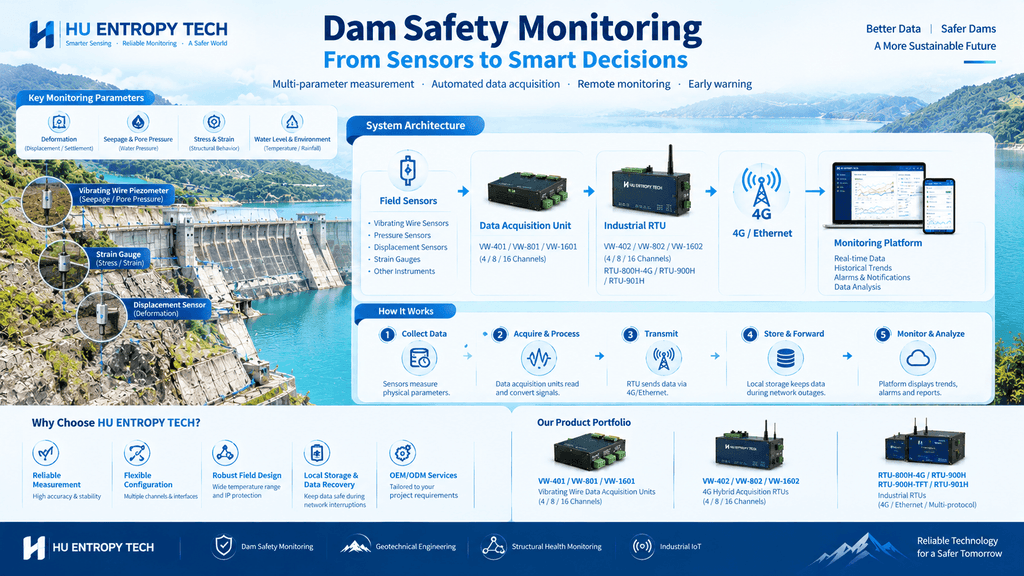
Dam safety monitoring is not simply about collecting sensor readings. It is about understanding how a dam behaves, identifying changes over time, and providing reliable data for engineering assessment and risk management.
Dams are exposed to changing water levels, hydraulic pressure, temperature variations, foundation conditions, and long-term material behavior. Even when a dam appears stable, engineers need reliable monitoring data to evaluate its condition and identify unusual trends.
This is why modern dam safety monitoring systems combine multiple measurement technologies, data acquisition equipment, communication networks, and monitoring software.
In this article, we will explore the key monitoring parameters, the role of vibrating wire sensors, how automated data acquisition works, and what engineers should consider when designing a reliable remote monitoring system.
1. What Does Dam Safety Monitoring Need to Measure?
A dam monitoring system should be designed around the dam’s structure, geological conditions, potential failure mechanisms, and applicable engineering requirements.
Different parameters reveal different aspects of dam behavior.
A. Deformation Monitoring
Deformation monitoring helps engineers understand whether a dam or its surrounding structures are moving or changing shape.
Depending on the dam type and monitoring objectives, measurements may include:
- Horizontal and vertical displacement
- Settlement
- Relative movement at joints
- Tilt or inclination
- Surface displacement and deformation trends
Different instruments may be used, including surveying instruments, GNSS equipment, displacement sensors, and inclinometers.
The choice depends on the required measurement range, accuracy, monitoring frequency, installation conditions, and engineering design.
Deformation data becomes particularly useful when measurements are evaluated over time and compared with water levels, temperature, and other relevant operating conditions.
B. Seepage and Pore-Water Pressure Monitoring
Seepage-related monitoring is another important part of dam safety assessment.
Engineers may monitor pore-water pressure, uplift pressure, seepage flow, and related parameters to understand hydraulic conditions within the dam body, foundation, and surrounding geological formations.
Common instruments include vibrating wire piezometers and other pressure-measuring devices selected for the application.
Changes in pore-water pressure can provide useful information about hydraulic behavior. However, an individual reading should not be interpreted in isolation. Engineers need to consider instrument location, baseline conditions, water levels, seasonal variations, and the overall monitoring plan.
Reliable long-term measurements help engineers identify trends that may require further investigation.
C. Stress, Strain, and Structural Behavior
Depending on the dam type and design, engineers may also monitor stress-related or strain-related parameters, joint behavior, temperature, and other structural indicators.
Vibrating wire instruments are commonly used in geotechnical and civil engineering applications because their measurement principle is suitable for a range of embedded and installed instruments.
The actual sensor type must be selected according to the physical parameter being measured and the project’s technical specifications.
D. Water Level and Environmental Parameters
Reservoir water level, temperature, rainfall, and other environmental parameters can help engineers interpret changes in monitoring data.
For example, a measured change may be associated with a change in reservoir level, temperature, or another operating condition rather than an immediate structural problem.
Monitoring multiple parameters together can therefore provide a more useful engineering picture than examining a single measurement independently.
2. What Is the Role of Vibrating Wire Sensors?
Vibrating wire sensors are widely used in geotechnical and civil engineering monitoring.
A typical vibrating wire sensor contains a tensioned wire. When the sensor responds to a physical change, the tension in the wire changes, which affects its natural vibration frequency.
The measuring electronics excite the wire and detect its vibration signal. The measured frequency can then be processed according to the sensor’s calibration relationship to derive the relevant engineering measurement.
A simplified measurement process is:
Physical Change → Sensor Response → Wire Vibration Frequency → Electronic Measurement → Engineering Data
Depending on the sensor design, vibrating wire technology can be used in instruments such as:
- Piezometers for pore-water pressure monitoring
- Strain gauges for strain-related measurements
- Load cells for force or load measurement
- Displacement transducers for movement measurement
- Other compatible vibrating wire instruments
It is important to distinguish the sensor from the acquisition equipment.
The sensor measures the physical parameter. A compatible vibrating wire data acquisition unit reads the sensor’s signal and converts it into usable measurement data.
The acquisition unit must be compatible with the sensor type and its electrical and measurement requirements.
For dam monitoring projects, engineers should verify sensor compatibility, measurement performance, channel capacity, cable requirements, environmental conditions, and the applicable calibration data before selecting the acquisition hardware.
3. Why Is Automated Data Acquisition Important?
Manual measurement may be suitable for some inspection activities, but it can become inefficient when a project has many monitoring points or requires frequent measurements over long periods.
Automated data acquisition helps reduce dependence on manual visits and supports more consistent data collection.
A typical automated monitoring process includes:
- Field sensors measure the required physical parameters.
- Data acquisition equipment reads the sensor signals.
- Measurements are recorded with relevant timestamps and identification information.
- Data is transmitted to a local system or remote monitoring platform, depending on the architecture.
- Engineers review historical trends, compare parameters, and investigate unusual changes.
The benefits may include more frequent measurements, improved access to historical records, reduced routine site visits, and easier integration with remote monitoring software.
However, automation does not eliminate the need for inspection, calibration, maintenance, or engineering interpretation.
The quality of the monitoring results still depends on appropriate instrument selection, installation, configuration, and data validation.
4. How Do Data Acquisition Units and Industrial RTUs Work Together?
One of the most important design decisions is determining which device performs each function.
A vibrating wire data acquisition unit and an industrial RTU may serve different but complementary roles.
Vibrating Wire Data Acquisition Unit
A dedicated vibrating wire acquisition unit is designed to read compatible vibrating wire instruments.
Depending on the model, it may support multiple measurement channels and provide a communication interface for integration with another device or monitoring system.
Industrial RTU
An Industrial RTU, or Remote Terminal Unit, is commonly used for remote telemetry and communication with field equipment.
Depending on its design, it may collect data from connected devices, transmit information through a supported network, perform local processing, and support remote monitoring functions.
An RTU does not necessarily replace a dedicated vibrating wire acquisition unit. Whether direct sensor measurement is possible depends on the specific hardware.
A simplified dam monitoring architecture may look like this:
Vibrating Wire Sensors → Vibrating Wire Data Acquisition Unit → Industrial RTU or Gateway → 4G/Ethernet → Monitoring Platform
In other applications, an integrated acquisition RTU may combine vibrating wire measurement and remote communication in one device.
The best architecture depends on the sensor configuration, number of channels, communication requirements, installation conditions, and overall project design.
5. Why Are 4G and Remote Monitoring Useful for Dam Safety?
Dam monitoring stations may be distributed across large sites, mountainous regions, reservoirs, and locations where a permanent wired network is impractical.
A 4G-enabled monitoring device can transmit data to a remote platform where engineers can access measurements without visiting every field station.
Depending on the system design, remote monitoring may support:
- Access to recent measurements
- Historical trend analysis
- Remote equipment status checks
- Configurable data reporting
- Integration with alarms and notifications
- Centralized monitoring of multiple stations
The exact capabilities depend on the acquisition equipment, RTU, communication service, and software platform.
For example, a project may configure a remote station to collect measurements at defined intervals and transmit the records through a 4G connection.
Sampling intervals and transmission intervals do not have to be identical. The system design should consider measurement requirements, network availability, power consumption, and the response time needed for the application.
Remote access improves operational convenience, but it does not replace the need for a clear monitoring plan and engineering procedures for evaluating abnormal conditions.
6. What Happens When the Network Goes Down?
A monitoring system may collect measurements correctly even when its connection to the remote platform is temporarily unavailable.
However, if the device cannot retain data locally, a communication interruption may result in missing historical records.
For applications requiring greater data continuity, engineers should evaluate whether the selected acquisition unit or RTU supports local storage and Store-and-Forward.
A typical recovery sequence is:
Normal Communication → Network Interruption → Local Data Storage → Network Recovery → Historical Data Forwarding → Platform Synchronization
Before deployment, confirm:
- Whether data collection continues during a network outage
- Whether local storage is available
- How much data can be retained
- Whether original measurement timestamps are preserved
- Whether stored records can be forwarded automatically
- How duplicate records and storage limits are handled
Store-and-Forward behavior varies by model and configuration. Local storage alone does not guarantee automatic retransmission.
Power supply is another critical factor. If a remote station loses power, its ability to continue measuring and storing data depends on the equipment design and available backup power.
A reliable system should therefore consider communication recovery, storage capacity, power autonomy, and data integrity together.
7. Can Edge Computing Improve Dam Monitoring?
Traditional monitoring systems often transmit measurements to a central platform for processing and analysis.
Edge computing allows selected processing tasks to be performed closer to the field equipment, where supported by the device.
Depending on the application, local processing may include:
- Checking measurements against configured thresholds
- Evaluating simple rules or operating conditions
- Detecting communication or equipment status changes
- Prioritizing selected data for transmission
- Supporting local responses to defined events
For example, a monitoring station may be configured to report a measurement that exceeds a predefined threshold more urgently than routine measurements.
The threshold and response logic must be established by the responsible engineering team. A device should not be assumed to determine dam safety automatically merely because it supports edge processing.
Edge computing can help reduce unnecessary communication and improve response workflows, but its value depends on the application logic, device capabilities, and monitoring procedures.
8. How Should Engineers Design a Reliable Dam Monitoring System?
A reliable system starts with the monitoring objectives rather than a list of available products.
Step 1: Define the Monitoring Parameters
Determine which parameters must be measured, where the instruments will be installed, and what measurement performance the project requires.
Step 2: Select Compatible Sensors
Choose instruments according to the physical parameters, environmental conditions, installation methods, measurement range, and project specifications.
Step 3: Select Suitable Acquisition Equipment
Confirm that the acquisition unit supports the required sensor types, number of channels, measurement performance, and communication interfaces.
Step 4: Define the Communication Architecture
Determine whether the project needs RS485, Modbus, 4G, Ethernet, or another supported interface or communication method.
Step 5: Evaluate Data Continuity
Assess local storage, Store-and-Forward, timestamps, power autonomy, and the system’s response to network interruptions.
Step 6: Integrate with the Monitoring Platform
Confirm data formats, register maps, communication protocols, timestamps, and the platform’s requirements for historical records and alarms.
Step 7: Test the Complete System
Before commissioning, verify the complete measurement and communication chain under realistic conditions.
Testing should cover sensor readings, data transmission, historical record handling, power behavior, alarm configuration, and recovery from communication interruptions where applicable.
A system-level test is important because a device that performs well in isolation may still encounter integration problems when connected to other equipment.
9. HU ENTROPY TECH Solutions for Dam Safety Monitoring
At HU ENTROPY TECH, we provide vibrating wire data acquisition hardware, industrial RTUs, and OEM/ODM services for engineering monitoring applications.
Our current product portfolio includes several options for different system architectures.
Vibrating Wire Data Acquisition Units
- VW-401: 4-channel RS485 vibrating wire data acquisition unit
- VW-801: 8-channel RS485 vibrating wire data acquisition unit
- VW-1601: 16-channel RS485 vibrating wire data acquisition unit
These models are designed for applications requiring compatible vibrating wire measurement and an RS485 interface.
4G Hybrid Acquisition RTUs
- VW-402: 4-channel 4G hybrid acquisition RTU
- VW-802: 8-channel 4G hybrid acquisition RTU
- VW-1602: 16-channel 4G hybrid acquisition RTU
These models combine vibrating wire acquisition with 4G-oriented remote monitoring functionality, subject to the specific model’s supported features and configuration.
Industrial RTUs
Our industrial RTU portfolio also includes:
- RTU-800H-4G
- RTU-900H
- RTU-900H-TFT
- RTU-901H
The appropriate product depends on the required interfaces, data acquisition arrangement, communication method, local processing needs, and integration architecture.
For a dam safety project, the first step is to identify the instruments and monitoring parameters. The next step is to determine how the data should be acquired, transmitted, stored, and integrated into the customer’s monitoring platform.
We also support OEM/ODM cooperation for customers who need hardware adapted to their own monitoring products or system requirements.
Learn more about HU ENTROPY TECH:
Conclusion: Dam Safety Monitoring Requires More Than Sensors
Effective dam safety monitoring combines appropriate instruments, reliable data acquisition, suitable communication infrastructure, and a well-designed process for reviewing and interpreting measurements.
Deformation monitoring helps engineers understand structural movement. Seepage and pore-water pressure monitoring provide information about hydraulic conditions. Vibrating wire instruments support a range of geotechnical measurements, while automated acquisition and remote telemetry make long-term data collection more practical.
At the same time, reliable operation depends on details that are sometimes overlooked: sensor compatibility, power supply, data storage, communication recovery, and integration with the monitoring platform.
No single device can replace a properly designed monitoring system or the engineering judgment required to assess dam safety.
The objective is to build a system that provides reliable, traceable data and supports timely engineering decisions throughout the dam’s service life.
Question for dam safety engineers and monitoring system integrators:
When designing an automated dam monitoring system, which challenge requires the most attention in your experience: sensor selection, data acquisition, communication reliability, power autonomy, or data interpretation?
I’d welcome your perspective.
#DamSafety #DamMonitoring #VibratingWire #DataAcquisition #IndustrialRTU #StructuralHealthMonitoring #GeotechnicalEngineering #RemoteMonitoring #IndustrialIoT #HuEntropyTech
