
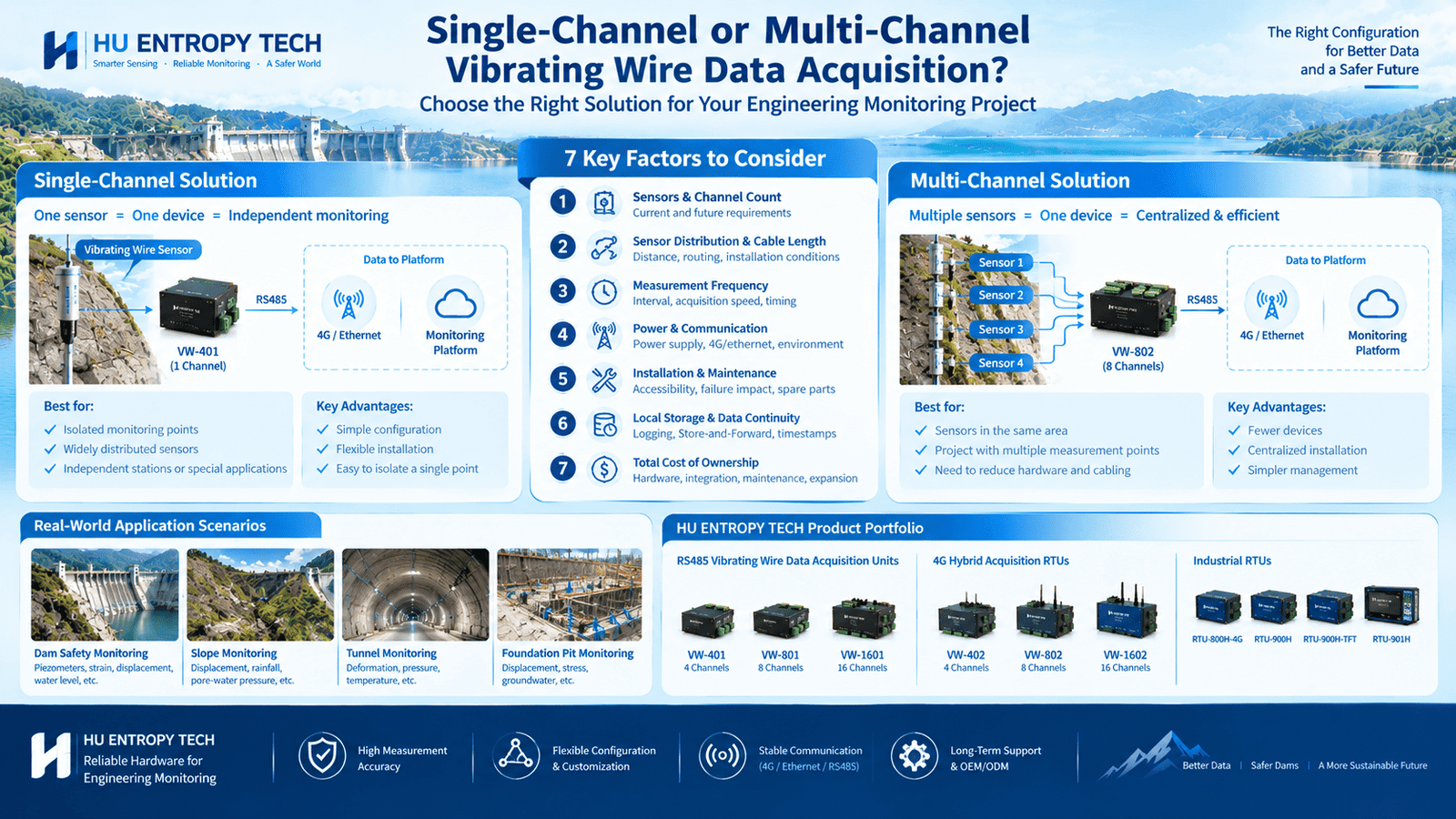
Should you use one vibrating wire data logger per sensor, or choose a multi-channel unit to monitor several sensors from a single device?
This is a common question when designing monitoring systems for dams, slopes, tunnels, foundation pits, bridges, and other civil engineering projects.
At first glance, the decision seems straightforward: a single-channel device measures one sensor, while a multi-channel device measures several. But in practice, the best choice depends on more than the number of sensors.
Engineers must also consider measurement frequency, sensor distribution, cable routing, power supply, communication requirements, maintenance access, future expansion, and total project cost.
In this article, we will compare single-channel and multi-channel vibrating wire data acquisition solutions and explain how to select a configuration that fits your engineering project.
1. What Is the Difference Between Single-Channel and Multi-Channel Data Acquisition?
A vibrating wire data acquisition unit reads signals from compatible vibrating wire sensors and converts them into measurement data for recording, transmission, or further analysis.
The main difference between single-channel and multi-channel equipment is the number of measurement channels supported by one device.
Single-Channel Data Acquisition
A single-channel device is designed to measure one compatible sensor at a time.
A simplified architecture is:
One Sensor → One Acquisition Channel → Data Recording or Transmission
This configuration may be suitable for an isolated monitoring point, a simple measurement task, or an application where sensors are located far apart and each point requires independent equipment.
Potential advantages include:
- A straightforward measurement configuration
- Independent installation at individual monitoring points
- Flexibility when sensors are widely distributed
- Easier isolation of a particular measurement point in some system designs
However, using one device per sensor can increase the number of hardware units, power connections, enclosures, communication links, and maintenance points across a larger project.
Multi-Channel Data Acquisition
A multi-channel unit supports several compatible measurement channels within one device.
For example, a four-channel unit can support up to four compatible sensor measurement channels, subject to the model’s specifications and configuration.
A simplified architecture is:
Multiple Sensors → Multi-Channel Data Acquisition Unit → Data Recording or Transmission
Potential advantages include:
- Fewer acquisition devices for grouped sensors
- More centralized installation
- Reduced duplication of some hardware and communication infrastructure
- Easier management of nearby measurement points
- A more straightforward path for expanding a monitoring station within available channel capacity
However, a multi-channel device is not automatically the best choice. If sensors are distributed across a large site, grouping them may require longer cables, more complicated routing, or additional protection measures.
The key is to match the channel configuration to the physical layout and operating requirements of the monitoring project.
2. When Is a Single-Channel Solution More Suitable?
Single-channel acquisition can be a practical choice in several scenarios.
Scenario A: An Isolated Monitoring Point
Suppose a project requires monitoring one vibrating wire instrument at a remote location.
Installing a large multi-channel unit with several unused channels may not be economical if there are no plans to add nearby sensors.
A dedicated single-channel device may offer a simpler solution, provided its measurement performance, environmental protection, power supply, and communication capabilities meet the requirements.
Scenario B: Sensors Are Widely Distributed
Consider a large slope monitoring project with sensors installed at different elevations and separated by substantial distances.
Placing all sensors on a centralized multi-channel unit may require extensive cable routing.
Depending on the site layout, separate acquisition devices installed closer to the sensors may reduce cable complexity and make installation more practical.
The decision should account for cable specifications, electrical noise, sensor requirements, installation costs, and maintenance access.
Scenario C: Independent Monitoring Stations
Some projects require individual stations to operate independently.
For example, different monitoring points may have separate power supplies, communication links, or maintenance schedules.
A single-channel configuration can support this architecture when independent operation is more important than centralized hardware.
Scenario D: Specialized or Low-Volume Applications
A single-channel device may also be useful for equipment testing, specific measurement tasks, or projects with only a small number of monitoring points.
In these cases, the most important consideration is whether the device meets the required technical specifications without introducing unnecessary system complexity.
Important: A single-channel configuration is not inherently more accurate or reliable than a multi-channel configuration. Actual performance depends on the specific device design, measurement circuitry, installation, and operating conditions.
3. When Is a Multi-Channel Solution More Suitable?
Multi-channel acquisition is often attractive when multiple sensors are installed within the same monitoring area.
Scenario A: Dam Safety Monitoring
A dam monitoring project may include multiple vibrating wire piezometers, strain-related instruments, or other compatible vibrating wire sensors.
When several measurement points are located near the same acquisition station, a multi-channel unit can help consolidate data collection.
Instead of installing separate acquisition hardware at every point, engineers can group compatible sensors according to the site layout and channel requirements.
This may reduce duplicated equipment and simplify the overall architecture.
Scenario B: Foundation Pit Monitoring
A foundation pit may contain numerous monitoring points distributed along retaining structures and within surrounding ground.
If several compatible vibrating wire instruments are installed near the same collection point, a multi-channel acquisition unit can provide a convenient way to manage their measurements.
The number of channels should be selected according to the actual instrument layout, not simply the total number of sensors on the construction site.
Scenario C: Tunnel Monitoring
Tunnel projects may involve multiple monitoring locations along a tunnel section or across adjacent structural elements.
Where compatible sensors are grouped within reasonable cable distances, multi-channel acquisition can help consolidate field equipment and communication arrangements.
For long tunnels, however, a distributed architecture with multiple acquisition stations may be more practical than one centralized device serving every measurement point.
Scenario D: Bridges and Structural Health Monitoring
Bridge monitoring systems can involve numerous sensors distributed across different structural elements.
Multi-channel vibrating wire acquisition is useful where compatible instruments are grouped within a common monitoring station.
For a large bridge, engineers may still need multiple acquisition units distributed across the structure to balance cable lengths, channel capacity, and maintenance requirements.
The most suitable solution is often a combination of several acquisition stations rather than a single device for the entire project.
4. Seven Factors Engineers Should Evaluate Before Choosing
Sensor count is only the starting point. The following factors can have a significant impact on the final selection.
1. Number of Sensors and Required Channels
First, determine how many compatible vibrating wire sensors need to be measured at each acquisition location.
Then consider future expansion.
For example, if a station currently requires six channels, an eight-channel unit may provide room for additional sensors, provided the other requirements are satisfied.
However, buying a device with significantly more channels than the project needs may not be economical if those channels are unlikely to be used.
2. Sensor Distribution and Cable Length
A project may have many sensors but no convenient way to group them into a single acquisition station.
Engineers should consider:
- Distance between sensors
- Cable routing and protection
- Installation accessibility
- Electrical interference
- Sensor-specific cable and interface requirements
A multi-channel unit can reduce hardware duplication, but the savings may be offset by longer or more complex cabling.
3. Measurement Frequency and Timing
How often must each sensor be measured?
Some applications require periodic readings at relatively long intervals. Others require more frequent acquisition because of project-specific monitoring requirements.
Before choosing a device, confirm its supported measurement interval, acquisition speed, and channel-handling behavior.
Do not assume that a multi-channel unit measures every channel simultaneously. Depending on the device design, channels may be measured sequentially or handled through another acquisition method.
If measurements must be completed within a particular time window, verify that the selected model can meet that requirement under the intended configuration.
4. Power Supply and Communication
A single-channel device installed at a remote location may need its own power and communication arrangements.
A multi-channel unit may consolidate some of these requirements when several sensors are connected at one station.
But the result depends on the system architecture.
For example, a remote station may use an RS485 acquisition unit connected to a separate industrial RTU, or it may use an integrated 4G acquisition RTU.
Engineers should consider the complete arrangement, including power consumption, communication coverage, transmission intervals, and backup power requirements.
5. Installation and Maintenance
Every additional field device introduces another potential maintenance point.
A distributed single-channel architecture may require technicians to inspect and maintain many individual devices.
A centralized multi-channel architecture may reduce the number of devices, but a failure affecting one unit could interrupt measurements from several connected sensors.
This is an important trade-off.
Engineers should evaluate the consequences of device failure, access conditions, spare-part strategy, and the time required to diagnose and replace equipment.
6. Local Storage and Data Continuity
For remote monitoring, determine where measurement records are stored and how they are transmitted.
Depending on the architecture, data may be stored in the acquisition unit, an industrial RTU, a gateway, or another component.
If network outages are a concern, verify whether the selected equipment supports local data logging and Store-and-Forward.
Also confirm storage capacity, retention behavior, timestamp handling, and automatic retransmission where required.
These functions vary by model and configuration. A multi-channel device should not automatically be assumed to have more storage or better recovery capability than a single-channel device.
7. Total Cost of Ownership
The initial equipment price is only one part of the cost.
A useful comparison should include:
- Acquisition hardware
- Enclosures and installation accessories
- Cable and routing costs
- Power supply and backup power
- Communication equipment and service
- Installation and commissioning
- Maintenance and replacement
- Future expansion
For small, widely distributed installations, several independent acquisition devices may be practical.
For larger installations with grouped sensors, multi-channel equipment may reduce duplicated hardware and simplify maintenance.
The most economical option is the one that meets the engineering requirements at the lowest reasonable total cost—not necessarily the one with the lowest purchase price.
5. A Practical Example: Choosing Channels for a Monitoring Station
Imagine an engineering monitoring station with six compatible vibrating wire sensors.
There are two possible approaches.
Option A: Six single-channel devices
Each sensor has its own acquisition device.
Potential benefits:
- Independent device configuration
- Flexibility in physically distributing the equipment
- Isolation of some device-level failures
Potential disadvantages:
- More hardware units
- More individual power and communication connections
- Potentially higher installation and maintenance effort
Option B: One multi-channel device with sufficient capacity
The six sensors are connected to a suitable multi-channel acquisition arrangement.
Potential benefits:
- Fewer acquisition devices
- More centralized installation
- Potentially simpler power and communication infrastructure
Potential disadvantages:
- Sensor cables must be routed to the selected acquisition location
- A device-level failure may affect several channels
- The acquisition unit must support the required measurement schedule and interfaces
In this example, an eight-channel unit may be a candidate because it has sufficient nominal channel capacity for six sensors and may leave room for expansion.
However, the final choice still depends on sensor compatibility, cable distances, acquisition timing, power supply, and reliability requirements.
This illustrates a general principle: channel capacity should be selected together with the physical and operational design of the monitoring station.
6. How to Calculate the Required Number of Acquisition Units
A simple starting point is:
Required number of units = Number of sensors ÷ Channels per unit, rounded up to the next whole number
For example, if a project has 20 compatible vibrating wire sensors and each acquisition unit supports eight channels:
20 ÷ 8 = 2.5
The minimum theoretical requirement is therefore three eight-channel units, assuming every sensor can be connected to the selected units and all other technical requirements are met.
However, this calculation only establishes nominal channel capacity.
The final design may require more units because of:
- Physical separation between sensors
- Cable-length or installation constraints
- Different sensor types or configurations
- Required acquisition timing
- Power or communication limitations
- Redundancy and maintenance requirements
- Planned expansion or independent monitoring zones
For large projects, it is usually better to divide the site into practical monitoring stations first and then calculate the required channel capacity for each station.
This produces a more realistic design than simply dividing the total sensor count by the largest available channel number.
7. HU ENTROPY TECH: Choosing Between 4-, 8-, and 16-Channel Solutions
At HU ENTROPY TECH, we provide vibrating wire data acquisition hardware, industrial RTUs, and OEM/ODM services for engineering monitoring applications.
Our current portfolio includes several channel configurations for different system architectures.
RS485 Vibrating Wire Data Acquisition Units
<text weight=”medium”>VW-401 — 4 channels</text>
Suitable for monitoring stations with a relatively small group of compatible vibrating wire sensors.
<text weight=”medium”>VW-801 — 8 channels</text>
A potential option for stations requiring more channels while maintaining a centralized acquisition arrangement.
<text weight=”medium”>VW-1601 — 16 channels</text>
Designed for applications requiring a higher channel count within one RS485 acquisition unit.
4G Hybrid Acquisition RTUs
<text weight=”medium”>VW-402 — 4 channels</text>
<text weight=”medium”>VW-802 — 8 channels</text>
<text weight=”medium”>VW-1602 — 16 channels</text>
These models combine vibrating wire acquisition with 4G-oriented remote monitoring functionality. The specific interfaces and capabilities should be confirmed against the selected model’s documentation.
The choice between an RS485 acquisition unit and a 4G hybrid acquisition RTU depends on the overall monitoring architecture.
For example, an RS485 unit may be suitable when a separate RTU or gateway already manages remote communication. A 4G hybrid acquisition RTU may be worth evaluating when the project requires an integrated acquisition and cellular telemetry arrangement.
Neither approach is universally better. The appropriate solution depends on the site layout, sensor count, communication infrastructure, power conditions, and integration requirements.
We also support OEM/ODM cooperation for customers who require hardware configurations suited to their own monitoring products or projects.
Learn more about our products:
Conclusion: Choose the Architecture Before Choosing the Channel Count
Single-channel and multi-channel vibrating wire data acquisition solutions each have practical applications.
Single-channel equipment may be suitable for isolated sensors, widely distributed monitoring points, or systems requiring independent field devices.
Multi-channel equipment can be attractive when several compatible sensors are grouped within the same monitoring area, helping consolidate hardware and simplify installation.
But channel count alone does not determine system quality.
The best choice depends on sensor distribution, measurement timing, cable routing, power supply, communication architecture, maintenance strategy, and total cost of ownership.
For larger projects, the most effective solution may combine several multi-channel acquisition units distributed across different monitoring stations.
The objective is not to maximize the number of channels in one device. It is to design a monitoring system that collects reliable data efficiently and can be maintained throughout the project’s lifecycle.
Question for engineers and system integrators:
When designing a vibrating wire monitoring system, do you prefer centralized multi-channel acquisition or distributed acquisition devices near individual sensors? What factors have influenced your decision in real projects?
I’d welcome your experience.
#VibratingWire #DataAcquisition #EngineeringMonitoring #DamSafety #GeotechnicalEngineering #StructuralHealthMonitoring #IndustrialRTU #RemoteMonitoring #OEM #ODM #HuEntropyTech
