
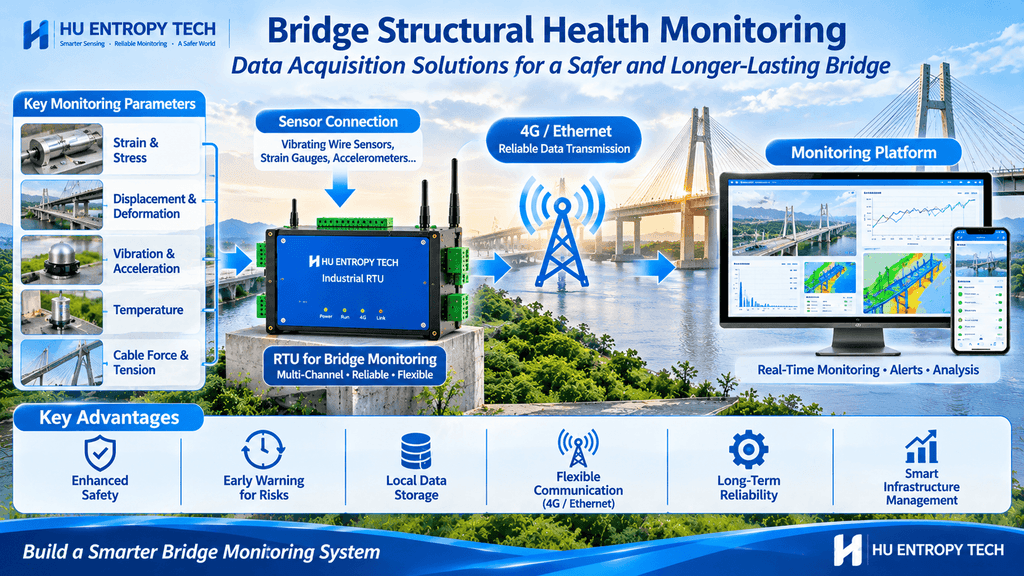
How to Select Sensors, Data Loggers, Industrial RTUs, and Communication Architectures for Reliable Bridge Monitoring
Bridges are critical infrastructure assets.
They are exposed to traffic loads, wind, temperature variations, material aging, environmental conditions, and long-term structural changes. Over time, these factors may affect their structural performance and service life.
For bridge owners, engineering consultants, and infrastructure operators, understanding the condition of a bridge is essential for maintenance planning, risk assessment, and structural safety management.
This is why Bridge Structural Health Monitoring (BSHM) systems are increasingly used in modern infrastructure projects.
However, an effective monitoring system requires more than installing sensors on a bridge.
It needs a well-designed data acquisition architecture that can collect measurements accurately, manage different sensor types, transmit information reliably, and provide useful data for engineering analysis.
So, how should engineers design a data acquisition solution for bridge health monitoring?
1. What Parameters Should a Bridge Monitoring System Measure?
A bridge monitoring system should be designed according to the bridge structure, its operating conditions, potential risks, and monitoring objectives.
Different bridges may require different combinations of sensors.
Common monitoring parameters include:
Structural strain and stress
Strain gauges and vibrating wire strain gauges can be used to monitor changes in structural strain at selected locations.
These measurements help engineers evaluate structural responses under traffic loads, temperature variations, and other operating conditions.
Displacement and deformation
Displacement sensors, inclinometers, and other deformation monitoring instruments can help track changes in structural position and movement.
Vibration and acceleration
Accelerometers and vibration sensors are used to monitor dynamic structural responses caused by traffic, wind, and other excitation sources.
Structural temperature
Temperature sensors help engineers understand thermal effects on bridge components and interpret structural measurement data.
Cable force and tension
For cable-supported bridges, suitable force or tension monitoring instruments may be installed to observe changes in cable conditions.
Environmental and traffic-related parameters
Depending on the project, monitoring may also include wind speed, wind direction, humidity, vehicle loads, and other environmental or operational information.
The monitoring objectives determine the sensor selection, acquisition frequency, and data processing requirements.
2. Different Sensors Require Different Data Acquisition Methods
One of the most important considerations in bridge monitoring is sensor compatibility.
Not all sensors use the same measurement principle or output interface.
A monitoring project may involve several types of instruments:
| Sensor Type | Typical Measurement | Common Acquisition Considerations |
|---|---|---|
| Vibrating wire strain gauge | Structural strain | Frequency-based measurement and sensor calibration |
| Electrical resistance strain gauge | Strain | Signal conditioning and suitable bridge measurement circuits |
| Accelerometer | Acceleration and vibration | Sampling frequency, bandwidth, and dynamic range |
| Displacement sensor | Structural movement | Signal type, measurement range, and resolution |
| Tilt sensor | Angular change | Digital or analog interface and measurement stability |
| Temperature sensor | Temperature | Sensor-specific interface and compensation requirements |
| Load or cable-force sensor | Load or tension | Measurement range, calibration, and signal compatibility |
Some sensors provide analog signals, some communicate digitally, and others require dedicated acquisition electronics.
For example, a vibrating wire sensor cannot simply be connected to an ordinary analog input without a suitable measurement circuit.
Similarly, dynamic acceleration monitoring requires acquisition equipment with an appropriate sampling rate and signal-processing capability.
The first step in designing a bridge monitoring system is to classify the sensors by measurement principle and acquisition requirements.
3. Static Monitoring and Dynamic Monitoring Need Different Architectures
Bridge monitoring generally involves both static and dynamic measurements.
Although they may belong to the same overall monitoring system, their acquisition requirements can be significantly different.
Static monitoring
Static monitoring focuses on relatively slow changes in structural conditions.
Typical applications include:
- Long-term strain monitoring
- Structural deformation monitoring
- Displacement measurement
- Temperature monitoring
- Cable-force trend monitoring
Depending on the sensor type, measurements may be collected at intervals ranging from seconds to minutes or hours.
Vibrating wire acquisition units are suitable for compatible vibrating wire sensors used in long-term engineering monitoring.
Dynamic monitoring
Dynamic monitoring focuses on rapidly changing structural responses.
Typical applications include:
- Bridge vibration analysis
- Traffic-induced structural response
- Modal analysis
- Wind-induced vibration
- Dynamic load response
These applications may require high-speed sampling, synchronized channels, appropriate anti-aliasing filters, and specialized dynamic data acquisition systems.
An ordinary industrial RTU or a low-speed logger should not be assumed to support these requirements.
The practical principle is simple: use acquisition equipment designed for the measurement speed and signal characteristics of each sensor.
4. A Typical Bridge Health Monitoring Data Acquisition Architecture
A complete bridge monitoring system usually contains several functional layers.
A simplified architecture is:
Bridge Sensors → Data Acquisition Units → Industrial RTU / Communication Gateway → Network → Monitoring Platform
Each layer performs a different task.
Layer 1: Field Sensors
Sensors are installed at selected structural locations to measure strain, displacement, vibration, temperature, cable force, and other parameters.
Layer 2: Data Acquisition
Compatible acquisition devices collect signals from the sensors and convert them into digital measurement records.
Different sensor groups may require separate acquisition units.
Layer 3: Industrial RTU or Communication Gateway
The RTU or gateway connects acquisition equipment to the communication network.
Depending on its capabilities, it may also collect additional signals, manage communication, perform basic data processing, and support local data storage.
Layer 4: Communication Network
Data can be transmitted through Ethernet, 4G, or other communication methods selected according to the site conditions.
Layer 5: Monitoring Platform
The platform stores and displays measurement data, generates alarms, supports historical analysis, and provides information for engineering assessment.
The architecture should be designed as one coordinated system rather than a collection of independent devices.
5. Why Multi-Channel Data Acquisition Matters
Bridge monitoring projects may involve many sensors distributed across different structural locations.
For example, engineers may install vibrating wire strain gauges at multiple bridge sections to monitor long-term structural behavior.
If every sensor requires an independent acquisition device, the installation can become more complicated.
Multi-channel acquisition units can help consolidate compatible sensor connections.
For example, HU ENTROPY TECH offers the following vibrating wire acquisition configurations:
- VW-401: 4 channels
- VW-801: 8 channels
- VW-1601: 16 channels
For applications requiring 4G connectivity, the corresponding hybrid acquisition RTU options include:
- VW-402: 4 channels
- VW-802: 8 channels
- VW-1602: 16 channels
These products are designed for compatible vibrating wire sensor measurement applications.
Multi-channel configurations can help engineers:
- Reduce the number of individual acquisition units
- Organize sensor connections by monitoring area
- Simplify field installation
- Improve equipment management
- Expand monitoring capacity through modular deployment
However, channel count is only one selection factor.
Engineers should also consider sensor compatibility, cable length, installation location, measurement interval, power supply, communication requirements, and maintenance accessibility.
6. How Should Engineers Choose Between RS485 and 4G Acquisition Solutions?
Communication architecture is another important part of bridge monitoring system design.
Two common approaches are RS485-based acquisition and integrated 4G acquisition.
RS485-based acquisition
An RS485 acquisition device communicates with a local controller, RTU, or gateway through a wired serial connection.
This approach can be appropriate when:
- Acquisition units are installed within a manageable distance
- A local communication network is available
- The project uses a centralized field controller
- Engineers want to integrate multiple devices into one local network
The communication protocol, such as Modbus RTU, must also be supported and correctly configured.
Integrated 4G acquisition RTU
A 4G-enabled acquisition RTU can collect compatible sensor data and transmit it to a remote monitoring platform through a cellular network.
This approach may be useful when:
- Monitoring points are geographically distributed
- Wired communication infrastructure is difficult to install
- Remote data access is required
- Independent monitoring stations are preferred
The selection depends on bridge layout, cellular coverage, installation conditions, data transmission requirements, and operating costs.
For large bridges, a hybrid architecture combining local wired acquisition networks with remote cellular or Ethernet communication may be more appropriate.
7. Data Reliability Is Essential for Long-Term Bridge Monitoring
A bridge monitoring system may operate for many years.
Its value depends not only on collecting measurements but also on maintaining reliable historical records.
Communication interruptions can occur because of network problems, equipment maintenance, or power failures.
For monitoring points that require continuous records, local data storage and data recovery functions are important.
An acquisition device or RTU with suitable Store-and-Forward capabilities may support the following workflow:
- Collect sensor measurements.
- Store records locally with timestamps.
- Continue recording during temporary communication interruptions, subject to available power and storage.
- Re-establish the network connection.
- Transmit stored records to the monitoring platform.
Engineers should verify the actual storage capacity, retention period, retransmission mechanism, and power backup arrangement.
Other important considerations include:
- Measurement timestamps
- Data consistency
- Device status monitoring
- Communication error handling
- Backup and recovery procedures
- Long-term equipment maintenance
For structural health monitoring, reliable historical data is essential for identifying long-term trends and evaluating changes in structural behavior.
8. Data Integration: Turning Measurements Into Useful Engineering Information
Collecting data from sensors is only the beginning.
A bridge monitoring platform should organize measurements in a way that engineers can understand and use.
Typical platform functions include:
Real-time monitoring dashboards
Display measurements from different bridge sections and monitoring points.
Historical trend analysis
Compare measurement changes over days, months, or years.
Alarm management
Generate alerts when configured thresholds or abnormal conditions are detected.
Geographical and structural visualization
Associate measurement points with their actual positions on the bridge.
Data reporting
Export measurement records for engineering review, maintenance planning, and technical reporting.
Device management
Monitor acquisition equipment, communication status, and field station conditions.
To achieve reliable integration, engineers should define data formats, sensor identifiers, measurement units, timestamps, calibration information, and alarm rules during system design.
Communication protocols may include Modbus RTU, Modbus TCP, MQTT, or HTTP/HTTPS, depending on the equipment and platform architecture.
RS485 is an electrical interface, not a communication protocol. The interface and protocol must both be compatible.
9. A Practical Example: Designing a Bridge Monitoring Acquisition System
Consider a bridge monitoring project that requires long-term monitoring of several structural sections.
The monitoring requirements include:
- Vibrating wire strain measurement
- Structural temperature measurement
- Displacement monitoring
- Remote data access
- Centralized historical data management
A possible system design could be:
Step 1: Install compatible field sensors
Place vibrating wire strain gauges and temperature sensors at selected structural locations. Install suitable displacement instruments where required.
Step 2: Select appropriate acquisition equipment
Use compatible vibrating wire acquisition units for vibrating wire measurements. Select separate acquisition equipment for other sensor types according to their signal requirements.
Step 3: Organize local communication
Connect acquisition units through suitable local interfaces, such as RS485, where supported.
Step 4: Connect the industrial RTU or gateway
Use an appropriately configured RTU or gateway to integrate the field acquisition equipment and manage remote communication.
Step 5: Transmit data to the monitoring platform
Use 4G or Ethernet according to the installation environment and communication requirements.
Step 6: Configure platform functions
Set up monitoring dashboards, historical data storage, alarms, and device status monitoring.
This architecture allows different measurement subsystems to work together while maintaining their individual acquisition requirements.
For bridges requiring high-speed vibration monitoring, a dedicated dynamic acquisition subsystem should be incorporated rather than relying on a conventional low-speed RTU.
10. What Should Engineers Consider When Selecting Bridge Monitoring Equipment?
Before selecting data acquisition equipment, engineers should evaluate the following factors:
1. Sensor compatibility
Does the device support the measurement principle and electrical output of the selected sensor?
2. Measurement performance
Are the required measurement range, resolution, accuracy, and stability supported?
3. Sampling frequency
Can the acquisition equipment meet the requirements for static or dynamic monitoring?
4. Channel capacity
How many sensors need to be connected at each monitoring location?
5. Communication architecture
Is RS485, Ethernet, 4G, or another communication method more suitable?
6. Data storage and recovery
Can the system maintain historical records during network interruptions?
7. Environmental conditions
Can the equipment operate reliably under the temperature, humidity, vibration, and electrical conditions at the installation site?
8. Platform integration
Are the required communication protocols and data formats supported?
9. Long-term maintenance
Are technical documentation, firmware support, spare parts, and replacement arrangements available?
A good acquisition solution should meet both the technical requirements of the sensors and the operational requirements of the complete bridge monitoring system.
11. HU ENTROPY TECH Data Acquisition Solutions for Engineering Monitoring
At HU ENTROPY TECH, we provide vibrating wire data acquisition hardware, industrial RTUs, and OEM/ODM services for engineering monitoring applications.
Our product portfolio includes several options for compatible vibrating wire measurement and remote data acquisition.
Vibrating Wire Data Acquisition Units
- VW-401: 4-channel
- VW-801: 8-channel
- VW-1601: 16-channel
4G Hybrid Vibrating Wire Acquisition RTUs
- VW-402: 4-channel
- VW-802: 8-channel
- VW-1602: 16-channel
Industrial RTUs
- RTU-800H-4G
- RTU-900H
- RTU-900H-TFT
- RTU-901H
These products can be considered for different field acquisition, communication, and monitoring integration requirements.
The specific interfaces, supported protocols, measurement functions, and storage capabilities vary by model.
For projects involving accelerometers, high-speed dynamic acquisition, or other specialized sensor types, the acquisition equipment must be selected according to the relevant technical requirements. Our RTU and vibrating wire product portfolio should not be assumed to replace specialized dynamic data acquisition systems.
We also support OEM/ODM cooperation for international monitoring companies, equipment brands, and system integrators.
Explore our products and services:
Conclusion: A Reliable Bridge Monitoring System Starts With the Right Acquisition Architecture
Bridge structural health monitoring is a long-term engineering process.
It requires compatible sensors, appropriate data acquisition equipment, reliable communication, organized data management, and a monitoring platform that can turn measurements into useful engineering information.
The most effective solution is not necessarily the one with the most sensors or the largest number of channels.
It is the architecture that matches the bridge’s monitoring objectives, sensor characteristics, measurement frequency, installation conditions, and long-term maintenance requirements.
At HU ENTROPY TECH, we believe that reliable engineering monitoring starts with reliable data acquisition.
Smarter Sensing. Reliable Monitoring. A Safer World.
Question for bridge engineers and system integrators:
When designing a bridge health monitoring system, which challenge is most important in your projects: sensor integration, multi-channel acquisition, dynamic data monitoring, remote communication, or long-term data reliability?
#BridgeMonitoring #StructuralHealthMonitoring #DataAcquisition #VibratingWire #IndustrialRTU #InfrastructureMonitoring #StructuralEngineering #IndustrialIoT #EngineeringMonitoring
