
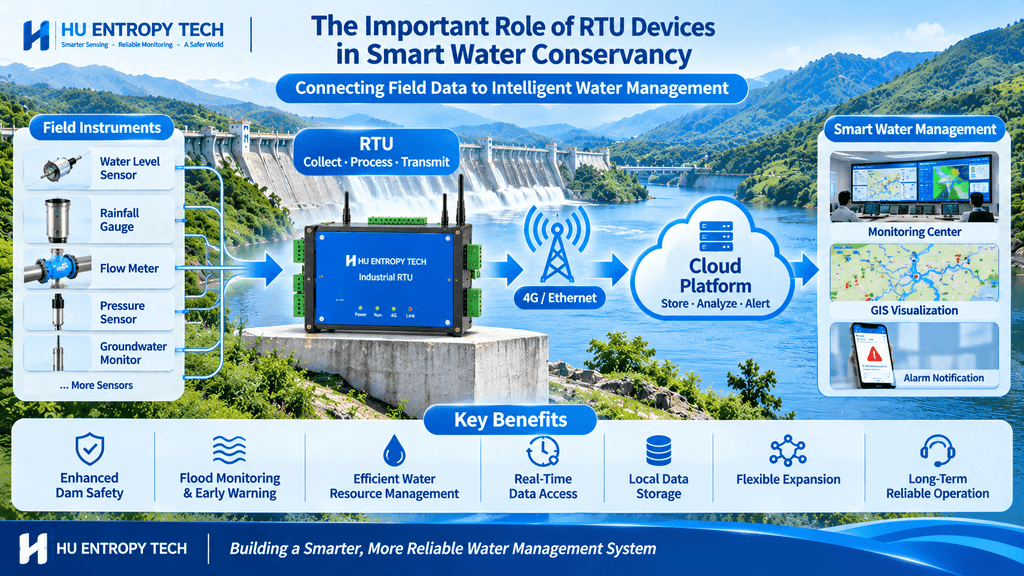
Connecting Field Sensors, Remote Monitoring Stations, and Intelligent Water Management Platforms
Water management is becoming increasingly data-driven.
Across the world, water authorities, engineering companies, and infrastructure operators are investing in digital technologies to improve the monitoring, management, and protection of water resources.
From large dams and reservoirs to rivers, irrigation systems, flood control facilities, and groundwater monitoring networks, modern water infrastructure requires more than traditional instruments and periodic manual inspections.
It needs continuous access to reliable field data, efficient communication, and centralized information management.
This is where Remote Terminal Units (RTUs) play an important role.
An RTU connects field instruments to digital monitoring systems. It collects data, manages communication, and helps transfer information from remote monitoring stations to central platforms.
But what exactly does an RTU contribute to smart water conservancy development?
1. Building the Foundation of Digital Water Monitoring
A smart water conservancy system relies on data from many geographically distributed locations.
A typical water management project may need to monitor:
- Reservoir water levels
- River water levels and flow conditions
- Rainfall and precipitation
- Dam deformation and seepage
- Groundwater levels
- Water pressure and temperature
- Irrigation channels and water distribution facilities
- Pumping stations and hydraulic equipment
These measurements provide the information required for operational management, engineering safety assessment, and water resource planning.
However, field sensors cannot independently create a complete digital monitoring system.
Their measurement data must be collected, organized, transmitted, and made available to the relevant monitoring applications.
An RTU serves as an important field-level connection point between instruments and the digital platform.
2. Connecting Different Sensors and Field Instruments
Water conservancy projects often involve instruments from different manufacturers and with different electrical interfaces.
For example, a monitoring station may contain:
- Water level sensors
- Rain gauges
- Flow meters
- Pressure transmitters
- Temperature sensors
- Displacement instruments
- Vibrating wire piezometers
- Strain gauges
Depending on the instrument, data may be provided through RS485, RS232, analog 4–20 mA, pulse signals, digital inputs, or other interfaces.
An appropriately configured industrial RTU can integrate compatible instruments into a common acquisition architecture.
This reduces the complexity of managing separate communication devices for every field instrument.
For engineering monitoring applications involving vibrating wire sensors, dedicated vibrating wire data acquisition units can be used to measure the sensor signals. Their measurement data can then be integrated into a broader RTU and IoT architecture, depending on the interfaces and system design.
The key is to select compatible acquisition hardware based on the actual sensor specifications.
3. Enabling Remote Communication Across Large Water Management Areas
Water infrastructure is often spread across large geographical regions.
A reservoir, river basin, or irrigation network may contain dozens or hundreds of monitoring stations.
Connecting every station to a central control room through dedicated cables can involve substantial installation and maintenance work.
Industrial RTUs with suitable communication options can help simplify this architecture.
Depending on the model and site conditions, communication methods may include:
- 4G cellular networks
- Ethernet
- RS485
- RS232
- LoRa or other wireless technologies
For example, a 4G RTU can collect data from local instruments and transmit it to a remote monitoring platform through an available cellular network.
A typical architecture is:
Field Sensors → Data Acquisition / Industrial RTU → 4G or Ethernet → Cloud Platform → Water Management Center
This allows remote monitoring stations to become part of a connected water management network.
For locations without reliable cellular coverage, alternative communication solutions may be required.
4. Supporting Flood Monitoring and Early Warning Systems
Flood monitoring is one of the most important applications of smart water conservancy.
Heavy rainfall, rising river levels, and rapidly changing water conditions may require timely monitoring and communication.
An RTU can collect data from connected rainfall gauges, water level sensors, and other field instruments.
The data can then be transmitted to a monitoring platform, where configured rules and analytical functions can help identify abnormal conditions.
A typical monitoring workflow includes:
- Sensors measure rainfall and water levels.
- The RTU collects measurement data.
- Data is transmitted to the monitoring platform.
- The platform compares measurements with configured thresholds.
- Alerts are generated when predefined conditions are met.
- Responsible personnel receive notifications and assess the situation.
The RTU provides the field data connection. The monitoring platform generally handles centralized visualization, alarm rules, historical analysis, and user notifications.
It is important to distinguish monitoring and warning functions from automatic flood control. Automated gate operation, pump control, and other critical actions require dedicated control logic, safety interlocks, and appropriate system engineering.
5. Improving Dam Safety and Structural Monitoring
Dam safety monitoring is another important part of smart water conservancy.
A dam may require long-term monitoring of deformation, seepage, pore-water pressure, stress, strain, and other engineering parameters.
Many of these measurements rely on specialized sensors, including vibrating wire instruments.
For example:
- Piezometers can monitor pore-water pressure.
- Strain gauges can measure structural strain.
- Displacement instruments can monitor movement.
- Temperature sensors can provide environmental and structural temperature data.
Vibrating wire sensors require compatible acquisition equipment to measure their signals accurately.
HU ENTROPY TECH provides vibrating wire data acquisition units in different channel configurations, including 4-channel, 8-channel, and 16-channel options.
The collected measurements can be integrated into a larger monitoring architecture through suitable communication and gateway arrangements.
When combined with an industrial RTU and a monitoring platform, these devices can help connect individual engineering measurements to a centralized dam safety monitoring system.
6. Supporting Local Data Storage and Data Recovery
Remote water monitoring stations may experience temporary communication interruptions.
Cellular signals can be unstable in mountainous areas, and network maintenance or power interruptions may affect data transmission.
For long-term monitoring, losing measurement records can create gaps in historical datasets.
An RTU with appropriate local storage and retransmission functions can help reduce this risk.
A typical Store-and-Forward process works as follows:
- The RTU collects data from connected instruments.
- Measurement records are stored locally with timestamps.
- Communication becomes temporarily unavailable.
- Data continues to be recorded, subject to available power and storage.
- The connection is restored.
- Stored records are transmitted to the monitoring platform.
This is particularly useful for remote reservoirs, river monitoring stations, dam facilities, and other unattended locations.
Engineers should verify storage capacity, retention time, retransmission behavior, and power backup arrangements when selecting the equipment.
7. Enabling Edge Processing and More Efficient Data Management
A smart water management system does not need to send every raw signal directly to the cloud.
Depending on the RTU’s capabilities, some data handling can take place at the field level.
Possible edge functions include:
- Data collection and formatting
- Protocol conversion
- Scheduled acquisition
- Local threshold comparison
- Event detection
- Data packaging
- Communication management
For example, an RTU may collect data at configured intervals and transmit measurement records according to a different reporting schedule.
This can help optimize network usage and reduce unnecessary communication.
More advanced analytics, such as regional flood forecasting and hydraulic modeling, generally require dedicated software platforms and additional data sources.
The RTU provides the field-level data foundation for these higher-level applications.
8. Integrating RTUs With Smart Water Management Platforms
The value of field data increases when it can be integrated into a centralized management platform.
A smart water platform may combine information from multiple monitoring stations and present it through:
- Geographic information system (GIS) maps
- Real-time monitoring dashboards
- Historical data charts
- Alarm and notification management
- Equipment status monitoring
- Data analysis and reporting
- Remote device management
Communication protocols are an important part of this integration.
Common technologies include:
Modbus RTU: Commonly used for serial communication between field devices.
Modbus TCP: Used for communication over Ethernet networks.
MQTT: Commonly used for lightweight messaging between devices, gateways, and IoT platforms.
HTTP/HTTPS: Can support API-based data exchange and platform integration.
RS485 should not be confused with Modbus RTU: RS485 is an electrical interface, while Modbus RTU is a communication protocol.
The actual protocol support depends on the selected RTU, gateway, firmware, and system configuration.
Before deployment, engineers should confirm data formats, register maps, communication settings, authentication requirements, and platform compatibility.
9. Supporting the Development of Integrated Water Infrastructure
Smart water conservancy is not limited to a single monitoring application.
It increasingly involves the integration of different infrastructure systems.
For example, a regional water management platform may combine:
- Reservoir and dam monitoring
- River and rainfall monitoring
- Flood warning stations
- Irrigation and water distribution systems
- Pumping station monitoring
- Groundwater monitoring
- Remote equipment status monitoring
Industrial RTUs can help connect these distributed field systems to a unified data architecture.
This makes it easier for water management organizations to collect information from different locations and manage their monitoring resources centrally.
The long-term objective is to move from isolated monitoring devices toward a more connected and coordinated water management system.
10. What Should Engineers Consider When Selecting RTUs for Smart Water Conservancy?
Not every RTU is suitable for every water management application.
Before selecting equipment, engineers should evaluate the following factors:
Sensor compatibility: Does the RTU support the required sensor interfaces and measurement signals?
Communication capability: Does it support the communication methods available at the site?
Data storage: Can it retain records during network interruptions?
Power requirements: Is it suitable for mains, battery, or solar-powered installations?
Environmental conditions: Can it operate within the site’s temperature, humidity, and electrical conditions?
Platform integration: Are the required protocols and data formats supported?
Remote maintenance: Can engineers configure, diagnose, and maintain the device efficiently?
Scalability: Can the architecture support additional monitoring stations in future project phases?
The best solution is not necessarily the RTU with the largest number of functions. It is the device that meets the project’s actual technical and operational requirements.
11. HU ENTROPY TECH: RTU and Data Acquisition Solutions for Water Monitoring
At HU ENTROPY TECH, we provide vibrating wire data acquisition hardware, industrial RTUs, and OEM/ODM services for engineering monitoring applications.
Our product portfolio includes several options that can support different parts of a smart water monitoring architecture.
Industrial RTUs
- RTU-800H-4G
- RTU-900H
- RTU-900H-TFT
- RTU-901H
These models address different remote monitoring, data acquisition, and integration requirements. Specific interfaces and functions should be confirmed against each model’s documentation.
Vibrating Wire Data Acquisition Units
- VW-401: 4-channel
- VW-801: 8-channel
- VW-1601: 16-channel
4G Hybrid Vibrating Wire Acquisition RTUs
- VW-402: 4-channel
- VW-802: 8-channel
- VW-1602: 16-channel
These product configurations can be considered for projects involving vibrating wire measurements and remote data acquisition.
For customers with specific monitoring requirements, we also support OEM/ODM cooperation and technical discussions about product configuration and system integration.
Explore our products and services:
Conclusion: RTUs Are an Important Link in Smart Water Conservancy
The development of smart water conservancy requires more than sensors, communication networks, or cloud platforms working independently.
It requires a coordinated architecture that connects field instruments, remote monitoring stations, data transmission, and centralized information management.
Industrial RTUs play an important role in this architecture by collecting field data, connecting different instruments, managing communication, and supporting remote monitoring.
When combined with suitable sensors, communication infrastructure, data platforms, and engineering expertise, RTUs help transform distributed monitoring points into an integrated water management network.
At HU ENTROPY TECH, we believe that better water management begins with reliable field data.
Smarter Sensing. Reliable Monitoring. A Safer World.
Question for water management professionals and system integrators:
In your smart water conservancy projects, which area needs the most improvement: remote data acquisition, flood warning, dam safety monitoring, communication reliability, or platform integration?
#SmartWaterConservancy #SmartWater #IndustrialRTU #HydrologicalMonitoring #WaterManagement #FloodMonitoring #DamSafety #IndustrialIoT #RemoteMonitoring #DataAcquisition
