
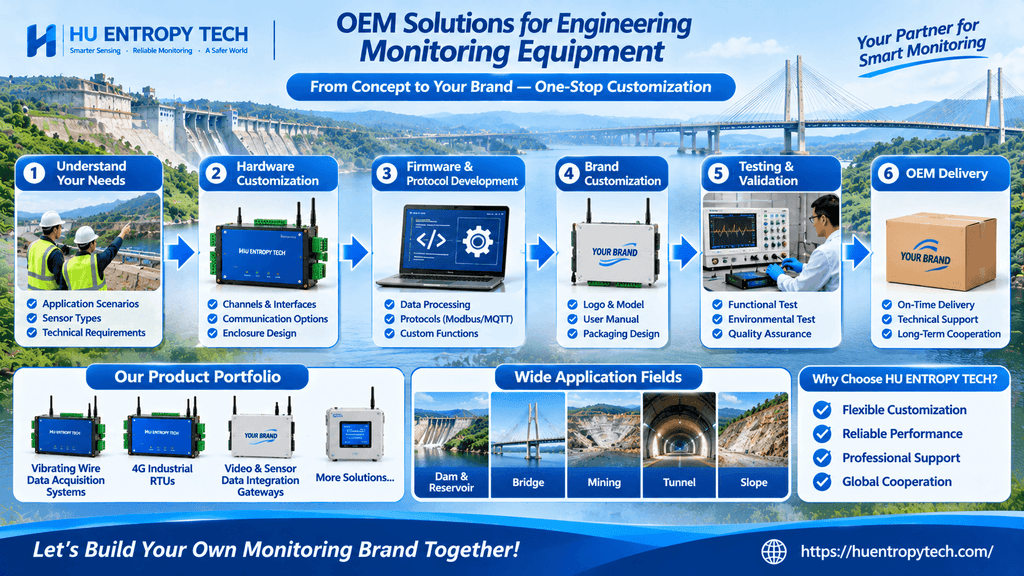
From Hardware Customization to Complete Product Integration
As the global demand for automated engineering monitoring continues to grow, more monitoring companies, system integrators, and instrumentation distributors are looking for reliable OEM equipment suppliers.
Instead of developing every device independently, companies can work with an experienced OEM supplier to develop monitoring hardware under their own brand, reduce development costs, and expand their product portfolios.
But what should a professional OEM solution include?
OEM cooperation is not simply about printing a customer’s logo on an existing device. A comprehensive solution should cover hardware customization, communication interfaces, firmware configuration, product appearance, testing, and long-term technical support.
This article explains how engineering monitoring equipment suppliers can provide practical OEM solutions.
1. Understanding the Customer’s Application Requirements
Every engineering monitoring project has different technical requirements.
Before starting an OEM project, the supplier should understand the customer’s intended applications and system architecture.
Typical requirements may include:
- Dam safety and hydrological monitoring
- Structural health monitoring
- Geotechnical and foundation pit monitoring
- Tunnel and underground engineering
- Mine slope and ground stability monitoring
- Water resources and environmental monitoring
- Industrial remote monitoring
The supplier should clarify several key questions:
- What types of sensors will the equipment connect to?
- How many measurement channels are required?
- Which communication interfaces are needed?
- Does the system require 4G, Ethernet, RS485, or LoRa?
- Which data transmission protocols are expected?
- Does the customer have an existing monitoring platform?
- Are there special requirements for power supply, enclosure, or installation?
A clear technical specification helps both parties avoid unnecessary development and reduces the risk of mismatched products.
2. Hardware Customization
Hardware is the foundation of an OEM monitoring product.
A capable supplier should offer flexible hardware configurations based on the customer’s application.
Typical customization options include:
Channel Configuration
For vibrating wire monitoring, different projects may require different channel capacities.
For example:
- 4-channel acquisition units
- 8-channel acquisition units
- 16-channel acquisition units
The appropriate configuration depends on sensor quantity, installation layout, and project requirements.
Communication Interfaces
Depending on the product architecture, available options may include:
- RS485
- RS232
- TTL
- 4G LTE
- Ethernet
- LoRa or LoRaWAN
Not every interface is suitable for every device. The actual configuration should be confirmed during technical evaluation.
Input and Output Interfaces
For industrial RTUs and monitoring gateways, customization may involve:
- Digital inputs
- Relay outputs
- Analog inputs
- Serial communication interfaces
- Sensor-specific acquisition circuits
For vibrating wire sensors, dedicated measurement circuits are required. A generic analog input cannot directly replace a compatible vibrating wire measurement interface.
3. Firmware and Communication Protocol Customization
Hardware alone does not make a complete monitoring solution.
Firmware determines how a device acquires, processes, stores, and transmits data.
Depending on the product architecture, OEM firmware development or configuration may include:
- Customized acquisition intervals
- Sensor measurement settings
- Data formats and register mapping
- Communication parameters
- Alarm-related functions
- Local data storage
- Automatic data retransmission after network recovery
- Device identification and configuration tools
Communication protocol compatibility is particularly important when integrating equipment into an existing monitoring platform.
Common integration requirements may involve:
- Modbus RTU
- Modbus TCP
- MQTT
- TCP/IP
- HTTP or HTTPS APIs
These protocols serve different purposes. For example, Modbus RTU is commonly used for serial communication, while MQTT is often used for transmitting monitoring data to IoT platforms.
The supplier should confirm which protocols are supported by the selected hardware and whether additional firmware development is necessary.
4. Branding and Product Appearance Customization
For distributors and monitoring companies, building their own product brand is an important reason to choose OEM cooperation.
A professional supplier may provide:
- Customized product logos
- Private-label nameplates
- Customized model numbers
- Product labels and serial number formats
- Customized user manuals
- Packaging design
- English documentation and technical datasheets
Depending on the project, enclosure dimensions, connector positions, and front-panel layouts may also be adjusted.
However, mechanical changes should be evaluated carefully because they may affect internal component layout, thermal performance, protection ratings, and manufacturing costs.
The objective is to create a product that fits the customer’s brand and application without compromising engineering reliability.
5. Integration with Existing Monitoring Platforms
Many overseas customers already have their own monitoring software or cloud platforms.
They do not necessarily need a completely new software system. What they need is compatible hardware that can work within their existing infrastructure.
An OEM supplier should therefore evaluate:
- Data communication methods
- Data formats
- Device identification
- Sensor channel mapping
- Timestamp requirements
- Network configuration
- Data upload intervals
- Connection recovery mechanisms
For example, a monitoring company may use its own cloud platform but require a customized 4G RTU to collect field data and transmit it through MQTT.
In this situation, the hardware supplier should work with the customer’s software team to confirm the communication specifications and complete integration testing.
A well-designed OEM solution should make hardware integration easier rather than create another isolated system.
6. Testing and Quality Verification
Testing is one of the most important stages of OEM development.
A product should not be considered ready simply because the prototype powers on and communicates successfully.
Depending on the product and application, verification may include:
| Test Item | Purpose |
|---|---|
| Functional testing | Verify measurement and device functions |
| Interface testing | Check sensor and communication connections |
| Communication testing | Verify data transmission and protocol compatibility |
| Power testing | Evaluate normal operation and power stability |
| Environmental testing | Assess performance under specified operating conditions |
| Long-term operation | Identify potential issues during continuous operation |
| Integration testing | Confirm compatibility with the customer’s platform |
For monitoring equipment used in dams, bridges, tunnels, mines, and other critical infrastructure, product verification should be based on the project’s technical specifications and applicable requirements.
The testing scope, acceptance criteria, and responsibilities should be agreed upon before mass production.
7. OEM vs. ODM: Which Cooperation Model Is Better?
OEM and ODM are two common cooperation models, but they are not exactly the same.
| Item | OEM | ODM |
|---|---|---|
| Product basis | Existing hardware platform | Supplier’s product design or platform |
| Customer involvement | Defines branding and customization requirements | Defines application and product requirements |
| Hardware changes | Usually limited or project-specific | May involve deeper design changes |
| Development workload | Generally lower | Generally higher |
| Development cycle | Often shorter | Depends on design complexity |
| Best suited for | Brands and distributors expanding product lines | Companies developing differentiated products |
OEM is suitable for companies that already know what type of product they need.
ODM is more suitable for companies that require a supplier to participate in product design and development.
In practice, many projects combine both approaches. An existing hardware platform may be adapted through customized interfaces, firmware, and product appearance.
8. How to Choose the Right OEM Engineering Monitoring Supplier
Price is important, but it should not be the only consideration.
Before selecting an OEM partner, evaluate the following:
- Engineering experience: Does the supplier understand actual monitoring applications?
- Hardware capabilities: Can it provide the required acquisition channels and interfaces?
- Firmware flexibility: Can it support customized functions and communication protocols?
- Integration capability: Can its equipment connect to existing monitoring platforms?
- Testing procedures: Does it have a clear prototype verification and quality control process?
- Documentation: Can it provide reliable technical specifications and user manuals?
- Long-term support: Can it support product maintenance, firmware updates, and repeat orders?
A reliable OEM relationship should be based on technical capability, transparent communication, and consistent product quality.
9. HU ENTROPY TECH: OEM/ODM Solutions for Engineering Monitoring
At HU ENTROPY TECH, we provide engineering monitoring hardware and OEM/ODM customization services for international customers.
Our product portfolio includes:
- Vibrating Wire Data Acquisition Systems
- 4-channel, 8-channel, and 16-channel acquisition solutions
- Industrial 4G RTUs
- 4G and LoRa communication options
- Video & Sensor Data Integration Gateways
- Customized hardware and firmware solutions
- Online Visual Tracking System
Our current hardware platforms include the VW-401, VW-801, VW-1601, VW-402, VW-802, VW-1602, RTU-800H-4G, RTU-900H, and RTU-901H series.
Depending on the project, we can discuss product branding, channel configurations, communication interfaces, firmware functions, and integration requirements.
We understand that different customers have different product strategies and technical systems. Our goal is to help engineering monitoring companies develop suitable hardware solutions without having to build every part of the manufacturing process themselves.
Build Your Own Monitoring Product Brand
If you are an engineering monitoring company, instrumentation distributor, or system integrator looking for an OEM/ODM partner, we welcome the opportunity to discuss your requirements.
Share your product concept, technical specifications, or existing system architecture with us.
HU ENTROPY TECH
Smarter Sensing · Reliable Monitoring · A Safer World
Website: https://huentropytech.com/
