
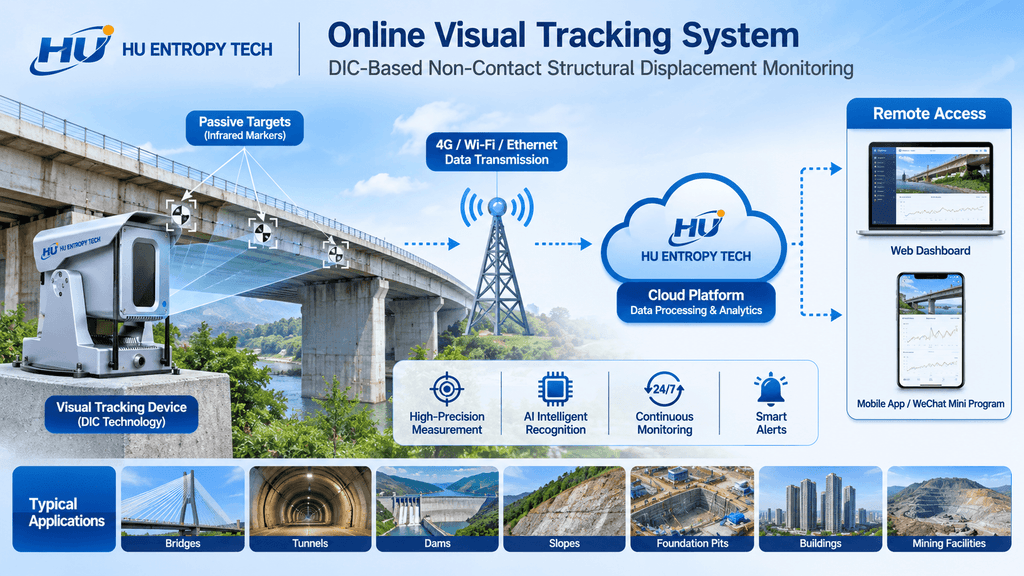
Non-Contact, Multi-Point Displacement Measurement for Bridges, Tunnels, Dams, and Other Critical Infrastructure
Structural health monitoring plays an increasingly important role in maintaining the safety and reliability of critical infrastructure. Bridges, tunnels, dams, slopes, and high-rise buildings are continuously exposed to environmental changes, traffic loads, ground movement, and long-term structural deterioration.
Traditional monitoring methods often rely on contact sensors, manual measurements, and extensive cable connections. While these methods remain valuable, they can involve complicated installation, considerable maintenance work, and limitations when monitoring multiple points over a large area.
With advances in computer vision and digital image processing, Digital Image Correlation (DIC) technology is providing another approach to structural displacement monitoring.
1. What Is DIC-Based Visual Displacement Monitoring?
Digital Image Correlation (DIC) is an optical measurement technique that analyzes changes in images to determine the displacement of selected points on an object.
In an online visual tracking system, a measurement device is installed at a relatively stable location, while passive targets are positioned on the structure being monitored.
The system continuously captures images and identifies the target positions. By comparing their image coordinates over time, it calculates displacement in horizontal and vertical directions.
Based on oblique-axis DIC technology, this approach combines high-resolution imaging, intelligent target recognition, and computational analysis to provide non-contact, multi-point displacement measurement.
Unlike conventional contact sensors, the visual measurement device does not need to be physically connected to every monitoring point.
2. Key Advantages of Online Visual Tracking Systems
Non-Contact Measurement
The system measures displacement through optical imaging and passive targets. This reduces the need for installing individual contact measurement devices at every monitoring point.
Multi-Target Monitoring
A single measurement device can track multiple targets simultaneously. This makes it suitable for monitoring several locations across bridges, tunnels, slopes, and other structures.
Continuous Automated Monitoring
The system automatically acquires measurement data and uploads it to a cloud-based platform through communication options such as 4G. Users can remotely access monitoring results and historical data.
Adaptability to Complex Environments
Environmental conditions such as weather, changing illumination, atmospheric disturbance, vibration, and partial target obstruction can affect optical measurement.
The system incorporates algorithms for temperature compensation and interference mitigation to help maintain measurement stability under varying site conditions.
Visual Records and Remote Alerts
With its integrated imaging functions, the system can save on-site images when abnormal conditions are detected. Configurable alerts can help monitoring personnel identify potential issues and respond in a timely manner.
3. Typical Engineering Applications
DIC-based visual tracking technology can support displacement monitoring across a wide range of civil engineering applications.
Bridge Structural Health Monitoring
Bridge displacement and deflection are important indicators in structural performance assessment.
Visual tracking systems can be installed on bridge piers or other stable locations to monitor targets positioned beneath the bridge deck.
Typical monitoring applications include:
- Static bridge deflection
- Dynamic bridge deflection
- Horizontal displacement
- Multi-point structural movement
Tunnel Deformation Monitoring
Tunnel deformation monitoring often involves multiple measurement points distributed across different cross-sections.
By tracking targets positioned at the crown, haunches, and springlines, the system can support:
- Tunnel convergence monitoring
- Crown settlement monitoring
- Lining displacement monitoring
- Multi-section deformation analysis
Slope and Landslide Monitoring
Surface displacement can provide important information about slope movement.
Visual monitoring devices can be installed at relatively stable locations with a clear line of sight to targets positioned on slope surfaces or retaining structures.
Typical monitoring parameters include:
- Horizontal displacement
- Vertical displacement
- Surface settlement
- Changes in target positions over time
Dam and Reservoir Safety Monitoring
For dams, reservoirs, and embankments, passive targets can be distributed along selected monitoring sections.
The system tracks individual targets to monitor horizontal displacement and settlement, supporting long-term deformation observation.
Foundation Pit Monitoring
During deep excavation, retaining structures may experience horizontal and vertical displacement.
By installing passive targets on diaphragm walls or other retaining structures, the visual tracking system can provide automated displacement measurements and remote data access.
4. From Measurement Devices to Cloud-Based Monitoring
Modern structural health monitoring is not only about collecting measurement data. It is also about transmitting, managing, visualizing, and analyzing that data efficiently.
A typical online visual monitoring system consists of:
- Visual Tracking Device: Captures images and measures target displacement.
- Passive Targets: Provide identifiable measurement points on the monitored structure.
- Communication Network: Transmits measurement data through 4G or other supported communication methods.
- Cloud Monitoring Platform: Displays real-time measurements, historical trends, and alert information.
- User Access: Allows engineers and project managers to review monitoring data remotely.
Depending on project requirements, the system can also be integrated with other monitoring instruments and sensor data acquisition devices to support a more comprehensive monitoring solution.
5. Combining Visual Measurement with Conventional Sensors
Visual tracking technology does not replace every type of structural monitoring sensor.
It is particularly suitable for measuring visible target displacement. However, parameters such as strain, stress, pore water pressure, internal deformation, and temperature require corresponding sensors.
For this reason, combining visual measurement with conventional geotechnical sensors can provide a more comprehensive monitoring framework.
For example:
- Visual tracking systems measure surface displacement.
- Vibrating wire instruments acquire data from compatible vibrating wire sensors.
- Industrial RTUs collect and transmit data from distributed monitoring devices.
- Cloud platforms bring different monitoring data streams together.
The appropriate combination depends on the structure, monitoring objectives, site conditions, and project requirements.
6. Hu Entropy Tech: Visual Monitoring and Engineering Data Acquisition
At Hu Entropy Tech, we focus on engineering monitoring hardware and industrial IoT solutions.
Our Online Visual Tracking System (DIC Tracker-ONS) is based on oblique-axis DIC technology and combines high-resolution imaging, target tracking, displacement measurement, and cloud-based data transmission.
Key product capabilities include:
- Non-contact, multi-point 2D displacement measurement
- Automatic target recognition and tracking
- Continuous automated data acquisition
- 4G, Wi-Fi, and wired Ethernet communication options
- Environmental interference mitigation algorithms
- Remote monitoring and data visualization
- Optional solar and battery power configurations
Together with our vibrating wire data acquisition instruments and industrial RTUs, we aim to provide flexible hardware options for engineering monitoring companies, system integrators, and infrastructure projects.
Conclusion
As infrastructure monitoring continues to evolve, non-contact visual measurement is becoming an important option for projects that require automated, multi-point displacement monitoring.
DIC-based visual tracking systems offer an alternative approach to conventional contact measurement, particularly where remote observation, flexible deployment, and reduced field wiring are important considerations.
By combining visual measurement, sensor data acquisition, industrial communication, and cloud-based monitoring, engineering teams can build more flexible and integrated structural health monitoring systems.
Hu Entropy Tech — Engineering Monitoring Hardware and IoT Solutions.
🌐 Website: https://huentropytech.com/
📩 Contact us to discuss your structural monitoring project or OEM/ODM requirements.
#StructuralHealthMonitoring #DIC #VisualDisplacementMonitoring #BridgeMonitoring #TunnelMonitoring #DamSafety #SlopeMonitoring #EngineeringMonitoring #IndustrialIoT #HuEntropyTech
