
How Automation, IoT, and Artificial Intelligence Are Transforming Infrastructure Safety Monitoring
Engineering monitoring is entering a new stage of development.
For decades, many infrastructure monitoring projects have relied heavily on manual inspections, periodic measurements, and on-site data collection. Engineers visit monitoring locations, read instruments, record measurements, and transfer the results to analysis systems.
This traditional approach has played an important role in dam safety, bridge monitoring, tunnel engineering, mining, geotechnical projects, and other infrastructure applications.
However, as infrastructure networks become larger and monitoring requirements become more demanding, traditional methods face several challenges:
- Limited inspection frequency
- High labor and maintenance costs
- Delays between measurement and reporting
- Difficulty monitoring remote or hazardous locations
- Increasing volumes of monitoring data
- Limited ability to identify complex changes across multiple parameters
Over the next five years, engineering monitoring is likely to become more automated, connected, and intelligent.
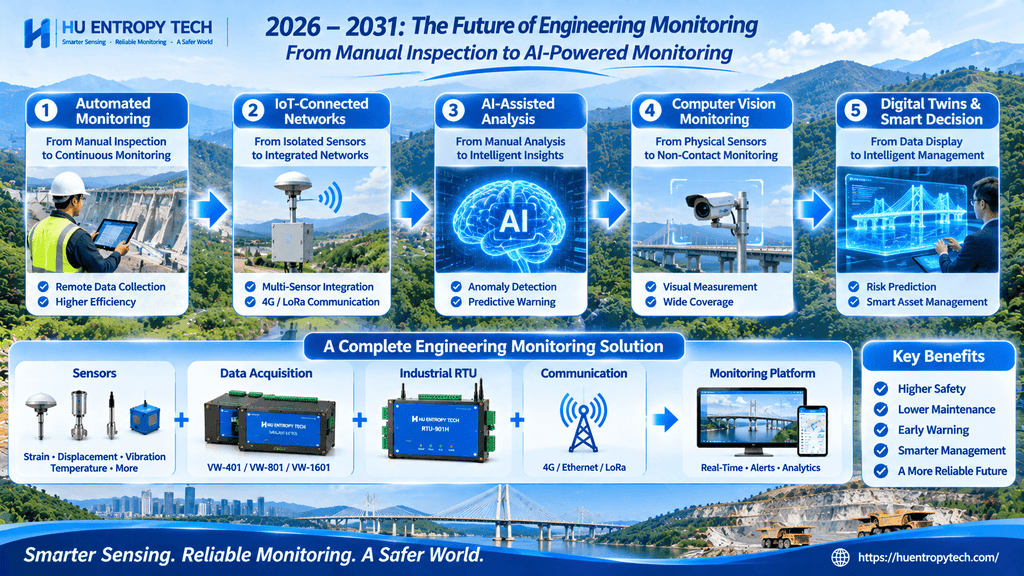
The transformation will not happen overnight. Instead, it will involve the gradual integration of sensors, automated data acquisition, industrial communication devices, cloud platforms, computer vision, and AI-assisted analysis.
Here are five important trends that may shape the industry between 2026 and 2031.
1. From Manual Inspection to Continuous Automated Monitoring
The first major trend is the transition from periodic manual inspection to continuous or higher-frequency automated monitoring.
Traditional monitoring often depends on engineers visiting sites at scheduled intervals. This can be sufficient for certain applications, but it may not provide timely information when environmental conditions or structural behavior change rapidly.
Automated monitoring systems offer a different approach.
Sensors installed at critical locations can collect measurements automatically and transmit the data to remote monitoring platforms.
Typical monitoring parameters include:
- Displacement and deformation
- Settlement and structural movement
- Crack opening and expansion
- Pore water pressure and groundwater levels
- Strain and stress
- Vibration and acceleration
- Rainfall and environmental conditions
Automated data acquisition units and industrial RTUs can collect information from compatible sensors and transmit it through 4G, Ethernet, LoRa, or other supported communication technologies.
Engineers can then review monitoring data remotely without having to visit every measurement point.
The key change is not simply replacing manual work with electronics. It is making monitoring information more continuous, accessible, and useful for engineering decisions.
2. From Isolated Sensors to IoT-Based Monitoring Networks
The second trend is the development of connected monitoring networks.
In many traditional projects, different instruments operate independently. Data may be stored in separate devices, collected manually, or transferred through different software systems.
This creates information silos and makes it difficult to understand the overall condition of an engineering structure.
IoT-based monitoring systems aim to connect different measurement devices through a unified data architecture.
A typical architecture includes:
- Field Sensors: Vibrating wire sensors, displacement sensors, inclinometers, pressure sensors, GNSS devices, and environmental instruments.
- Data Acquisition: Compatible data loggers and acquisition units collect and process sensor measurements.
- Industrial RTUs and Gateways: Devices manage communication, local storage, and remote data transmission.
- Communication Networks: 4G LTE, Ethernet, LoRa, or other suitable technologies connect field equipment to the monitoring platform.
- Cloud or Central Platform: Data is stored, visualized, analyzed, and managed centrally.
Common communication technologies and protocols may include RS485, Modbus RTU, Modbus TCP, MQTT, and HTTP-based interfaces, depending on device and platform compatibility.
For example, a dam monitoring project may combine vibrating wire piezometers, displacement monitoring instruments, water-level sensors, and rainfall stations.
Instead of reviewing each measurement independently, engineers can access data from multiple monitoring points through one integrated platform.
This makes it easier to identify relationships between environmental conditions and structural responses.
3. From Conventional Data Analysis to AI-Assisted Monitoring
Artificial intelligence is expected to become an increasingly important part of engineering monitoring.
Traditional monitoring analysis often relies on predefined thresholds, engineering experience, statistical methods, and manual interpretation.
These methods remain essential, but AI-assisted tools can provide additional capabilities when sufficient high-quality historical and real-time data is available.
Potential applications include:
Anomaly Detection
Machine learning models can help identify unusual measurement patterns that may not be obvious from individual readings.
Trend Analysis
AI-assisted algorithms can analyze historical measurements and identify changes in displacement, settlement, pressure, or other monitoring parameters.
Multi-Parameter Correlation
By combining sensor measurements with rainfall, groundwater levels, temperature, and other environmental information, analytical models may help engineers investigate possible relationships between different variables.
Predictive Maintenance
Equipment performance data can help identify potential communication failures, abnormal power consumption, or sensor-related issues before they cause prolonged monitoring interruptions.
Intelligent Alarm Assistance
AI systems may help prioritize abnormal events and provide additional context for engineers reviewing monitoring alerts.
However, AI should not be treated as an independent authority on structural safety.
Monitoring predictions depend on data quality, model validation, site conditions, and engineering knowledge. Critical safety decisions must remain subject to qualified professional assessment and applicable engineering procedures.
AI is best understood as a tool that helps engineers process more information and identify potential issues earlier.
4. From Conventional Measurement to Computer Vision and Non-Contact Monitoring
Another important development is the growing application of computer vision in engineering monitoring.
Traditional monitoring often requires sensors to be physically installed at measurement locations. While this remains necessary for many applications, some structures and locations are difficult to access or instrument.
Computer vision offers an alternative approach for suitable measurement scenarios.
By combining high-resolution imaging, image processing, digital image correlation (DIC), and AI-based target recognition, vision-based systems can measure the movement of selected targets without requiring direct physical contact with the monitored structure.
Potential applications include:
- Bridge deflection monitoring
- Building deformation monitoring
- Dam displacement monitoring
- Foundation pit movement
- Slope deformation
- Crack and structural movement observation
- Continuous monitoring of selected infrastructure components
For example, an online visual tracking system can use cameras and passive targets to capture images continuously and calculate changes in target positions over time.
Depending on system design and site conditions, the system may provide displacement, deflection, deformation trends, and other derived monitoring indicators.
The advantages of non-contact monitoring can include easier deployment at difficult-to-access locations and reduced dependence on certain types of physical sensor installation.
However, vision-based measurements also have limitations. Camera stability, lighting, visibility, target installation, atmospheric conditions, calibration, and measurement distance can all affect performance.
Computer vision should therefore complement, rather than automatically replace, conventional sensor-based monitoring.
The future of engineering monitoring will increasingly involve combining physical sensors with vision-based measurement technologies.
5. From Data Visualization to Digital Twins and Intelligent Decision Support
The fifth trend is the evolution of monitoring platforms.
Early monitoring systems mainly focused on collecting data, displaying measurements, and generating threshold alarms.
Future platforms are likely to provide more integrated capabilities, including:
- Real-time monitoring dashboards
- Historical data analysis
- Multi-parameter visualization
- Automated alarm management
- AI-assisted anomaly detection
- Three-dimensional infrastructure models
- Digital twin integration
- Maintenance and risk management workflows
A digital twin can connect physical infrastructure with digital models and monitoring data.
For example, a bridge digital twin may combine structural geometry, sensor locations, displacement measurements, temperature, vibration, and inspection records.
Engineers can use this integrated information to understand how different parts of the structure behave over time.
However, a digital twin is more than a 3D visualization. Its practical value depends on reliable data acquisition, accurate asset information, consistent data integration, and meaningful engineering models.
Industrial RTUs, acquisition devices, communication gateways, and monitoring sensors will remain essential because the quality of intelligent analysis depends on the quality of the data collected from the field.
6. What Will Engineering Monitoring Equipment Need to Become?
As monitoring systems become more automated and connected, equipment requirements will also evolve.
Future monitoring devices will need to support more than basic measurement and communication.
Important capabilities will include:
Flexible Sensor Connectivity
Equipment should support different sensor types and interfaces through appropriate measurement circuits and communication configurations.
Reliable Remote Communication
4G, Ethernet, LoRa, and other communication options will help monitoring systems adapt to different project environments.
Local Data Storage
When communication networks become unavailable, local storage and reliable data recovery mechanisms can help prevent data loss.
Edge Processing
Some data filtering, preliminary analysis, and event detection may increasingly take place closer to the monitoring site, reducing unnecessary data transmission and response delays.
Platform Compatibility
Open and well-documented communication interfaces will be important for connecting equipment to different software platforms.
Low-Power Operation
Remote monitoring stations often operate in locations without stable grid power. Efficient power management is therefore essential for many field applications.
Long-Term Reliability
Monitoring equipment may operate continuously in outdoor environments exposed to temperature changes, moisture, dust, vibration, and other challenging conditions.
The ability to maintain stable operation over long periods will remain a fundamental requirement.
7. The Future Is Integrated Monitoring, Not a Single Technology
One important point should not be overlooked: no single sensor, communication technology, or AI algorithm can meet every engineering monitoring requirement.
Different projects require different combinations of technologies.
For example:
| Application | Typical Monitoring Technologies |
|---|---|
| Dam Safety | Vibrating wire sensors, displacement monitoring, water-level monitoring, RTUs |
| Bridge Monitoring | Displacement, strain, vibration, GNSS, and vision-based systems |
| Mine Slope Monitoring | GNSS, inclinometers, crack meters, piezometers, rainfall monitoring |
| Tunnel Monitoring | Convergence, deformation, displacement, and environmental monitoring |
| Foundation Pit Monitoring | Inclinometers, settlement monitoring, crack meters, and groundwater monitoring |
| Water Resources | Water-level sensors, flow measurement, rainfall monitoring, and 4G RTUs |
The future monitoring architecture will increasingly combine multiple measurement technologies, communication networks, and analytical tools.
The objective is to create a reliable information chain:
Sensors → Data Acquisition → Industrial RTUs → Communication Networks → Monitoring Platforms → AI-Assisted Analysis → Engineering Decisions
Every stage matters.
An advanced AI platform cannot compensate for inaccurate measurements. A high-performance sensor cannot deliver its full value if the data cannot be collected or transmitted reliably.
The development of intelligent monitoring therefore depends on the coordinated improvement of the entire system.
8. HU ENTROPY TECH: Supporting the Next Generation of Engineering Monitoring
At HU ENTROPY TECH, we believe the future of engineering monitoring will be built on reliable hardware, flexible communication, and intelligent system integration.
We provide engineering monitoring hardware and OEM/ODM solutions for international customers, including:
Vibrating Wire Data Acquisition Systems
- VW-401 / VW-801 / VW-1601
- VW-402 / VW-802 / VW-1602
- 4-channel, 8-channel, and 16-channel configurations
Industrial Remote Terminal Units
- RTU-800H-4G
- RTU-900H / RTU-900H-TFT
- RTU-901H
Communication and Integration
- 4G and LoRa communication options
- Sensor data acquisition and remote transmission
- Video and sensor data integration solutions
- OEM/ODM hardware and firmware customization
Online Visual Tracking System
Our vision-based monitoring solution combines optical measurement, image processing, and AI-based target recognition to support continuous, non-contact deformation monitoring in suitable engineering applications.
We aim to support engineering monitoring companies, system integrators, and equipment distributors with practical hardware solutions that can be integrated into their own monitoring systems.
Conclusion: The Next Five Years Will Redefine Engineering Monitoring
The transition from manual inspection to intelligent monitoring is already underway, although the pace of adoption will vary across regions and applications.
Over the next five years, several developments are likely to become increasingly important:
- More automated and continuous data acquisition
- Wider adoption of IoT-connected monitoring networks
- Greater use of AI-assisted analysis and anomaly detection
- More applications of computer vision and non-contact measurement
- Deeper integration of digital twins and intelligent monitoring platforms
The goal is not to replace engineers with machines.
It is to give engineers more reliable data, better analytical tools, faster access to information, and stronger support for engineering decisions.
The future of engineering monitoring will not be defined by AI alone. It will be defined by how effectively sensors, hardware, communication, software, and engineering expertise work together.
HU ENTROPY TECH
Smarter Sensing · Reliable Monitoring · A Safer World
Website: https://huentropytech.com/
