
Combining Visual Information and Sensor Measurements for Smarter Infrastructure Monitoring
Engineering monitoring is evolving.
For many years, infrastructure monitoring systems have relied primarily on physical sensors to measure parameters such as displacement, strain, vibration, settlement, water pressure, and temperature.
These measurements provide essential quantitative information about the condition of structures and engineering environments.
At the same time, video surveillance systems have been widely deployed at dams, bridges, tunnels, mines, construction sites, and other critical infrastructure facilities.
However, in many projects, video surveillance and sensor monitoring still operate as two separate systems.
The video system shows what is happening at the site, while the sensor system provides numerical measurements. Engineers often need to switch between different platforms to understand the relationship between visual events and measurement changes.
What if these two sources of information could be integrated into one monitoring system?
By combining video surveillance with sensor data acquisition, communication networks, and intelligent analysis, engineering monitoring systems can provide a more comprehensive understanding of field conditions.
This approach may become an important development direction for the next generation of engineering monitoring.
1. Why Is Integrating Video and Sensor Data Important?
Traditional sensor-based monitoring provides accurate and quantifiable measurements within the capabilities of the selected instruments.
For example:
- Displacement sensors measure structural movement.
- Vibrating wire piezometers monitor pore water pressure.
- Strain gauges measure structural strain.
- Inclinometers monitor subsurface deformation.
- Accelerometers measure vibration and dynamic response.
- Rain gauges record rainfall conditions.
These measurements are essential for engineering analysis.
However, sensor readings alone may not always explain what is happening around the monitoring location.
Consider a bridge monitoring scenario.
A displacement sensor may detect an unusual change in structural movement. The measurement identifies a potential abnormal condition, but engineers may also need to understand whether there was nearby construction activity, an impact event, unusual traffic, or another visible change.
Video surveillance can provide additional visual context.
Similarly, at a mine slope, sensor data may indicate increasing displacement or changes in groundwater pressure. Video can help engineers observe visible surface conditions, falling rocks, construction activity, or other site events.
By integrating the two information sources, engineers can review both quantitative measurements and visual evidence.
Sensors tell us how the measured parameters are changing. Video helps us understand what is happening at the site.
Together, they provide a more complete monitoring picture.
2. How Does a Video and Sensor Data Integration System Work?
A typical integrated monitoring architecture consists of several interconnected components.
Step 1: Sensor Data Acquisition
Different types of field sensors collect monitoring measurements.
Depending on the project, these may include:
- Vibrating wire sensors
- Displacement transducers
- Crack meters
- Strain gauges
- Pressure and water-level sensors
- Temperature sensors
- Accelerometers
- Other compatible monitoring instruments
Data acquisition units and industrial RTUs collect measurements through appropriate sensor interfaces and communication protocols.
Step 2: Video Surveillance
Cameras are installed at selected monitoring locations to capture real-time or scheduled video streams.
Depending on the system design, video equipment may support:
- Live video monitoring
- Scheduled image capture
- Continuous or event-triggered recording
- Remote video access
- Integration with monitoring software
The actual capabilities depend on camera specifications, network bandwidth, storage capacity, and system configuration.
Step 3: Data Communication and Integration
Sensor data and video information are transmitted to a central monitoring platform through suitable communication networks.
Common communication options include:
- 4G LTE
- Ethernet
- Fiber-optic networks
- Wireless communication
- Other project-specific network solutions
Industrial RTUs and integration gateways can serve as important communication components.
For example, an industrial RTU may collect sensor measurements and transmit structured data to a cloud platform through a supported protocol such as MQTT.
Video streams may use a separate network or video transmission architecture.
The integration platform then associates sensor measurements with corresponding video sources, locations, and timestamps.
Step 4: Unified Monitoring Platform
The platform brings different types of information together.
Engineers may be able to view:
- Sensor measurement dashboards
- Real-time video streams
- Historical measurement curves
- Alarm notifications
- Event records
- Monitoring location information
- Related visual evidence
For example, when a sensor reading exceeds a configured threshold, the platform may display the corresponding camera view or a video recording around the event time.
This makes it easier to review abnormal conditions without searching through separate systems.
Step 5: Intelligent Analysis and Alarm Management
Once video and sensor data are integrated, additional analytical capabilities become possible.
Depending on the platform and available data, these may include:
- Sensor threshold alarms
- Rate-of-change detection
- Video event detection
- Image-based movement analysis
- Multi-parameter correlation
- Event association and historical review
- AI-assisted anomaly identification
It is important to distinguish between sensor-based measurement alarms and AI-based video recognition.
They are different technologies and should be independently validated before being combined into safety-related decision workflows.
3. Five Important Applications of Video and Sensor Data Integration
The combination of visual information and sensor measurements can be useful across several engineering applications.
1. Dam Safety Monitoring
Dams require continuous attention to deformation, seepage, water levels, structural conditions, and surrounding environments.
An integrated system may combine:
- Vibrating wire piezometers
- Displacement monitoring instruments
- Water-level sensors
- Rainfall monitoring
- Cameras overlooking critical areas
When an abnormal measurement occurs, engineers can review the corresponding visual information to investigate possible site conditions.
2. Bridge Structural Health Monitoring
Bridge monitoring systems may combine strain, displacement, vibration, temperature, and environmental measurements with video surveillance.
This can help engineers review structural measurements alongside visible traffic conditions, construction activities, and potential external events.
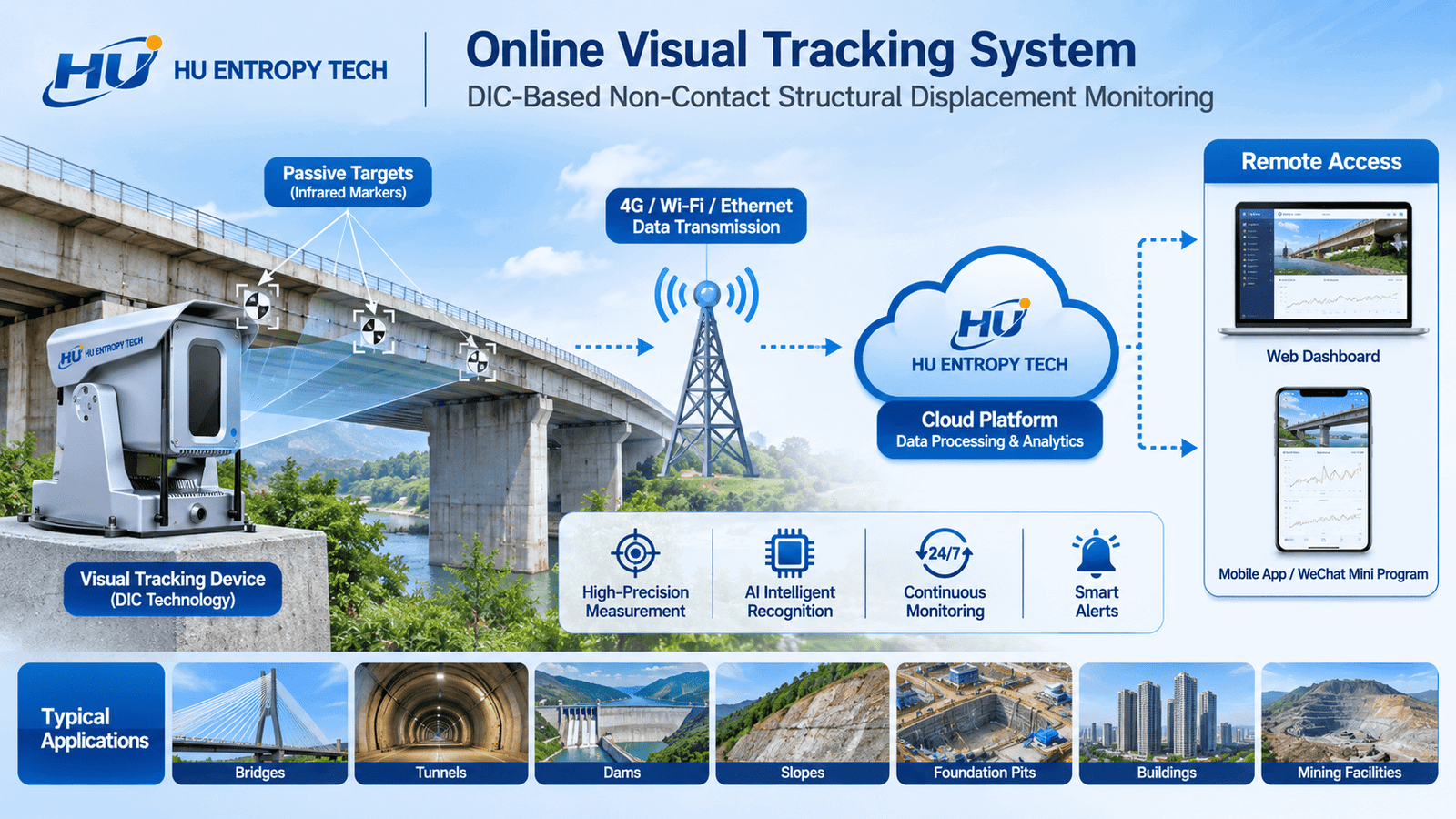
For certain applications, specialized computer vision systems can also provide non-contact displacement or deflection measurements.
3. Mine Slope and Geological Hazard Monitoring
Mine slopes and surrounding geological environments may change due to rainfall, excavation, groundwater variation, and other factors.
An integrated monitoring system may combine:
- GNSS displacement monitoring
- Inclinometers
- Crack meters
- Vibrating wire piezometers
- Rain gauges
- Video surveillance
Sensor data provides quantitative measurements, while video offers additional visual context for reviewing slope conditions and field activities.
4. Tunnel and Underground Engineering
Tunnel monitoring involves deformation, convergence, structural behavior, groundwater conditions, and construction activities.
Integrating cameras with compatible monitoring sensors can help project teams review measurements alongside construction progress and visible site conditions.
5. Foundation Pit and Construction Site Monitoring
Foundation pits are affected by excavation activities, groundwater conditions, surrounding structures, and construction loads.
A combined system may integrate:
- Inclinometers
- Settlement monitoring
- Crack meters
- Groundwater monitoring
- Cameras at critical construction locations
This helps engineers connect monitoring records with visible construction activities and site events.
4. Video Surveillance Is Not the Same as Computer Vision Measurement
An important technical distinction should be made.
Video surveillance and computer vision measurement are related, but they serve different purposes.
Video Surveillance
Primarily provides visual observation, recording, and remote site access.
Its main purpose is to help personnel see site conditions and review events.
Computer Vision Measurement
Uses image processing, calibration, target recognition, and measurement algorithms to calculate physical quantities such as displacement or deformation.
For example, a vision-based displacement monitoring system may track fixed targets on a bridge or building and calculate their positional changes over time.
AI Video Analytics
Uses algorithms to recognize selected visual events or objects, such as personnel, vehicles, falling objects, or visible changes in a monitored area.
These technologies can work together, but they should not be treated as interchangeable.
A conventional security camera does not automatically become a precision engineering measurement instrument simply because it is connected to an AI platform.
Measurement accuracy requires an appropriate optical setup, calibration, stable installation, suitable targets, and validated algorithms.
5. What Are the Main Technical Challenges?
Although integration offers clear benefits, building a reliable system requires careful engineering.
Data Synchronization
Video and sensor measurements must have reliable timestamps.
Without proper time synchronization, it may be difficult to determine whether a visual event corresponds to a particular sensor anomaly.
Network Bandwidth
Video streams usually require substantially more bandwidth than numerical sensor data.
In remote monitoring locations, network capacity must be considered carefully.
A practical architecture may transmit sensor data continuously while using scheduled image capture, compressed video, or event-triggered video transmission.
Power Consumption
Cameras, communication equipment, and monitoring devices all consume power.
For remote sites powered by solar systems or batteries, the overall energy budget must be evaluated.
System Compatibility
Different sensors, cameras, RTUs, and monitoring platforms may use different interfaces, protocols, and data formats.
The integration architecture should define how each component communicates and how the platform associates data with monitoring locations.
Data Storage and Management
Continuous video recording can generate large amounts of data.
The system needs an appropriate strategy for local storage, cloud storage, retention periods, and event-based retrieval.
Reliability and Cybersecurity
Remote monitoring systems require stable communication, controlled access, secure data transmission, and appropriate network protection.
These requirements become especially important when monitoring critical infrastructure.
6. The Role of Industrial RTUs in Integrated Monitoring Systems
Industrial RTUs are important components in many integrated engineering monitoring architectures.
They connect field devices with remote platforms and help manage data collection and communication.
Depending on the model and configuration, an industrial RTU may provide:
- Multi-sensor data acquisition
- RS485 or other serial interfaces
- Digital and analog inputs
- Local data storage
- 4G remote communication
- Configurable acquisition and transmission intervals
- MQTT or other supported communication protocols
For video and sensor integration, the RTU may transmit structured sensor data while the video system manages camera streams through its own communication architecture.
The monitoring platform connects these information sources through device identifiers, monitoring locations, and timestamps.
This division of responsibilities is important.
A standard industrial RTU should not automatically be assumed to process or transmit high-bandwidth video streams. Video handling may require a dedicated video gateway, network video recorder, edge computer, or other suitable hardware.
A well-designed architecture assigns each device the functions it is designed to perform.
7. What Will the Next Generation of Integrated Monitoring Look Like?
In the coming years, integrated monitoring systems may evolve in several directions.
More Multi-Source Data Integration
Sensor measurements, video, environmental data, weather information, and inspection records may increasingly be managed within unified platforms.
Event-Driven Monitoring
Instead of continuously transmitting every type of information at maximum frequency, systems may use sensor thresholds or detected events to trigger additional image capture, video retrieval, or data collection.
AI-Assisted Visual Analysis
Computer vision and machine learning may help identify selected visual changes, abnormal events, or patterns that require engineering review.
Improved Remote Operation
Engineers may increasingly use centralized platforms to monitor multiple sites and review events remotely.
Integration with Digital Twins
Video, sensor measurements, and infrastructure models may be connected to provide a more comprehensive digital representation of physical assets.
The long-term objective is to move from separate monitoring devices toward coordinated information systems.
8. HU ENTROPY TECH: Connecting Sensor Data with Visual Monitoring
At HU ENTROPY TECH, we believe the integration of sensor data and visual information will become an important direction in engineering monitoring.
Our product portfolio includes hardware and solutions that support this development.
Vibrating Wire Data Acquisition Systems
- VW-401 / VW-801 / VW-1601
- VW-402 / VW-802 / VW-1602
- 4-channel, 8-channel, and 16-channel configurations
Industrial RTUs
- RTU-800H-4G
- RTU-900H / RTU-900H-TFT
- RTU-901H
Video and Sensor Data Integration Gateways
Solutions designed to support the integration of field sensor measurements and visual monitoring information, subject to project architecture and interface requirements.
Online Visual Tracking System
A vision-based monitoring solution combining optical measurement, image processing, and AI-based target recognition for non-contact deformation monitoring in suitable engineering applications.
We also provide OEM/ODM customization services for international monitoring companies, distributors, and system integrators.
Our goal is to help customers develop monitoring solutions that combine reliable field data acquisition, flexible communication, and practical system integration.
Conclusion: From Seeing Data to Understanding Site Conditions
Will video surveillance and sensor data integration become the next generation of engineering monitoring?
The answer is likely yes, particularly in projects where both quantitative measurements and visual context are important.
However, the real value does not come from simply connecting cameras to sensors.
It comes from integrating different information sources into a reliable monitoring architecture, synchronizing data, associating events, and presenting useful information to engineers.
Sensors provide measurable evidence. Video provides visual context. AI can help analyze information from both sources.
Together, they can make engineering monitoring more comprehensive, responsive, and intelligent.
The future of engineering monitoring is not just about collecting more data. It is about connecting different types of data to understand what is really happening in the field.
HU ENTROPY TECH
Smarter Sensing · Reliable Monitoring · A Safer World
Website: https://huentropytech.com/
