
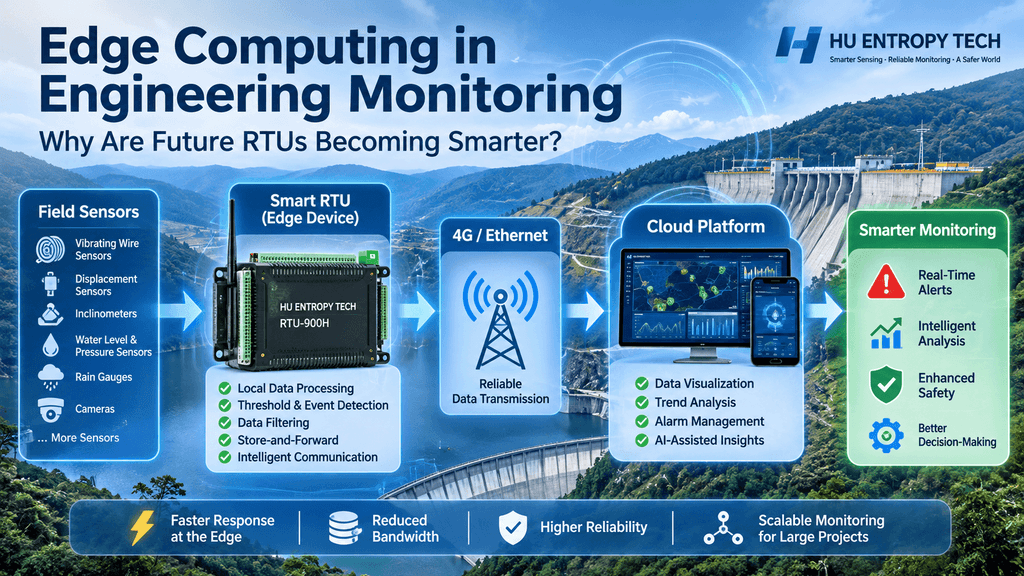
From Data Collection and Transmission to Intelligent Field-Level Processing
Engineering monitoring systems are becoming increasingly connected.
Across dams, bridges, tunnels, mines, foundation pits, and water infrastructure projects, sensors continuously generate large volumes of measurement data.
Traditional monitoring architectures typically rely on field devices to collect sensor readings and transmit them to a central server or cloud platform for storage, visualization, and analysis.
This approach remains widely used. However, as monitoring networks expand and real-time response becomes more important, sending every measurement directly to a remote platform is not always the most efficient solution.
This is where edge computing comes in.
By moving selected data processing and decision-making functions closer to the monitoring site, engineering monitoring systems can respond more efficiently to field conditions.
Industrial RTUs are expected to play an increasingly important role in this transformation.
The future RTU will not simply collect and transmit data. Depending on its hardware and firmware capabilities, it may also filter measurements, identify abnormal conditions, manage local events, and make communication more efficient.
So, why are RTUs becoming smarter, and what does this mean for engineering monitoring?
1. What Is Edge Computing in Engineering Monitoring?
Edge computing refers to processing data close to where it is generated, rather than sending all raw data to a centralized cloud platform for processing.
In an engineering monitoring system, the edge layer may include:
- Industrial RTUs
- Data acquisition units
- Edge gateways
- Industrial computers
- Local monitoring controllers
These devices can perform selected processing tasks before transmitting information to a remote monitoring platform.
For example, consider a dam monitoring station equipped with vibrating wire sensors, water-level sensors, and rainfall instruments.
In a traditional architecture, the field equipment collects measurements and sends them to a central platform. The platform performs most of the analysis and generates alarms.
With edge computing, a suitably configured RTU or edge gateway may also perform local functions, such as:
- Checking measurement values against configured thresholds
- Calculating basic statistics
- Identifying missing or invalid readings
- Detecting configured rate-of-change conditions
- Triggering event-based data transmission
- Temporarily storing data when communication is interrupted
The central platform can then receive both measurement data and relevant event information.
The result is a more distributed monitoring architecture.
2. Why Do Engineering Monitoring Systems Need Edge Computing?
There are several practical reasons why edge computing is becoming increasingly valuable.
1. Faster Response to Abnormal Conditions
In some applications, waiting for every measurement to travel to a remote server before performing basic checks may introduce unnecessary delays.
An edge device can evaluate configured conditions locally and trigger an event or notification through the available communication system.
For example, if a displacement measurement exceeds a predefined threshold, a suitably configured RTU may generate a local event and initiate an immediate data upload.
However, the actual alarm response time still depends on measurement frequency, processing capability, network availability, and platform configuration.
2. Reduced Communication Costs and Bandwidth Requirements
Remote monitoring sites may rely on 4G networks or other communication technologies with limited bandwidth or relatively high data costs.
Transmitting every raw measurement at high frequency may be unnecessary.
Edge processing can help by:
- Filtering redundant data
- Transmitting summarized measurements
- Uploading data when selected conditions are met
- Prioritizing important events
- Reducing unnecessary communication
For video and sensor integration systems, this can be especially useful.
Numerical sensor measurements usually require much less bandwidth than continuous video streams. Local event detection can help determine when additional images or video should be transmitted or retrieved.
3. More Reliable Operation During Network Interruptions
Remote engineering sites may experience unstable communication due to terrain, weather, network coverage, or power conditions.
If a device depends entirely on a continuous cloud connection, communication interruptions can affect data availability.
An edge-enabled monitoring architecture can provide local storage and selected offline processing functions.
When communication becomes available again, stored measurements can be transmitted according to the device’s recovery strategy.
This approach, often called Store-and-Forward, helps reduce the risk of losing monitoring records during temporary network failures.
4. Better Management of Large Monitoring Networks
Large infrastructure projects may involve hundreds or thousands of monitoring points.
Sending all raw data to one central platform can increase communication loads and processing requirements.
Edge devices can perform basic processing locally, allowing the central platform to focus on system-wide analysis, historical data management, visualization, and reporting.
This creates a more scalable architecture.
5. Greater Independence at Remote Sites
Some monitoring locations are difficult to access and may not have reliable network connections.
Local processing allows selected monitoring functions to continue even when the remote platform is temporarily unavailable.
This is particularly useful for remote dams, mine slopes, hydrological stations, and other geographically isolated monitoring locations.
3. Five Functions That Will Make Future RTUs Smarter
The evolution of RTUs will involve more than faster processors or additional communication interfaces.
Their value will increasingly depend on the functions they can perform at the field level.
1. Local Data Processing
Traditional RTUs primarily focus on acquiring and transmitting data.
Future models may support more local calculations, including:
- Data filtering
- Average and statistical calculations
- Measurement validation
- Basic trend calculations
- Data conversion and formatting
- Multi-channel data processing
These functions can reduce unnecessary data transmission and improve the usefulness of field information.
The actual processing capability depends on the device’s processor, memory, firmware, and supported measurement interfaces.
2. Local Alarm and Event Detection
A suitably configured RTU can monitor measurement values and compare them with predefined conditions.
Possible functions include:
- Upper and lower threshold checks
- Rate-of-change detection
- Communication failure detection
- Sensor status monitoring
- Power supply status monitoring
- Event-triggered data transmission
For example, a mine slope monitoring station may be configured to report measurements more frequently when selected displacement conditions are reached.
Alarm thresholds and response rules must be established by qualified engineers based on site conditions and applicable requirements.
The RTU executes configured logic; it does not independently determine whether a slope, dam, or bridge is safe.
3. Intelligent Communication Management
Communication management is another important part of edge intelligence.
Future RTUs may provide more flexible communication strategies, such as:
- Scheduled data transmission
- Event-driven uploads
- Automatic reconnection
- Communication status monitoring
- Local buffering
- Data retransmission after network recovery
- Prioritization of selected data
For remote monitoring stations, these capabilities can improve communication efficiency and operational reliability.
4. Multi-Source Data Integration
Engineering monitoring increasingly requires information from different types of sensors and field equipment.
A future edge device or gateway may help integrate data from:
- Vibrating wire sensors
- Analog displacement sensors
- Digital instruments
- Environmental sensors
- Water-level instruments
- GNSS monitoring equipment
- Video systems and external monitoring gateways
Not every RTU can connect directly to every sensor type.
Different instruments require compatible measurement circuits, electrical interfaces, drivers, and communication protocols.
For example, vibrating wire sensors require dedicated measurement circuits. A standard analog input is not a substitute for a vibrating wire acquisition channel.
The role of the RTU is to collect and coordinate compatible data sources within its supported hardware and software architecture.
5. Edge AI and Advanced Analytics
As processor performance improves, some monitoring devices and edge gateways may support more advanced analytical functions.
Potential applications include:
- Anomaly detection
- Pattern recognition
- Basic predictive analysis
- Image-based event recognition
- Equipment condition monitoring
- Intelligent data classification
However, edge AI should not be confused with ordinary RTU threshold logic.
A simple threshold comparison does not require artificial intelligence. Machine learning and AI-based functions generally require additional algorithms, suitable processing resources, representative training data, and validation.
In many projects, the most practical architecture will combine local rule-based processing with more advanced AI analysis on an edge computer or cloud platform.
4. How Does an Edge Computing Monitoring Architecture Work?
A modern engineering monitoring system may be divided into four functional layers.
Layer 1: Field Sensing
Sensors collect physical measurements from the monitored structure or environment.
Examples include vibrating wire sensors, displacement transducers, pressure sensors, rainfall instruments, and temperature sensors.
Layer 2: Data Acquisition and Edge Processing
Data acquisition units and industrial RTUs collect measurements through compatible interfaces.
Depending on their capabilities, they may perform:
- Data validation
- Local calculations
- Threshold checks
- Event detection
- Local storage
- Communication management
Layer 3: Communication Network
Processed measurements and event information are transmitted through suitable communication technologies, such as:
- 4G LTE
- Ethernet
- LoRa
- Fiber-optic networks
- Other project-specific communication links
Layer 4: Cloud Monitoring Platform
The central platform receives and manages information from multiple monitoring stations.
Its functions may include:
- Real-time dashboards
- Historical data storage
- Trend analysis
- Multi-station comparison
- Alarm management
- Reports and visualization
- AI-assisted analysis
- Digital twin integration
The overall architecture can be summarized as:
Sensors → Data Acquisition → Edge RTU/Gateway → Communication Network → Cloud Platform → Engineering Analysis
The key change is that some processing functions are distributed to the field rather than being performed exclusively in the cloud.
5. Practical Applications of Edge Computing in Engineering Monitoring
Dam Safety Monitoring
An edge-enabled monitoring station can collect compatible measurements from vibrating wire piezometers, displacement instruments, water-level sensors, and rainfall monitoring devices.
Local threshold checks and data storage can help maintain monitoring records during communication interruptions.
Mine Slope Monitoring
A monitoring station may combine displacement measurements, groundwater information, rainfall data, and other field parameters.
A configured RTU can identify selected measurement conditions and trigger additional data reporting.
This can help engineers review potentially abnormal trends more efficiently.
Bridge Structural Health Monitoring
Edge devices can perform selected processing tasks for strain, temperature, displacement, or other compatible measurements.
For high-speed vibration monitoring, specialized dynamic acquisition systems are still required. A conventional low-speed RTU should not be assumed to replace them.
Hydrological Monitoring
Remote water-level and rainfall stations can use local data storage, scheduled communication, and event-based reporting.
These functions are useful where communication coverage and power availability vary across monitoring locations.
Tunnel and Foundation Pit Monitoring
Distributed acquisition and edge processing can help manage measurements from multiple monitoring points.
Local data checks and communication management can improve the efficiency of large monitoring networks.
6. Edge Computing vs. Cloud Computing: Which Is More Important?
Edge computing and cloud computing are not competing technologies.
They serve different purposes and work best together.
| Function | Edge Computing | Cloud Computing |
|---|---|---|
| Data acquisition | Near field devices | Usually receives acquired data |
| Basic data validation | Suitable | Suitable |
| Local threshold checks | Suitable | Suitable |
| Immediate local event processing | Suitable | Depends on network connection |
| Long-term data storage | Limited by local capacity | Suitable |
| Large-scale data analysis | Depends on device resources | Suitable |
| Multi-site visualization | Limited | Suitable |
| Advanced AI model training | Usually limited | Often more suitable |
| System-wide reporting | Limited | Suitable |
The most effective architecture is often a combination of both.
The edge layer handles time-sensitive local tasks and communication management, while the cloud platform manages long-term storage, broader analysis, and coordination across multiple sites.
7. What Should Engineers Consider When Selecting an Edge-Enabled RTU?
As RTUs become more capable, engineers should look beyond the processor or communication specification.
The following factors are important:
1. Sensor Compatibility
Does the device support the required sensor types, measurement circuits, and electrical interfaces?
2. Processing Capability
Can it perform the required calculations, filtering, and local event detection?
3. Communication Flexibility
Does it support the required network technologies and communication protocols?
4. Local Storage
How much data can it store, and how does it recover data after communication interruptions?
5. Power Management
Can it operate reliably within the project’s power budget, including battery or solar-powered applications?
6. Environmental Protection
Is its enclosure and operating temperature range suitable for the installation environment?
7. Firmware Customization
Can acquisition intervals, data formats, communication settings, and selected processing functions be configured or customized?
8. Platform Integration
Can the device communicate with the customer’s existing monitoring software through documented interfaces and protocols?
A smarter RTU is not necessarily the device with the most functions.
It is the device that provides the right capabilities for the actual monitoring application.
8. HU ENTROPY TECH: Building the Hardware Foundation for Intelligent Monitoring
At HU ENTROPY TECH, we believe edge computing will become an increasingly important part of engineering monitoring.
Reliable field acquisition, communication, and local data management are essential foundations for more intelligent monitoring systems.
Our product portfolio includes:
Vibrating Wire Data Acquisition Systems
- VW-401 / VW-801 / VW-1601
- VW-402 / VW-802 / VW-1602
- 4-channel, 8-channel, and 16-channel configurations
Industrial RTUs
- RTU-800H-4G
- RTU-900H / RTU-900H-TFT
- RTU-901H
Communication and Integration Solutions
- 4G and LoRa communication options
- Remote sensor data acquisition
- Video and sensor data integration gateways
- OEM/ODM hardware and firmware customization
Depending on the selected hardware platform and project requirements, we can discuss customized acquisition intervals, communication configurations, data transmission methods, and integration functions.
We also recognize that different customers have different monitoring platforms and system architectures.
Our goal is to provide flexible and reliable hardware solutions that help monitoring companies build connected, scalable, and increasingly intelligent systems.
Conclusion: The Future RTU Will Do More Than Transmit Data
Edge computing is changing the role of industrial RTUs in engineering monitoring.
Traditional devices mainly focus on data acquisition and communication. Future edge-enabled devices are likely to take on more responsibilities, including local processing, event detection, communication management, and selected analytical functions.
This does not mean every RTU needs to become a powerful AI computer.
In many engineering applications, reliable measurement, local storage, basic processing, and stable communication will deliver the greatest practical value.
The most effective monitoring architecture will combine capable field devices, edge processing, communication networks, and cloud-based analysis.
The future RTU will not simply tell us what the sensors measured. It will help determine what information matters, when it should be reported, and how the monitoring system should respond.
HU ENTROPY TECH
Smarter Sensing · Reliable Monitoring · A Safer World
Website: https://huentropytech.com/
