
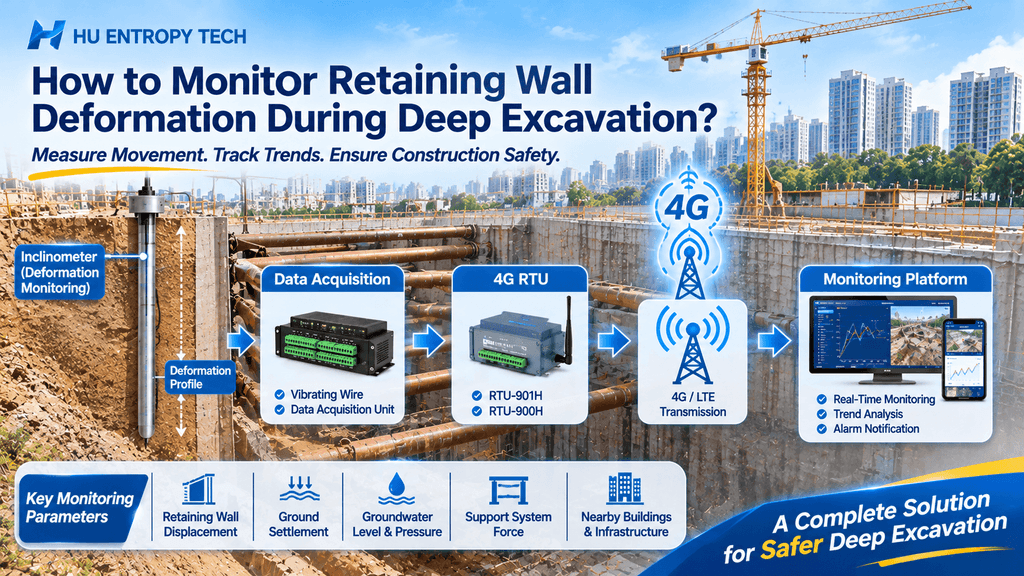
Measure wall movement. Track deformation trends. Support safer and more informed excavation decisions.
Deep excavation is a complex geotechnical process. As soil is removed, the surrounding ground responds to changes in stress, groundwater conditions, and the behavior of the excavation support system.
One of the most important parameters in deep foundation pit monitoring is retaining wall deformation.
Retaining walls help maintain excavation stability and limit the movement of surrounding soil. Monitoring their deformation allows engineers to understand how the wall responds during different excavation stages.
But how can retaining wall deformation be measured accurately and continuously?
This article introduces common monitoring methods, sensor technologies, automated data acquisition, and remote monitoring solutions used in deep excavation projects.
1. Why Is Retaining Wall Deformation Monitoring Important?
During excavation, the retaining wall may experience lateral movement due to:
- Soil removal and stress redistribution
- Changes in groundwater conditions
- Excavation depth and construction sequence
- Loads from nearby buildings and traffic
- Performance of struts, anchors, and other support systems
- Variations in soil properties
Monitoring wall deformation helps engineers evaluate the actual behavior of the excavation compared with the design assumptions.
The key objectives include:
- Identifying the magnitude of wall displacement
- Understanding the deformation profile along the wall depth
- Tracking changes during excavation
- Comparing measurements with design limits and alert thresholds
- Supporting timely engineering assessment
A single measurement shows the wall’s condition at one moment. A deformation trend helps engineers understand how that condition is evolving.
2. What Types of Retaining Wall Deformation Should Be Monitored?
The monitoring method depends on the wall type, excavation design, and project requirements.
2.1 Horizontal Displacement
Horizontal displacement is one of the most common parameters in retaining wall monitoring.
It describes how the wall moves laterally during excavation.
The movement may vary with depth, so engineers often need a deformation profile rather than only a measurement at the wall top.
2.2 Wall Top Displacement
The horizontal movement of the wall top can be monitored using surveying methods, displacement sensors, or other suitable instruments.
However, wall top movement alone may not represent the maximum deformation within the wall.
2.3 Deformation Along the Wall Depth
For diaphragm walls, sheet pile walls, and other embedded retaining structures, engineers often need to understand how displacement changes with depth.
This information helps identify the location and shape of the wall’s deformation profile.
2.4 Deformation Rate
The rate of displacement change can be important during active excavation.
A wall that is moving slowly and consistently may behave differently from one showing a rapid change over a short period.
Deformation rate should be evaluated together with absolute displacement, construction activities, and other monitoring data.
3. What Instruments Are Used to Monitor Retaining Wall Deformation?
Several monitoring technologies can be used, depending on the required accuracy, installation conditions, and monitoring frequency.
3.1 Inclinometers
<AsyncImage query=”geotechnical inclinometer casing deep excavation retaining wall instrument installation” aspectRatio=”16:9″/>
Inclinometers are widely used to measure lateral deformation of retaining structures and surrounding ground.
A typical inclinometer system includes:
- Inclinometer casing installed in a borehole or embedded structure
- A probe or sensor system
- Measurement cables or positioning equipment
- Data recording and analysis software
Traditional manual inclinometer measurements are performed by lowering a probe through the casing at defined intervals.
The measurements are used to calculate the lateral displacement profile along the depth.
For automated monitoring, fixed or in-place inclinometer systems can collect readings at configured intervals without requiring repeated manual probe measurements.
The suitability of an automated inclinometer depends on the sensor design, installation method, measurement range, and project requirements.
3.2 Automated In-Place Inclinometers
An automated inclinometer system may use multiple fixed sensors installed at selected depths.
These sensors measure changes in inclination, which can be used to estimate deformation along the monitored section.
When connected to a compatible data acquisition system, measurements can be collected and transmitted remotely.
This approach is useful when:
- Excavation progresses over an extended period
- Frequent deformation measurements are required
- Monitoring points are difficult to access
- Remote data availability is important
The final displacement profile depends on the sensor arrangement, reference conditions, calibration, and calculation method.
3.3 Displacement Sensors
Displacement transducers may be installed to measure movement between selected reference points.
They can be used for:
- Wall top displacement
- Joint or crack movement
- Local structural movement
- Relative displacement between components
These instruments provide localized measurements and should be selected according to the required range, installation geometry, and environmental conditions.
3.4 Surveying Instruments
Total stations and other surveying instruments can monitor the movement of designated wall targets.
Surveying methods are particularly useful for measuring surface or wall top displacement and for establishing reference coordinates.
They can complement inclinometer measurements by providing information about movement at accessible points.
4. How Does Automated Retaining Wall Monitoring Work?
An automated monitoring system connects field instruments with data acquisition, communication, and a monitoring platform.
A typical architecture is:
Inclinometer / Displacement Sensor → Data Acquisition Unit → RTU or Gateway → Communication Network → Monitoring Platform
The system operates through several stages.
Step 1: Install the Monitoring Instruments
Sensors are installed at locations selected according to the excavation design and monitoring plan.
Installation quality is critical because the measurement results depend on the stability of the reference points and the correct positioning of the instruments.
Step 2: Collect Field Measurements
The data acquisition equipment reads the connected sensors.
Different instruments may require different measurement interfaces, including:
- Vibrating wire measurement circuits
- RS485 digital communication
- Modbus RTU
- Analog measurement interfaces
- Dedicated inclinometer acquisition systems
The acquisition hardware must be compatible with the sensor’s output and measurement principle.
Step 3: Transmit Data Remotely
An industrial RTU or communication gateway can transmit compatible measurement data through 4G, Ethernet, or another supported communication network.
For construction sites with distributed monitoring points, 4G communication can provide a flexible way to connect field equipment with a remote platform.
Step 4: Display and Analyze Deformation Trends
The monitoring platform can display measurement records, historical trends, and data from multiple monitoring points.
Depending on the system, engineers may review:
- Displacement versus depth
- Wall top displacement
- Deformation versus excavation stage
- Displacement change over time
- Comparisons with groundwater and support system measurements
This allows the monitoring data to be evaluated in the context of actual construction progress.
5. Why Is 4G Remote Monitoring Useful for Deep Excavation?
Deep excavation sites may contain numerous monitoring points distributed around the perimeter.
Manual data collection can require repeated visits, especially when monitoring frequency increases during critical construction stages.
A 4G-based remote monitoring system can help improve data accessibility.
More Frequent Data Collection
Automated acquisition can support scheduled measurement intervals, subject to the capabilities of the sensor and acquisition equipment.
Remote Access
Engineers can review available monitoring data without needing to visit every measurement point for routine data retrieval.
Flexible Deployment
Where cellular coverage is available, 4G RTUs can reduce the need for long-distance communication cables between distributed field equipment and the remote platform.
Integration with Other Monitoring Parameters
Retaining wall deformation can be analyzed together with:
- Ground settlement
- Pore water pressure
- Groundwater level
- Support system loads
- Nearby building displacement
This integrated approach provides a more comprehensive picture of excavation behavior.
6. How Can Engineers Interpret Retaining Wall Deformation Data?
Monitoring data should not be evaluated in isolation.
A useful analysis considers several dimensions.
Absolute Displacement
How much has the wall moved relative to the established reference condition?
Deformation Profile
At which depth is the largest displacement observed?
Does the deformation shape change as excavation progresses?
Rate of Change
Is the displacement increasing gradually, stabilizing, or accelerating?
Construction Stage
Does the observed movement correspond to excavation depth, support installation, groundwater pumping, or another construction activity?
Comparison with Other Parameters
Are wall displacement trends consistent with settlement, groundwater pressure, and support system measurements?
The interpretation should follow the project’s monitoring plan and engineering criteria.
Automated alarms can help identify readings that exceed configured thresholds, but alarm settings must be established by qualified engineers. An alarm is a prompt for assessment, not an automatic determination of structural safety.
7. Common Challenges in Retaining Wall Monitoring
A reliable monitoring system requires careful attention to both instrumentation and data quality.
Incorrect Sensor Installation
Poor installation can affect measurement accuracy and the stability of reference conditions.
Inadequate Measurement Coverage
Monitoring only the wall top may miss important deformation occurring at deeper locations.
Sensor Compatibility
Not every sensor can be connected directly to a standard RTU.
Some instruments require dedicated acquisition systems or specialized interfaces.
Communication Interruptions
Cellular coverage, antenna placement, power supply, and network configuration can affect remote data transmission.
Misinterpretation of Data
A displacement value should be evaluated in relation to the baseline, measurement uncertainty, construction stage, and other relevant parameters.
Lack of Maintenance
Sensors, cables, enclosures, and communication equipment should be inspected according to the project’s maintenance requirements.
8. How HU ENTROPY TECH Supports Automated Geotechnical Monitoring
HU ENTROPY TECH provides engineering monitoring hardware for data acquisition and remote monitoring applications.
Our product portfolio includes:
- Multi-channel vibrating wire data acquisition units
- 4G vibrating wire acquisition RTUs
- Industrial 4G RTUs
- Remote sensor data acquisition and transmission hardware
- OEM/ODM hardware customization
These products can support monitoring architectures where compatible field instruments need to be connected to acquisition equipment and remote platforms.
For retaining wall deformation monitoring, the appropriate system may include specialized inclinometer equipment, displacement sensors, data acquisition units, industrial RTUs, and monitoring software.
The final configuration depends on the instrument interface, measurement requirements, channel capacity, communication method, and project architecture.
For monitoring system integrators and engineering equipment suppliers, flexible hardware integration can help address different project requirements.
Conclusion
Retaining wall deformation monitoring is an essential part of deep excavation observation.
By combining suitable instruments, reliable data acquisition, remote communication, and engineering analysis, monitoring systems can help engineers understand how retaining structures respond throughout excavation.
Automated monitoring improves access to measurement data and supports more consistent observation of deformation trends.
Measure the movement. Understand the trend. Make decisions based on reliable monitoring data.
HU ENTROPY TECH
Engineering Monitoring Hardware | Data Acquisition | Industrial RTU | OEM/ODM Solutions
Website: https://huentropytech.com/
