
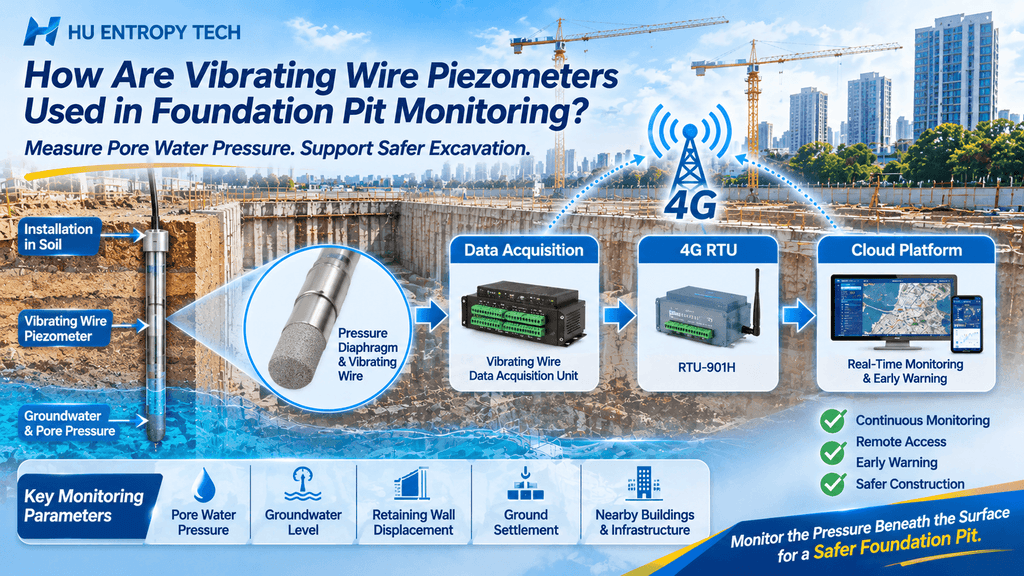
Understanding groundwater pressure is essential for evaluating soil behavior, excavation stability, and the performance of foundation pit support systems.
During deep excavation, groundwater conditions can change as soil is removed, drainage systems operate, and surrounding ground conditions respond to construction activities.
While engineers often focus on retaining wall displacement and surface settlement, pore water pressure is another critical parameter that should not be overlooked.
A vibrating wire piezometer provides a practical way to measure pore water pressure at selected depths and transmit the readings to a monitoring system.
In this article, we explore how vibrating wire piezometers work, where they are installed, and how they support automated foundation pit monitoring.
1. What Is a Vibrating Wire Piezometer?
A vibrating wire piezometer is a geotechnical instrument designed to measure pore water pressure within soil or rock.
It typically consists of:
- A pressure-sensitive diaphragm
- A tensioned vibrating wire
- An electromagnetic excitation and pickup coil
- A porous filter or pressure interface
- A protective housing
- An electrical cable for measurement and data transmission
The instrument is installed at a selected depth to monitor the water pressure within a specific soil layer or geological zone.
Unlike a conventional groundwater observation well, a piezometer is designed to measure pressure at a defined location and depth. Proper installation and sealing help isolate the target zone and reduce unwanted hydraulic connection with other layers.
2. How Does a Vibrating Wire Piezometer Work?
The measurement principle is based on the relationship between pressure, diaphragm deformation, and the resonant frequency of a tensioned wire.
The process can be explained in four stages.
Step 1: Pore Water Pressure Acts on the Diaphragm
Water pressure surrounding the instrument acts through the filter and causes the pressure-sensitive diaphragm to deform.
Step 2: Diaphragm Deformation Changes Wire Tension
The diaphragm is mechanically connected to a tensioned vibrating wire.
As the diaphragm moves, the tension in the wire changes.
Step 3: The Wire Is Excited and Its Frequency Is Measured
An electromagnetic coil excites the wire and detects its vibration.
The resulting resonant frequency changes according to the pressure applied to the diaphragm.
Step 4: The Measurement Is Converted into Pressure
A compatible vibrating wire readout or data acquisition unit records the frequency-based measurement.
Using the instrument’s calibration coefficients and the required temperature or correction information, the reading can be converted into engineering units such as kPa or meters of water head.
The measurement principle is widely used in geotechnical instrumentation because frequency-based signals can be transmitted over relatively long cable distances with limited sensitivity to changes in cable resistance. <Cite refs={[“turn792609search14″,”turn792609search6″,”turn792609search7”]}/>
3. Why Is Pore Water Pressure Important in Foundation Pit Monitoring?
Groundwater and pore water pressure influence the mechanical behavior of soil.
In saturated soil, effective stress is related to total stress and pore water pressure:
Effective stress = Total stress − Pore water pressure
In simplified terms, when pore water pressure increases while total stress remains unchanged, effective stress decreases.
This relationship is important because soil strength and deformation behavior are closely related to effective stress.
During foundation pit excavation, engineers may need to evaluate:
- Changes in groundwater pressure
- Groundwater drawdown caused by pumping
- Pressure differences between soil layers
- Potential seepage conditions
- The response of soft or low-permeability soil
- The relationship between pore pressure and ground deformation
A vibrating wire piezometer helps provide measurement data for these assessments.
It does not independently determine whether an excavation is safe. Engineers must interpret the readings together with the design, geological conditions, other monitoring parameters, and established alert criteria.
4. Where Are Vibrating Wire Piezometers Installed?
The installation location depends on the excavation design, geological profile, groundwater conditions, and monitoring objectives.
Common installation locations include:
4.1 Behind the Retaining Wall
Piezometers may be installed in the soil behind the retaining wall to monitor groundwater pressure changes associated with excavation and drainage.
4.2 Within Potentially Critical Soil Layers
Where soft clay, confined aquifers, or other sensitive geological layers are present, piezometers can be installed at selected depths to observe pressure changes within those layers.
4.3 Beneath the Excavation Base
In suitable geological conditions, piezometers may be installed beneath the excavation base to monitor groundwater pressure and evaluate conditions relevant to uplift or seepage assessments.
4.4 At Different Depths in the Same Borehole
Multiple vibrating wire piezometers can sometimes be installed at different elevations within one borehole.
This arrangement allows engineers to compare pressure conditions across several soil layers.
However, each monitoring zone must be properly isolated. The installation method and sealing details should follow the project specifications and the instrument manufacturer’s instructions. <Cite refs={[“turn792609search14″,”turn792609search17”]}/>
5. How Are Vibrating Wire Piezometers Connected to an Automated Monitoring System?
A vibrating wire piezometer is only one part of the monitoring architecture.
A typical automated system includes:
Vibrating Wire Piezometer → Vibrating Wire Data Acquisition Unit → RTU / Communication Gateway → 4G Network → Monitoring Platform
Field Measurement
The piezometer measures pore water pressure at the selected monitoring depth.
Data Acquisition
A compatible vibrating wire acquisition unit reads the sensor’s frequency-based signal and converts it into measurement data.
For multi-point monitoring, a multi-channel acquisition unit can collect readings from several vibrating wire instruments, depending on the channel configuration.
Remote Transmission
The acquisition equipment or connected RTU transmits the data through an available communication network.
A 4G RTU can be used where cellular coverage and the system architecture support remote data transmission.
Platform Visualization
The monitoring platform can display:
- Pore water pressure readings
- Pressure trends over time
- Data from different depths
- Comparison with groundwater level
- Configured threshold alarms
- Historical measurement records
The exact functions depend on the acquisition hardware, communication configuration, and monitoring software.
6. What Is the Difference Between a Vibrating Wire Piezometer and a Groundwater Level Sensor?
These instruments are related, but they do not necessarily measure the same thing.
| Instrument | Primary Measurement |
|---|---|
| Vibrating wire piezometer | Pore water pressure at a selected depth |
| Groundwater level sensor | Water level in a well or standpipe |
| Open standpipe piezometer | Hydraulic head at a defined monitoring interval |
A piezometer reading can be converted into hydraulic head when the pressure measurement and sensor elevation are known and the appropriate reference conditions are applied.
This means that a vibrating wire piezometer can provide information about groundwater conditions at depth, not simply the water level visible at the ground surface.
For foundation pit monitoring, engineers may use both pore pressure and groundwater level measurements to obtain a more complete understanding of the site’s hydraulic behavior.
7. Why Use Vibrating Wire Piezometers Instead of Manual Groundwater Monitoring?
Manual groundwater observations remain useful, especially for routine inspection and verification.
However, vibrating wire piezometers offer several advantages in automated monitoring applications.
Continuous or Scheduled Measurement
Automated acquisition can collect readings at configured intervals, helping engineers observe changes between manual inspection visits.
Remote Data Access
When connected to an RTU and monitoring platform, readings can be accessed remotely.
Multi-Depth Monitoring
Several instruments can be installed at different elevations to monitor pressure changes across geological layers.
Integration with Other Monitoring Parameters
Pore water pressure data can be compared with:
- Retaining wall displacement
- Ground settlement
- Support system loads
- Groundwater level
- Excavation progress
This combined analysis is often more informative than evaluating a single parameter independently.
Reduced Routine Data Retrieval
Automated transmission can reduce the need for personnel to visit every monitoring point solely to retrieve readings.
Field inspection, maintenance, and instrument verification remain necessary.
8. Common Challenges in Vibrating Wire Piezometer Monitoring
Reliable monitoring depends not only on the instrument itself but also on installation and system configuration.
Installation and Sealing
Incorrect installation or inadequate isolation of the target soil layer can affect measurement reliability.
Sensor Saturation and Filter Preparation
The filter and sensor preparation requirements depend on the instrument design and installation method. Follow the manufacturer’s procedures.
Cable Protection
Sensor cables should be protected against construction damage, excessive strain, and unsuitable installation conditions.
Measurement Compatibility
Vibrating wire piezometers require compatible vibrating wire measurement electronics.
They should not be connected directly to an ordinary analog input unless the acquisition device is specifically designed to support that sensor type.
Data Interpretation
Pressure readings should be evaluated using the correct calibration coefficients, sensor elevation, reference datum, and project-specific interpretation method.
A sudden change in readings should be checked against excavation activities, groundwater pumping, rainfall, other instruments, and possible equipment or communication issues.
9. How HU ENTROPY TECH Supports Vibrating Wire Piezometer Monitoring
HU ENTROPY TECH provides engineering monitoring hardware for geotechnical data acquisition and remote monitoring applications.
Our product portfolio includes:
- Multi-channel vibrating wire data acquisition units
- 4G vibrating wire acquisition RTUs
- Industrial 4G RTUs
- Remote sensor data acquisition and transmission hardware
- OEM/ODM hardware customization
These products can be considered for monitoring systems that integrate vibrating wire piezometers with other geotechnical instruments.
For system integrators and monitoring equipment suppliers, multi-channel acquisition and remote communication hardware can help build flexible monitoring architectures for foundation pits, dams, slopes, tunnels, and other infrastructure projects.
The appropriate configuration depends on sensor compatibility, channel capacity, communication requirements, power supply, and the monitoring platform.
Conclusion
Vibrating wire piezometers provide valuable information about pore water pressure within the ground.
In foundation pit monitoring, this data helps engineers understand groundwater behavior and evaluate its relationship with soil stress, excavation activities, and ground deformation.
When integrated with vibrating wire data acquisition units, industrial RTUs, and remote monitoring platforms, piezometers become part of a connected geotechnical monitoring system.
Monitor the pressure beneath the surface. Understand the changes within the ground.
HU ENTROPY TECH
Engineering Monitoring Hardware | Data Acquisition | Industrial RTU | OEM/ODM Solutions
Website: https://huentropytech.com/
