
Deep excavation projects are among the most challenging activities in urban construction and underground engineering.
Excavation for basements, underground stations, tunnels, and urban infrastructure can significantly change the stress conditions of surrounding soil and structures.
As excavation progresses, ground movement, groundwater changes, and deformation of retaining structures may affect nearby buildings, roads, underground utilities, and construction personnel.
For this reason, deep excavation monitoring is an essential part of geotechnical engineering and construction risk management.
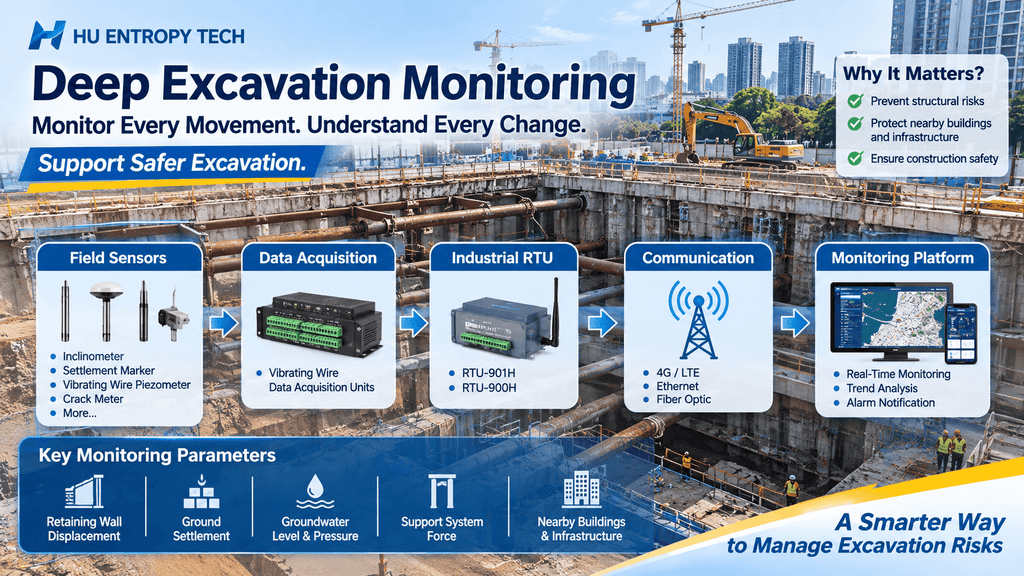
Modern monitoring systems combine field sensors, data acquisition units, industrial RTUs, communication networks, and monitoring platforms to provide engineers with timely and reliable information about excavation conditions.
In this article, we explore how an automated deep excavation monitoring system works, what parameters should be monitored, and how IoT technology supports safer and more efficient construction.
1. Why Is Deep Excavation Monitoring Necessary?
Excavation changes the original equilibrium of the surrounding ground.
As soil is removed, lateral earth pressure and groundwater conditions may change. Retaining walls, support systems, and surrounding structures can experience deformation.
Potential risks include:
- Excessive retaining wall displacement.
- Ground settlement around the excavation.
- Movement of nearby buildings and roads.
- Excessive deformation of struts or support systems.
- Groundwater drawdown or changes in pore water pressure.
- Soil instability and localized failure.
These risks are influenced by excavation depth, geological conditions, groundwater level, construction sequence, support design, and nearby infrastructure.
Monitoring provides quantitative information that helps engineers evaluate whether the observed behavior is consistent with the expected design conditions.
It also supports the implementation of appropriate construction measures when abnormal trends are identified.
2. What Parameters Should Be Monitored in Deep Excavation Projects?
A comprehensive monitoring program should be designed according to the excavation structure, surrounding environment, and potential failure mechanisms.
Common monitoring parameters include:
Retaining Wall Displacement
Horizontal displacement of diaphragm walls, sheet piles, or other retaining structures is one of the most important indicators in deep excavation monitoring.
Inclinometers and displacement sensors can be used to measure deformation at different locations or depths.
Ground Settlement
Excavation may cause settlement in the surrounding soil.
Settlement monitoring is particularly important near existing buildings, roads, railways, and underground utilities.
Common methods include precise leveling, settlement markers, and automated monitoring instruments.
Strut and Support System Forces
Struts, anchors, and other support components help maintain excavation stability.
Load cells and compatible strain measurement systems can be used to monitor changes in support forces.
Groundwater Level and Pore Water Pressure
Groundwater conditions can influence soil strength, excavation stability, and the behavior of surrounding structures.
Piezometers and groundwater level sensors are commonly used to monitor these parameters.
Building and Infrastructure Deformation
Nearby buildings, roads, pipelines, and other infrastructure may be affected by excavation-induced ground movement.
Crack meters, displacement sensors, tiltmeters, and other instruments may be used depending on the monitoring objectives.
The specific monitoring plan should be established by qualified geotechnical and structural engineers based on project conditions and applicable standards.
3. What Sensors Are Used in Deep Excavation Monitoring?
Different monitoring parameters require different measurement technologies.
| Monitoring parameter | Typical instruments |
|---|---|
| Retaining wall deformation | Inclinometers, displacement sensors |
| Ground settlement | Settlement markers, leveling instruments |
| Strut or anchor force | Load cells, compatible strain sensors |
| Pore water pressure | Vibrating wire piezometers |
| Groundwater level | Water level sensors |
| Building displacement | Displacement transducers, GNSS where appropriate |
| Structural tilt | Tiltmeters |
| Crack development | Crack meters |
For example, vibrating wire piezometers are widely used in geotechnical monitoring to measure pore water pressure.
Vibrating wire strain gauges and compatible load cells may also be used in selected applications to monitor structural or support-system behavior.
However, not every sensor can be connected directly to the same acquisition unit. Each instrument requires compatible measurement circuits, signal interfaces, and data conversion methods.
4. How Does an Automated Deep Excavation Monitoring System Work?
An automated monitoring system connects field instruments to a centralized data collection and management platform.
A typical architecture is:
Field Sensors → Data Acquisition Units → Industrial RTU / Gateway → Communication Network → Monitoring Platform
Each layer performs a specific function.
Field Sensors
Sensors measure deformation, pressure, settlement, groundwater conditions, and other physical parameters.
Data Acquisition Units
Acquisition units collect sensor signals and convert them into digital measurement values.
For vibrating wire instruments, dedicated vibrating wire measurement circuits are required.
Industrial RTUs and Gateways
RTUs or gateways collect data from compatible acquisition devices and transmit it to remote monitoring systems.
Depending on the model and configuration, they may support serial communication, Ethernet, 4G connectivity, local data storage, or scheduled data transmission.
Communication Network
Data can be transmitted through 4G LTE, Ethernet, fiber optic networks, or other suitable communication technologies.
Monitoring Platform
The platform provides data visualization, historical records, trend analysis, device status monitoring, and configurable alarm management.
This architecture allows engineers to access monitoring information without visiting every measurement point.
5. Why Is Real-Time or Automated Monitoring Important?
Traditional monitoring methods often rely on periodic manual measurements.
Manual monitoring remains valuable, particularly for verification and independent inspection. However, it may not provide sufficient temporal coverage when excavation conditions change rapidly.
Automated monitoring can offer several advantages.
More Frequent Measurements
Sensors can collect data at configured intervals, allowing engineers to observe deformation trends more closely.
Remote Data Access
Monitoring data can be reviewed from a central office or remote project management center.
Faster Notification
When configured alarm conditions are reached, the platform can notify responsible personnel through supported channels.
Reduced Manual Workload
Automated data collection can reduce repeated site visits for routine measurements.
Improved Historical Analysis
Long-term records help engineers compare deformation patterns with excavation stages, support installation, rainfall, and groundwater changes.
The appropriate sampling and upload intervals depend on the monitoring parameter, sensor characteristics, construction stage, and project risk level.
6. How Can IoT Technology Support Deep Excavation Safety?
IoT technology connects field monitoring equipment with digital construction management systems.
In a deep excavation project, IoT-based monitoring can support:
- Automatic sensor data collection.
- Remote monitoring of excavation conditions.
- Integration of multiple measurement parameters.
- Historical data analysis.
- Configurable threshold and trend alarms.
- Device communication status monitoring.
- Data sharing with project management platforms.
For example, engineers may compare retaining wall displacement, groundwater level, and support-system measurements during different excavation stages.
This integrated view can help identify unusual changes and support further engineering investigation.
It is important to emphasize that monitoring systems provide information for engineering decisions; they do not replace structural design, geotechnical assessment, or construction safety management.
Alarm thresholds and response procedures must be established by qualified professionals and linked to a clear site-specific action plan.
7. What Communication Methods Are Suitable for Deep Excavation Monitoring?
Communication requirements vary according to site layout and infrastructure availability.
RS485
RS485 is commonly used for communication between field instruments, data acquisition units, and industrial RTUs.
It is suitable for many industrial monitoring networks, especially when multiple devices are connected through a serial communication line.
Ethernet
Ethernet is useful when wired network infrastructure is available at the excavation site.
It can support communication between acquisition equipment, gateways, local servers, and monitoring systems.
4G LTE
4G is particularly useful for remote access and distributed monitoring stations.
It allows field equipment to transmit data to a remote platform without requiring a dedicated wired internet connection at every location.
Fiber Optic Communication
Fiber can be considered for large projects, long communication distances, or environments where reliable network infrastructure is required.
The selection should consider site coverage, cable routing, electromagnetic conditions, data volume, network reliability, and cybersecurity requirements.
8. How Can Solar Power Be Used at Remote Excavation Monitoring Points?
Some excavation monitoring points are located in areas where grid power is unavailable or difficult to access.
Solar-powered monitoring stations may be suitable for selected remote locations.
A typical configuration may include:
- Solar panels.
- Battery storage.
- Charge controllers.
- DC power regulation.
- Sensors and data acquisition units.
- Industrial RTUs and communication equipment.
The power system should be designed according to the total energy consumption of the connected equipment.
Engineers should also consider battery autonomy, seasonal sunlight, temperature, communication power peaks, and maintenance requirements.
For urban excavation projects with stable grid power, industrial AC/DC power supplies may be more practical.
9. How Should Engineers Select a Deep Excavation Monitoring System?
Before selecting monitoring hardware, project teams should define the monitoring requirements clearly.
Important considerations include:
1. Monitoring Objectives
Identify the structures, soil conditions, and physical parameters that require monitoring.
2. Sensor Compatibility
Confirm sensor types, measurement ranges, accuracy, output signals, and acquisition requirements.
3. Number of Monitoring Points
Determine the required acquisition channels and the distribution of monitoring locations.
4. Communication Architecture
Evaluate whether the project requires RS485, Ethernet, 4G, fiber, or a combination of communication methods.
5. Power Supply
Confirm whether monitoring points use grid power, batteries, solar power, or another power source.
6. Data Platform Integration
Check communication protocols, data formats, timestamps, measurement units, and alarm requirements.
7. Long-Term Reliability
Consider environmental protection, installation conditions, maintenance access, local data storage, and network recovery.
A successful monitoring system is not simply a collection of instruments. It is a coordinated solution in which every component is compatible with the others.
10. How HU ENTROPY TECH Supports Deep Excavation Monitoring Projects
At HU ENTROPY TECH, we provide engineering monitoring hardware, vibrating wire data acquisition units, industrial RTUs, and OEM/ODM solutions.
Our product portfolio includes:
Vibrating Wire Data Acquisition Units
- VW-401 / VW-801 / VW-1601: 4-channel, 8-channel, and 16-channel RS485 acquisition units.
- VW-402 / VW-802 / VW-1602: 4-channel, 8-channel, and 16-channel 4G hybrid vibrating wire acquisition RTUs.
These products can support compatible vibrating wire instruments used in geotechnical and structural monitoring, including selected piezometers, strain gauges, and other vibrating wire sensors.
Industrial RTUs
- RTU-800H-4G
- RTU-900H
- RTU-900H-TFT
- RTU-901H
Depending on the selected model and configuration, industrial RTUs can support remote data collection, communication, and integration with monitoring platforms.
OEM / ODM Solutions
We also support customized hardware and communication solutions for monitoring system integrators, geotechnical engineering companies, and equipment manufacturers.
Sensor compatibility, communication protocols, acquisition functions, and power requirements should always be confirmed against the relevant model specifications.
Conclusion
Deep excavation monitoring is an essential part of modern geotechnical engineering.
By combining field sensors, data acquisition units, industrial RTUs, communication networks, and monitoring platforms, engineers can obtain more frequent and reliable information about excavation behavior.
Automated monitoring supports deformation analysis, groundwater observation, remote data access, and timely notification of abnormal conditions.
For deep excavation contractors and monitoring system integrators, a well-designed monitoring architecture can improve data availability and support more informed construction risk management.
Monitor Every Movement. Understand Every Change. Support Safer Excavation.
HU ENTROPY TECH
Engineering Monitoring Hardware | Industrial RTUs | OEM / ODM Solutions
Website: https://huentropytech.com/
