
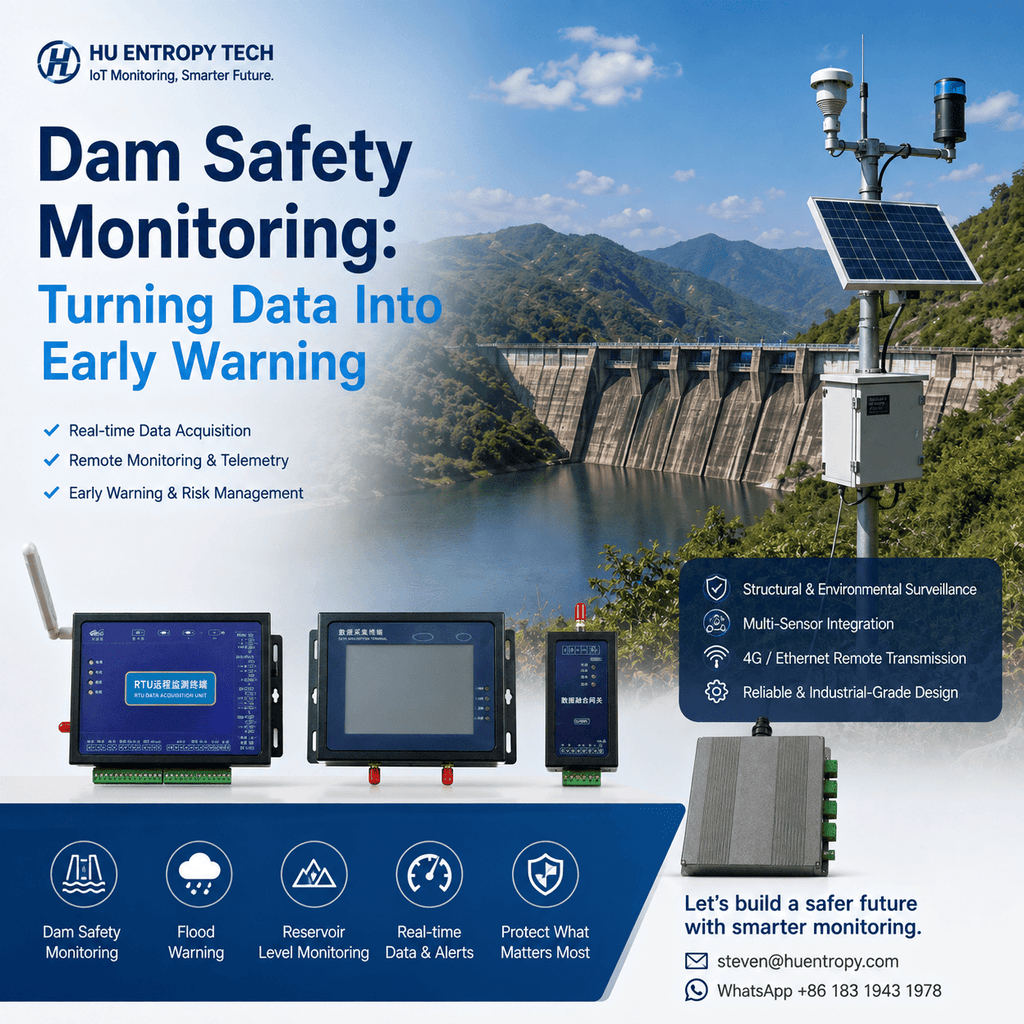
From Sensor Signals to Reliable Engineering Data
In engineering monitoring projects, sensors are responsible for measuring physical changes. But sensors alone cannot provide a complete automated monitoring solution.
Whether the project involves dam safety, bridge structural health, slope stability, tunnels, foundations, or mines, the monitoring system needs a way to collect sensor signals, convert them into usable data, and transmit that data to a monitoring platform.
This is where the Data Acquisition Unit (DAU) plays a critical role.
A reliable data acquisition system connects field sensors with industrial communication equipment and software platforms, enabling engineers to monitor structural and environmental conditions remotely and continuously.
In this article, we will explain what a Data Acquisition Unit does, why it is essential for automated monitoring, and how to select the right solution for your project.
1. What Is a Data Acquisition Unit?
A Data Acquisition Unit is a device that collects signals from sensors, processes or converts those signals into usable measurement data, and makes the data available to other systems.
Depending on the sensor type and application, it may support:
- Vibrating wire sensors
- Analog sensors, such as 4–20 mA transmitters
- Digital sensors
- RS485-connected instruments
- Other supported industrial measurement interfaces
A typical automated monitoring architecture looks like this:
Field Sensors
     ↓
Data Acquisition Unit
     ↓
Industrial RTU / IoT Gateway
     ↓
4G / Ethernet / Other Networks
     ↓
Cloud Monitoring Platform
     ↓
Engineers / Control Center
In some systems, the data acquisition function and the communication function are integrated into a single device. In others, separate acquisition units and RTUs are used.
The appropriate architecture depends on the sensor types, number of measurement points, communication requirements, and project scale.
2. Why Can’t Sensors Connect Directly to the Monitoring Platform?
A common question is: if modern sensors can measure physical parameters, why do we need an additional data acquisition device?
The answer is that a sensor’s measurement capability is not the same as a complete data acquisition and transmission capability.
There are several reasons.
2.1 Different Sensors Produce Different Signals
Different sensors use different measurement principles and output formats.
For example:
| Sensor Type | Typical Output |
|---|---|
| Vibrating wire sensor | Frequency signal |
| Pressure transmitter | Analog voltage or current |
| Digital sensor | Digital data |
| RS485 instrument | Serial communication data |
A monitoring system must be able to interpret the specific signal produced by each sensor.
For vibrating wire sensors, the acquisition device needs suitable signal excitation and frequency measurement functions. For a 4–20 mA sensor, the system needs a compatible analog input.
The acquisition hardware must therefore match the sensors used in the project.
2.2 Multiple Sensors Need Centralized Collection
A dam, bridge, or slope monitoring project may contain dozens or hundreds of measurement points.
Collecting data from every sensor individually can make the system more complicated to install, operate, and maintain.
A multi-channel data acquisition unit can collect data from multiple compatible sensors, reducing the number of separate devices required in suitable applications.
This can help simplify:
- Field wiring
- Equipment installation
- Communication configuration
- Power management
- Maintenance procedures
The actual number of channels required depends on the monitoring design and the types of sensors connected.
2.3 Measurement Data Must Be Made Available to Other Systems
Collecting a signal is only the first step.
The data may also need to be transmitted to an RTU, an IoT gateway, a SCADA system, or a cloud platform.
Standard interfaces and protocols, such as RS485 and Modbus RTU, can simplify integration with other equipment.
Without a compatible interface or protocol, even a technically capable acquisition device may be difficult to integrate into the overall monitoring system.
3. Five Key Functions of a Data Acquisition Unit
A Data Acquisition Unit may perform several important functions, depending on its design.
Function 1: Sensor Signal Acquisition
The device receives signals from connected sensors.
For vibrating wire sensors, this involves acquiring and measuring the sensor’s frequency signal. For analog sensors, it may involve sampling voltage or current signals.
Reliable acquisition is the foundation of the entire monitoring process.
Function 2: Signal Processing and Data Conversion
The acquisition device converts the raw sensor signal into a form that other devices or software can use.
Depending on the sensor and device, this may involve frequency measurement, analog-to-digital conversion, signal processing, or conversion into a standard data format.
Engineers can then use the resulting measurements for monitoring, analysis, and reporting.
Function 3: Multi-Channel Measurement
Many engineering projects require simultaneous monitoring of multiple locations or parameters.
A multi-channel acquisition unit can collect data from multiple compatible sensors through one device.
For example, a system might use:
- A single-channel unit for a small monitoring point
- A 4-channel unit for a compact installation
- An 8-channel or 16-channel unit for a larger group of sensors
Choosing the right channel configuration can help balance equipment cost, wiring complexity, and future expansion needs.
Function 4: Communication with Other Devices
A Data Acquisition Unit may provide interfaces such as RS485, RS232, or TTL, depending on the model.
When the device supports a standard protocol such as Modbus RTU, an RTU or gateway can retrieve the measurement data without requiring a completely proprietary communication architecture.
This is particularly useful when integrating equipment from different manufacturers.
Function 5: Support for Automated Monitoring
Once the measurement data is available to an RTU or monitoring platform, it can be incorporated into an automated workflow.
Depending on the overall system, this may include:
- Scheduled data collection
- Remote data transmission
- Historical data storage
- Threshold-based alarms
- Trend analysis
- Remote access for engineers
These functions may be implemented across several devices and software components rather than within the acquisition unit itself.
4. How Does a Data Acquisition Unit Work in an Automated Monitoring System?
Let’s use a slope stability monitoring project as an example.
The purpose is to monitor changes at a potentially unstable slope and provide engineers with timely information.

Step 1: Sensors Measure Field Conditions
Sensors installed at the slope measure relevant parameters, such as groundwater pressure, displacement, or strain, depending on the monitoring design.
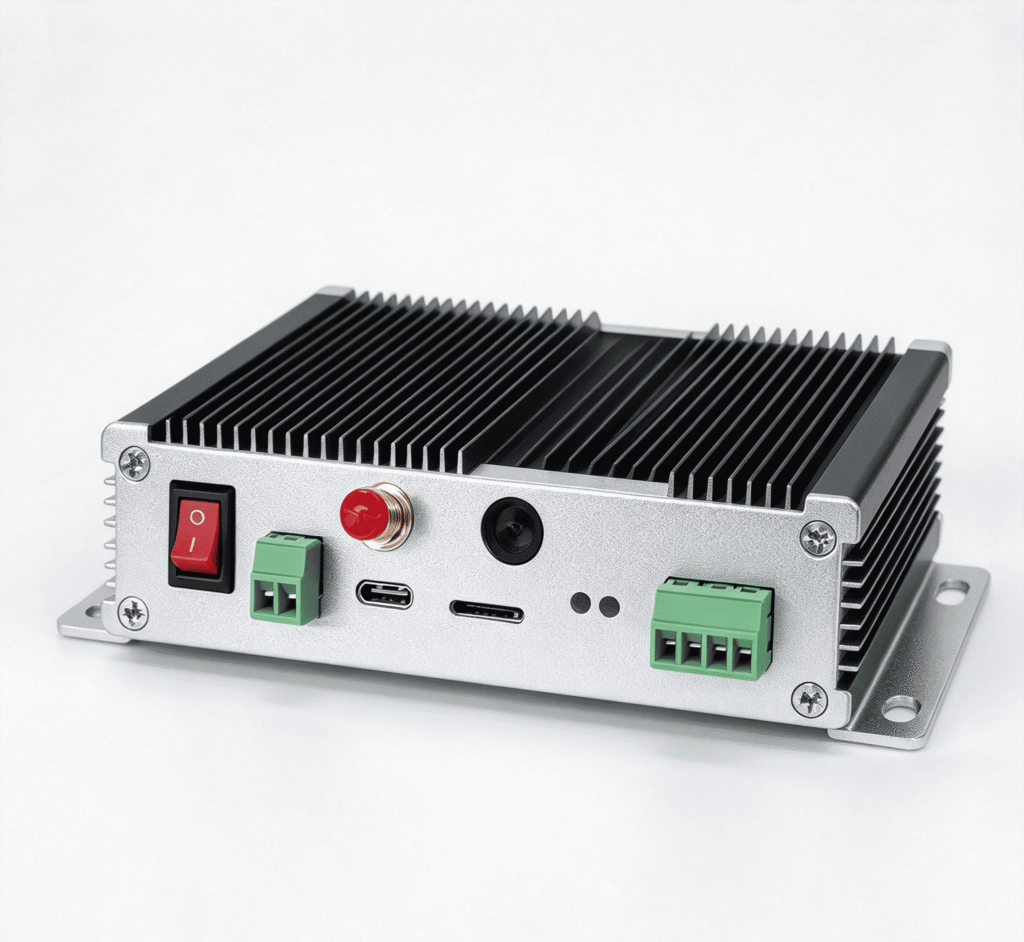
Step 2: The Data Acquisition Unit Collects Measurements
The acquisition device reads compatible sensor signals and converts them into measurement data.
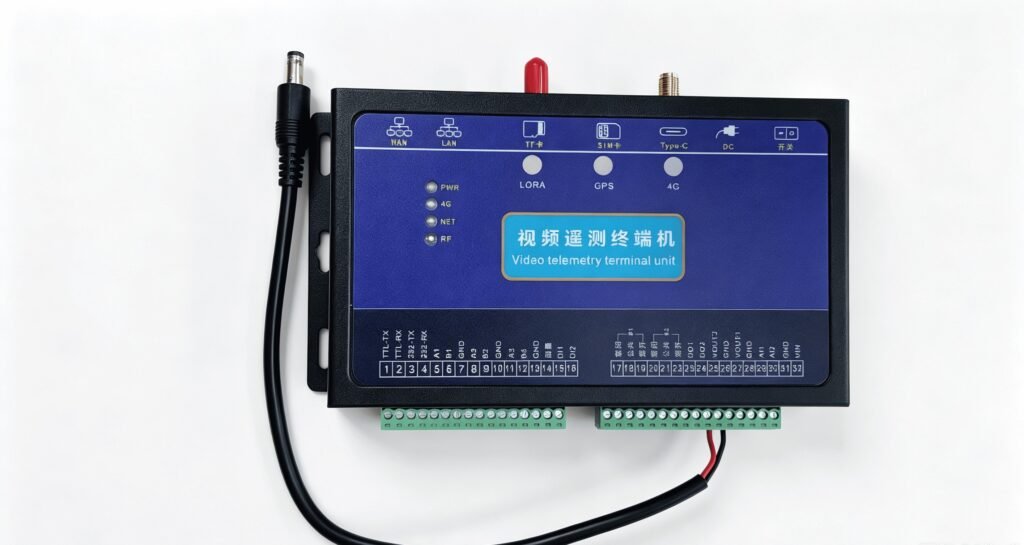
Step 3: An RTU Transmits the Data
The RTU or gateway sends the collected measurements to the monitoring platform through a supported communication network, such as 4G or Ethernet.
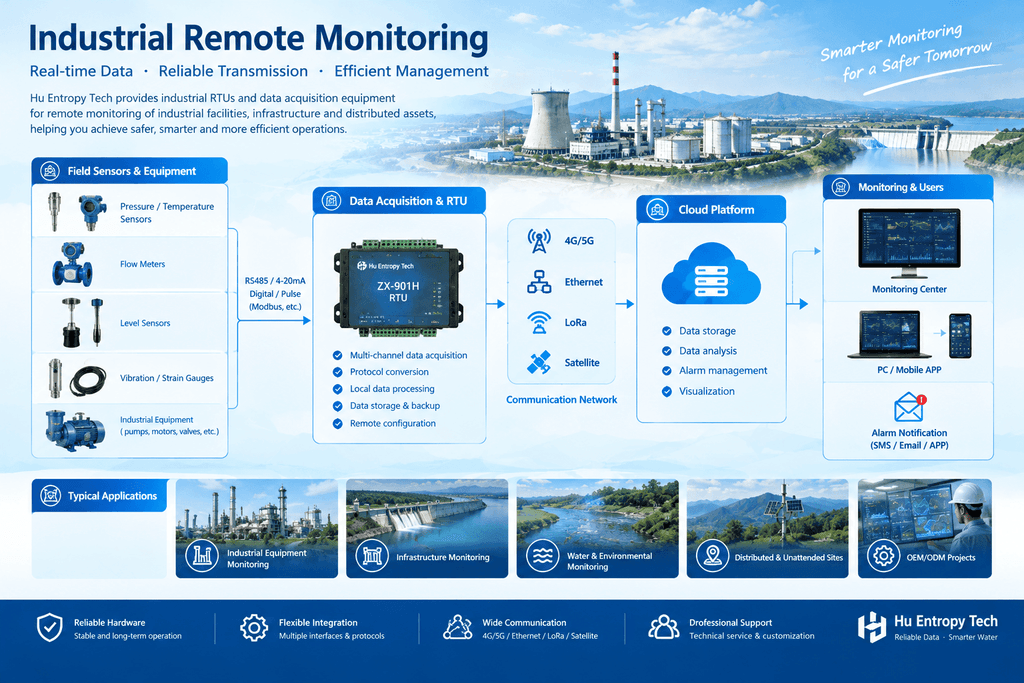
Step 4: Engineers Monitor the Results
The platform displays measurement values and historical trends. If configured thresholds are exceeded, the system can generate alerts.
This architecture allows engineers to obtain monitoring information without visiting every measurement point to collect readings manually.
However, the reliability of the final result depends on the entire chain: sensors, acquisition hardware, communications, power supply, software, and alarm configuration.
5. Data Acquisition Unit vs. Industrial RTU: What’s the Difference?
These two devices are closely related, but they do not necessarily serve the same purpose.
| Feature | Data Acquisition Unit | Industrial RTU |
|---|---|---|
| Primary role | Collect sensor measurements | Remote monitoring, telemetry, and control |
| Sensor interfaces | Depends on measurement type | Depends on supported I/O and interfaces |
| Signal measurement | Often a core function | May be integrated or handled by external devices |
| Communication | Often communicates with a host or gateway | Commonly supports remote communication |
| Data storage | Model-dependent | May include local logging |
| Remote control | Usually application-dependent | May support digital outputs, relays, or other control functions |
| Typical use | Sensor measurement and acquisition | Remote monitoring station or field gateway |
The distinction is functional, not absolute.
Some advanced RTUs include data acquisition capabilities. Some acquisition devices also support direct communication with monitoring platforms.
For example, a simple system may use a dedicated vibrating wire data logger connected to an RTU. A more integrated system may combine acquisition and remote communication in one device.
The best choice depends on system complexity, the required sensor interfaces, and the project’s operational requirements.
6. How to Choose the Right Data Acquisition Unit
Before selecting a device, engineers and system integrators should evaluate several factors.
6.1 Sensor Compatibility
Confirm that the device supports the sensor types used in the project.
For vibrating wire sensors, check the measurement method, frequency measurement performance, temperature measurement requirements, and supported sensor connections.
For analog or digital sensors, confirm the required input interfaces and signal ranges.
6.2 Number of Channels
Estimate the number of sensors that need to be connected to each acquisition unit.
Avoid choosing a unit with too few channels, which may increase equipment and wiring costs. Also avoid paying for unnecessary capacity if the project is small and unlikely to expand.
6.3 Communication Protocols
Check whether the device supports the interfaces and protocols required by the rest of the system.
RS485 and Modbus RTU are commonly used in industrial data acquisition architectures, but the actual requirements depend on the existing RTU, gateway, or monitoring platform.
6.4 Operating Environment
Consider the actual installation conditions, including:
- Ambient temperature
- Humidity and condensation
- Power supply stability
- Lightning and electrical interference
- Enclosure and installation requirements
- Accessibility for maintenance
Equipment intended for outdoor or remote installations should be selected according to the environmental demands of the application.
6.5 Integration and Expansion
If you are a system integrator, consider how easily the device can be integrated with your existing hardware and software.
It is also worth checking whether the manufacturer can support customized interfaces, communication settings, firmware, or OEM/ODM requirements where necessary.
7. The Role of Data Acquisition in Industrial IoT
Industrial IoT connects physical equipment with digital monitoring and management systems.
But an IoT platform can only work with the data it receives. If the field signals cannot be measured reliably or delivered in a usable format, the platform cannot compensate for that limitation.
A well-designed system therefore needs a reliable connection between the physical and digital layers:
Physical Layer
Sensors and Measurement Points
          ↓
Acquisition Layer
Data Acquisition Units / Data Loggers
          ↓
Communication Layer
Industrial RTUs / IoT Gateways
          ↓
Network Layer
4G / Ethernet / Other Supported Networks
          ↓
Application Layer
Cloud Platform / SCADA / Monitoring Software
          ↓
Decision Layer
Visualization / Alarms / Engineering Analysis
The acquisition layer is responsible for converting physical measurements into usable data. The communication and application layers then make that data accessible to engineers and operators.
For long-term monitoring projects, the overall architecture should also consider local data storage, communication interruptions, data integrity, and recovery procedures.
8. Hu Entropy Tech: Data Acquisition for Engineering Monitoring
At Shenzhen Hu Entropy Tech Co., Ltd., we develop hardware for engineering monitoring and Industrial IoT applications.
Our product range includes vibrating wire acquisition devices, multi-channel data acquisition units, and Industrial RTUs.
Examples include:
- ZX-201 — single-channel vibrating wire data acquisition
- ZX-401 — 4-channel acquisition
- ZX-801 — 8-channel acquisition
- ZX-1601 — 16-channel acquisition
- ZX-800H — Industrial 4G RTU
- ZX-901H — Industrial 4G Edge RTU with video overlay and remote telemetry
These products can be considered for monitoring architectures that require vibrating wire measurement, standard industrial communication, remote data transmission, or integration with IoT systems.
For monitoring equipment manufacturers and system integrators, OEM/ODM cooperation may also be explored according to the project’s hardware, communication, and integration requirements.
The appropriate product configuration should be selected based on the actual sensors, channel count, field environment, communication method, and monitoring platform.
Conclusion
A Data Acquisition Unit is a key component of an automated engineering monitoring system.
It connects field sensors with the digital systems used to monitor and analyze engineering conditions.
Its main functions may include:
- Acquiring sensor signals
- Converting signals into usable measurement data
- Supporting multiple measurement channels
- Communicating with RTUs, gateways, or other systems
- Enabling automated data collection and monitoring workflows
However, selecting an acquisition unit is not simply a matter of choosing the right number of channels.
Sensor compatibility, measurement performance, industrial reliability, communication flexibility, and system integration are all essential considerations.
For engineering monitoring companies, a well-designed data acquisition architecture can simplify installation, improve data availability, and make future system expansion easier.
At the end of the day, the purpose of data acquisition is not merely to collect signals. It is to turn field measurements into reliable, accessible, and actionable engineering data.
About Hu Entropy Tech
Shenzhen Hu Entropy Tech Co., Ltd. provides vibrating wire data acquisition hardware, Industrial RTUs, and OEM/ODM services for engineering monitoring applications.
We work with monitoring system integrators, engineering companies, equipment manufacturers, and international partners on hardware solutions for dam, bridge, tunnel, slope, foundation, and other geotechnical monitoring projects.
Website: https://huentropytech.com/
