
Digital twins are transforming the way engineers monitor, manage, and maintain critical infrastructure. From dams and bridges to tunnels, slopes, reservoirs, and industrial facilities, digital representations of physical assets are creating new opportunities for smarter and more proactive decision-making.
But there is one fundamental question that every digital twin project must answer:
How accurately does the digital model reflect what is actually happening in the physical world?
A sophisticated 3D model is only part of the solution. Without reliable, continuous, and meaningful field data, even the most advanced digital twin platform cannot provide a dependable picture of real-world conditions.
This is where industrial IoT hardware, remote data acquisition, and edge computing become essential.
1. From Static 3D Models to Data-Driven Digital Twins
A traditional digital model represents the geometry and design of a physical asset. A digital twin goes further by connecting that representation with data from the real asset.
For infrastructure monitoring, this data may include:
- Structural strain, pressure, and displacement
- Groundwater pressure and geotechnical conditions
- Water levels, rainfall, and flow
- Environmental and equipment operating conditions
- Video observations of the monitored site
When these data streams are integrated into a monitoring platform, engineers can compare current measurements with historical trends, configured thresholds, and engineering models.
The result is a more informative view of asset conditions, helping teams identify unusual changes, investigate potential risks, and make better-informed maintenance decisions.
The key is not simply collecting more data. It is collecting the right data, reliably, and delivering it in a format that the digital twin platform can use.
2. Digital Twins for Dam and Reservoir Safety
Dams and reservoirs are among the clearest examples of where digital twins can provide practical value.
A monitoring system may combine vibrating wire piezometers, strain gauges, displacement sensors, water-level sensors, and other field instruments to observe different aspects of dam behavior.
These instruments provide complementary information about the physical structure and its surrounding environment.
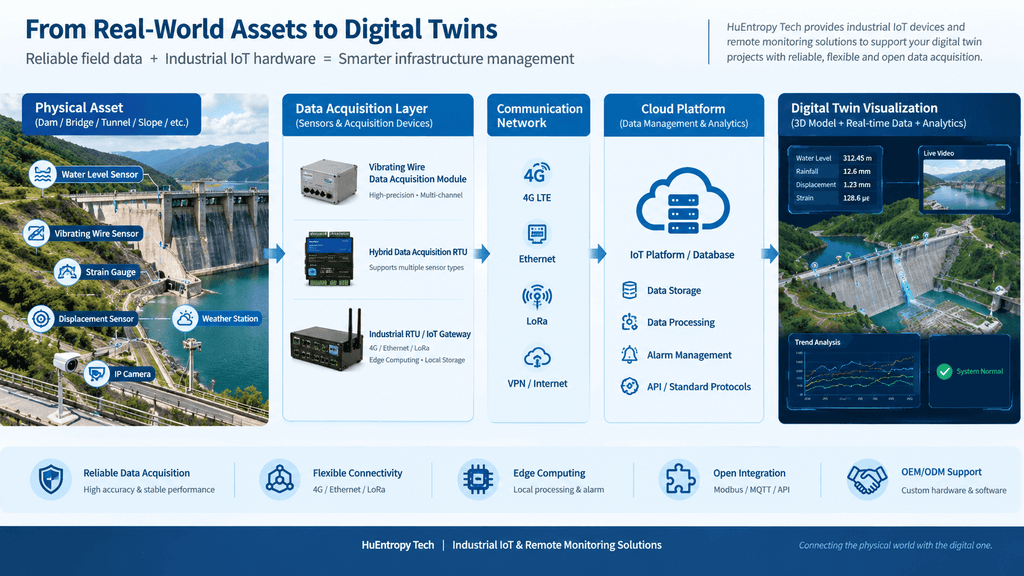
A typical system architecture includes:
- Field sensors: Measure pressure, strain, displacement, water level, and other engineering parameters.
- Data acquisition hardware: Converts sensor signals into usable digital measurements.
- Industrial RTUs and gateways: Collect, process, and transmit field data.
- Communication networks: Deliver measurements from remote locations to a central platform.
- Digital twin platform: Displays monitoring data alongside asset models, historical records, and alarm information.
For remote infrastructure, 4G connectivity, local data logging, and edge-based alarm logic can help maintain monitoring continuity and improve responsiveness.
Hu Entropy Tech provides vibrating wire data acquisition modules, hybrid data acquisition RTUs, and industrial IoT RTUs designed for integration into remote monitoring systems.
These devices can form part of the data acquisition and communication layer supporting a dam digital twin.
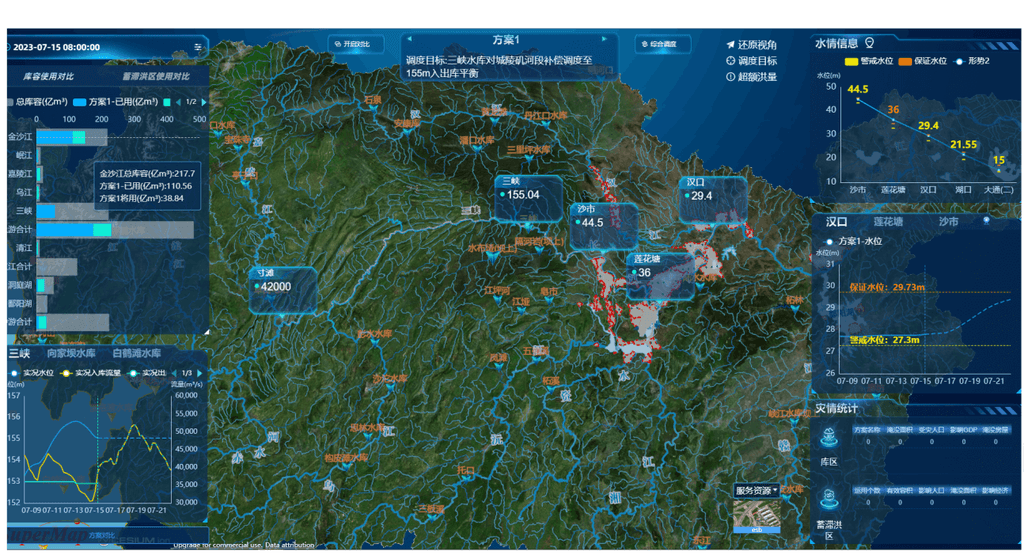
3. Bridge, Tunnel, and Slope Monitoring: Turning Measurements into Insight
Digital twins are also increasingly relevant to structural health monitoring and geotechnical engineering.
For a bridge, engineers may need to monitor strain, displacement, and other structural parameters over time.
For a tunnel or slope, measurements may include groundwater pressure, deformation, and other indicators selected according to the engineering design.
Vibrating wire sensors are widely used in geotechnical and structural monitoring applications. However, acquiring their signals accurately and consistently is only the first step.
The data must also be transmitted, stored, interpreted, and associated with the correct sensor and physical location.
Hu Entropy Tech’s vibrating wire acquisition product range includes single-channel modules, multi-channel transmitters, and hybrid RTU solutions.
Depending on the model and system configuration, these products support functions such as:
- High-precision vibrating wire signal acquisition
- RS485 communication and Modbus RTU integration
- Multi-channel monitoring
- Integration with additional digital sensors
- Local data storage and remote transmission
- Edge processing and alarm management
For digital twin developers and system integrators, these capabilities help bridge the gap between physical engineering instruments and software-based monitoring environments.
The goal is to make field measurements available to the digital model in a consistent and usable form.
4. Connecting Video and Sensor Data: Adding Visual Context
Numbers can indicate that something has changed. Video can help operators understand what is happening at the site.
Consider a remote slope monitoring station. Sensor measurements may indicate that a configured threshold has been exceeded. Operators may then need to examine the surrounding conditions to understand the event.
If sensor data and video are managed in separate systems, investigating an alarm can require switching between multiple interfaces and manually matching timestamps.
Integrating these data sources can provide a more unified operational view.
Hu Entropy Tech’s RTU-901H supports sensor acquisition, video overlay, 4G communication, LoRa connectivity, edge computing, and remote control functions. The RTU-AC04 provides a video and IoT data fusion approach, overlaying real-time sensor data directly onto compatible IP camera video streams.
These capabilities can support applications such as:
- Dam and reservoir monitoring
- Flood warning systems
- Landslide monitoring
- Remote infrastructure surveillance
- Industrial site monitoring
Video and sensor fusion does not replace engineering analysis. Instead, it adds context that can help operators verify conditions and investigate abnormal measurements.
For digital twin applications, this creates an opportunity to connect quantitative measurements with visual evidence from the physical environment.
5. Edge Computing: Why Digital Twins Need More Than Cloud Connectivity
Sending every measurement directly to a cloud platform is not always the most effective approach, especially at remote infrastructure sites.
Communication links may be unreliable. Power may be limited. Some alarms require a rapid local response, while transmitting unnecessary raw data can increase communication costs.
Edge computing addresses these challenges by processing data closer to where they are collected.
Depending on the hardware and configuration, edge functions may include:
- Local calculations and engineering parameter conversion
- Sensor data filtering
- Threshold evaluation and alarm decisions
- Local data logging
- Data buffering during communication interruptions
- Uploading stored measurements after connectivity is restored
For example, an RTU can evaluate a configured threshold locally and generate an alarm without relying entirely on a remote cloud application for that decision.
A Store-and-Forward mechanism can also help preserve measurement records during network interruptions and transmit stored data after the connection returns.
Hu Entropy Tech’s RTU portfolio includes models with edge computing, local logging, and Store-and-Forward capabilities.
For digital twin systems, these functions can improve the continuity and usability of field data. They do not eliminate every communication or data-quality risk, but they provide an important layer of resilience between the physical asset and the digital platform.
6. Open Integration Matters More Than a Closed Hardware Stack
A digital twin project rarely begins from scratch.
The system integrator may already have a preferred cloud platform, SCADA system, visualization engine, database, or analytics software. The project may also involve sensors and equipment from several manufacturers.
In this environment, hardware flexibility and interoperability are critical.
Industrial communication interfaces and protocols such as RS485, Modbus RTU/TCP, MQTT, and Ethernet can help connect field equipment with existing monitoring architectures, subject to the capabilities of each device and the integration design.
A practical digital twin architecture might look like this:
Physical asset → Sensors → Data acquisition → RTU / IoT gateway → Communication network → Data platform → Digital twin visualization and analytics
The architecture can also include video streams, historical databases, engineering calculations, and alarm management systems.
Not every device needs to perform every function. A well-designed system assigns responsibilities to the sensors, acquisition hardware, edge devices, communication infrastructure, and software platform according to the project’s requirements.
This modular approach gives system integrators greater flexibility when selecting hardware and developing application-specific solutions.
7. OEM/ODM Hardware for Digital Twin Solution Providers
Many digital twin companies specialize in software, 3D visualization, engineering analytics, or complete monitoring solutions. Developing every field hardware component in-house may not be the most efficient use of their engineering resources.
Working with a hardware partner can provide another option.
Hu Entropy Tech focuses on industrial IoT devices and remote monitoring solutions, including vibrating wire data acquisition hardware, industrial RTUs, video and IoT integration devices, and OEM/ODM services.
Depending on project requirements, cooperation may include:
- Hardware customization
- Firmware development
- Communication protocol integration
- Sensor and system integration support
- Application-specific embedded solutions
For digital twin platform developers, engineering monitoring companies, and system integrators, this can help connect software capabilities with the physical measurement infrastructure required by real-world projects.
The right approach depends on the target application, sensor requirements, environmental conditions, communication architecture, and integration specifications.
8. The Future: From Monitoring Assets to Understanding Their Behavior
The long-term value of digital twins lies in more than displaying live measurements on a screen.
When reliable field data is combined with historical trends, engineering models, analytics, and appropriate domain expertise, digital twin systems can help organizations move toward condition-based maintenance, improved risk assessment, and more informed asset management.
Artificial intelligence may further support anomaly detection, trend analysis, and predictive maintenance. However, these capabilities depend on data quality, suitable models, and validation against real engineering conditions.
The foundation remains the same: a dependable connection between the physical asset and its digital representation.
Without that connection, a digital twin risks becoming little more than a static visualization. With it, the system has the potential to become a useful operational tool.

Final Thoughts
Digital twins are not built by software alone.
They depend on a complete system that connects physical sensors, reliable data acquisition, industrial communication, edge computing, and software platforms.
For infrastructure applications, this connection is particularly important because monitoring data must remain meaningful over long operating periods and under challenging field conditions.
At Hu Entropy Tech, we believe reliable industrial IoT hardware is an important part of this foundation.
We welcome discussions with digital twin developers, engineering monitoring companies, system integrators, and OEM partners looking for flexible data acquisition and remote monitoring hardware.
Let’s connect the physical world with the digital one — one reliable measurement at a time.
Hu Entropy Tech | Industrial IoT & Remote Monitoring Solutions
Website: https://huentropytech.com/
Email: steven@huentropy.com
WhatsApp: +86 183 1943 1978
#DigitalTwin #IndustrialIoT #StructuralHealthMonitoring #InfrastructureMonitoring #EdgeComputing #RemoteMonitoring #EngineeringTechnology #OEMODM
