
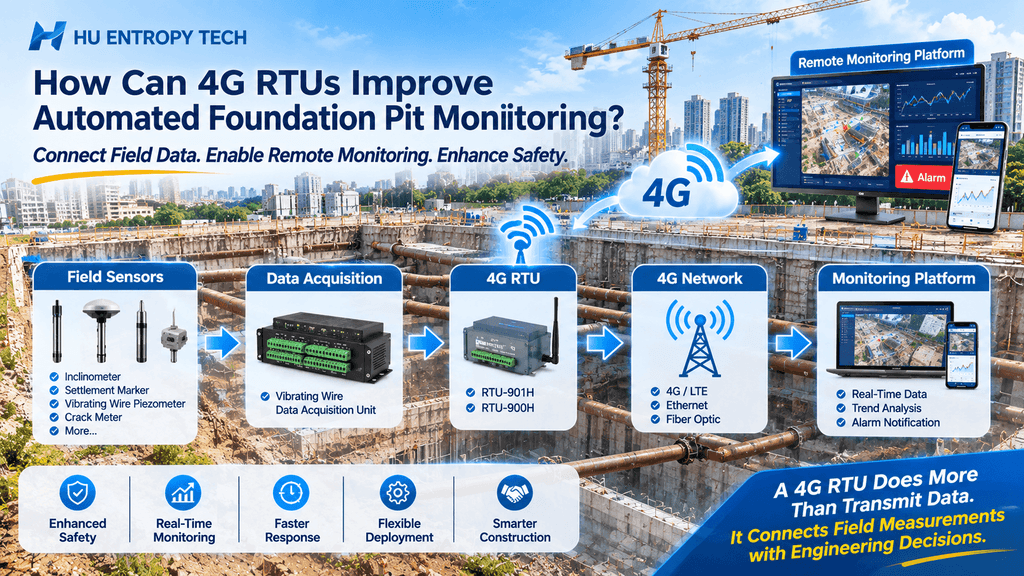
From field sensors to remote monitoring platforms, 4G RTUs help engineers build more connected, efficient, and reliable foundation pit monitoring systems.
Deep foundation pits are among the most challenging environments in construction engineering. Excavation changes the stress conditions of surrounding soil and structures, while groundwater variations and support system loads can introduce additional risks.
To understand these changes, engineers need continuous or scheduled monitoring of critical parameters.
Traditional manual monitoring remains important, but automated monitoring can provide more frequent data collection, reduce the need for routine site visits, and improve the availability of information for engineering assessment.
One important component of an automated monitoring system is the 4G Remote Terminal Unit (RTU).
1. Why Is Automated Foundation Pit Monitoring Important?
During excavation, engineers may need to monitor:
- Retaining wall displacement
- Ground and surface settlement
- Support system loads
- Groundwater level
- Pore water pressure
- Deformation of nearby buildings and infrastructure
- Changes in surrounding soil conditions
These parameters help engineers evaluate the behavior of the excavation and its surrounding environment.
When monitoring depends entirely on periodic manual measurements, changes occurring between inspection intervals may not be immediately visible.
Automated monitoring helps improve data continuity and makes remote access to field measurements more practical.
2. What Is a 4G RTU in a Foundation Pit Monitoring System?
A 4G RTU is an industrial remote monitoring device designed to collect field data, process or organize measurement information according to its capabilities, and transmit data to a remote monitoring platform through a cellular network.
In a foundation pit monitoring application, the RTU typically acts as a communication and data acquisition link between field instruments and the monitoring system.
A simplified architecture is:
Field Sensors → Data Acquisition / RTU → 4G Network → Monitoring Platform → Engineering Analysis
Depending on the system design, the RTU may integrate data acquisition functions directly or work together with dedicated sensor measurement units.
This distinction is important because different sensors require different measurement circuits and interfaces.
For example, vibrating wire sensors require compatible vibrating wire measurement electronics. They cannot simply be connected to a standard analog input without appropriate signal conditioning and measurement capability.
3. How Does a 4G RTU Work in Automated Monitoring?
A typical automated monitoring workflow includes several stages.
Step 1: Field Measurement
Sensors installed around the foundation pit measure physical parameters such as displacement, settlement, pressure, or structural load.
The sensor configuration depends on the excavation design, geological conditions, and monitoring requirements.
Step 2: Data Acquisition
Measurement devices collect readings from the connected sensors.
Depending on the system architecture, this may involve:
- Vibrating wire measurement modules
- RS485 instruments
- Modbus RTU devices
- Digital or analog measurement interfaces
- Dedicated data acquisition units
The acquisition equipment converts field measurements into data that can be transmitted or stored.
Step 3: Data Transmission Through 4G
The RTU or communication gateway sends the collected data to a remote server or monitoring platform through a 4G cellular network.
This can reduce the need for dedicated wired communication infrastructure across the monitoring site.
However, reliable communication depends on local cellular coverage, antenna installation, power availability, and network configuration.
Step 4: Remote Data Management
Once the data reaches the platform, engineers can view measurement records, compare trends, and review changes over time.
The platform may support:
- Real-time or scheduled data display
- Historical data storage
- Trend charts
- Threshold-based alarms
- Remote device status monitoring
- Data export and reporting
The actual functions depend on the platform and system integration.
4. Key Advantages of 4G RTUs for Foundation Pit Monitoring
4.1 More Frequent Data Collection
A 4G RTU-based system can support configurable measurement and reporting intervals.
For example, a project may require data collection every 15 minutes, every hour, or according to a specific monitoring schedule.
The appropriate interval should be determined by the engineering monitoring plan, site conditions, and applicable requirements.
More frequent data does not automatically mean better monitoring. Data quality, sensor installation, and correct interpretation remain essential.
4.2 Reduced Dependence on Manual Data Retrieval
Automated data transmission allows engineers to access field measurements remotely.
This is particularly useful when monitoring points are distributed across a large construction site or when frequent access to the excavation area is inconvenient.
Manual inspection and verification are still necessary for maintenance, calibration, and quality assurance.
4.3 Flexible Installation and Deployment
Compared with systems that rely entirely on long-distance communication cables, cellular RTUs can simplify deployment where 4G coverage is available.
This can be useful for:
- Urban construction sites
- Temporary excavation projects
- Remote monitoring points
- Sites with changing construction layouts
4.4 Support for Remote Alarm Notifications
When integrated with a monitoring platform, RTU-based systems can transmit measurement data for threshold evaluation.
If a parameter exceeds a configured limit, the platform may generate an alarm and notify the responsible personnel.
Alarm thresholds should be established by qualified engineers based on project design, monitoring plans, and applicable standards.
An RTU provides the data communication capability; the complete alarm function depends on the measurement system, software, configuration, and notification mechanism.
4.5 Better Visibility of Field Equipment
Some industrial RTUs support remote status reporting and configuration.
Depending on the model and system design, engineers may be able to check communication status, power conditions, or acquisition activity without visiting every monitoring point.
This helps improve maintenance planning and operational visibility.
5. What Sensors Can Be Connected to a 4G RTU?
The sensor and interface compatibility must be confirmed before selecting an RTU.
Common foundation pit monitoring instruments include:
| Monitoring Parameter | Typical Instrument |
|---|---|
| Retaining wall displacement | Inclinometer system or displacement sensor |
| Ground settlement | Settlement marker with leveling, or automated settlement system |
| Support force | Load cell or strain measurement system |
| Groundwater level | Water level sensor |
| Pore water pressure | Vibrating wire piezometer |
| Structural deformation | Crack meter or displacement transducer |
| Tilt or rotation | Tilt sensor or inclinometer |
For vibrating wire instruments, a compatible vibrating wire data acquisition unit is generally required.
For RS485 instruments, the RTU should support the appropriate communication interface and protocol, such as Modbus RTU where applicable.
Always verify sensor output, electrical interface, communication protocol, channel capacity, and measurement requirements before connecting field devices.
6. 4G RTU or Wired Monitoring System: Which Is Better?
Neither communication method is universally superior.
A wired system may be appropriate when:
- Stable cable infrastructure is already available
- The site requires a dedicated communication network
- Cellular coverage is poor
- The monitoring architecture favors centralized wired acquisition
A 4G RTU may be suitable when:
- Monitoring points are geographically distributed
- Remote data access is required
- Installation flexibility is important
- The site has reliable cellular coverage
- Rapid deployment is preferred
Some projects use a hybrid architecture, combining local wired sensor connections with 4G remote transmission.
This approach can balance measurement compatibility, installation cost, and communication flexibility.
7. What Should Engineers Consider When Selecting a 4G RTU?
Before choosing an RTU for foundation pit monitoring, engineers should evaluate:
- Sensor compatibility — Does the device support the required sensor type and measurement method?
- Channel capacity — Is the number of measurement channels sufficient?
- Communication interfaces — Are RS485, Ethernet, or other required interfaces available?
- Protocol support — Does the device support the protocol required by the monitoring platform?
- 4G connectivity — Are the supported cellular bands and local network coverage suitable?
- Power supply — Can the device operate reliably under the site’s power conditions?
- Environmental protection — Is the enclosure suitable for dust, moisture, temperature, and installation conditions?
- Data reporting interval — Can the acquisition and transmission schedule meet the monitoring plan?
- Platform integration — Can the RTU communicate with the existing software or cloud platform?
- Maintenance and configuration — Can engineers configure, diagnose, and maintain the system efficiently?
A successful monitoring system is not determined by the RTU alone. It depends on the complete solution, including sensors, acquisition equipment, communication, software, installation, and engineering procedures.
8. How HU ENTROPY TECH Supports Automated Foundation Pit Monitoring
HU ENTROPY TECH provides engineering monitoring hardware for data acquisition and remote monitoring applications.
Our product portfolio includes:
- Multi-channel vibrating wire data acquisition units
- 4G vibrating wire acquisition RTUs
- Industrial 4G RTUs
- Remote sensor data acquisition and transmission solutions
- OEM/ODM hardware customization
These products can be considered for foundation pit monitoring systems that require field data collection, remote communication, and integration with monitoring platforms.
The appropriate model and configuration depend on the sensors, channel requirements, communication protocol, power supply, and project architecture.
For system integrators and monitoring equipment suppliers, flexible hardware integration can help support different project requirements.
Conclusion
Automated foundation pit monitoring is not simply about installing sensors. It is about building a reliable connection between field measurements and engineering decisions.
A properly selected and configured 4G RTU can help improve data accessibility, support scheduled remote monitoring, and simplify communication between distributed field instruments and monitoring platforms.
The value of a 4G RTU lies in connecting the field to the engineer — making monitoring data more accessible when it matters.
HU ENTROPY TECH
Engineering Monitoring Hardware | Data Acquisition | Industrial RTU | OEM/ODM Solutions
Website: https://huentropytech.com/
