
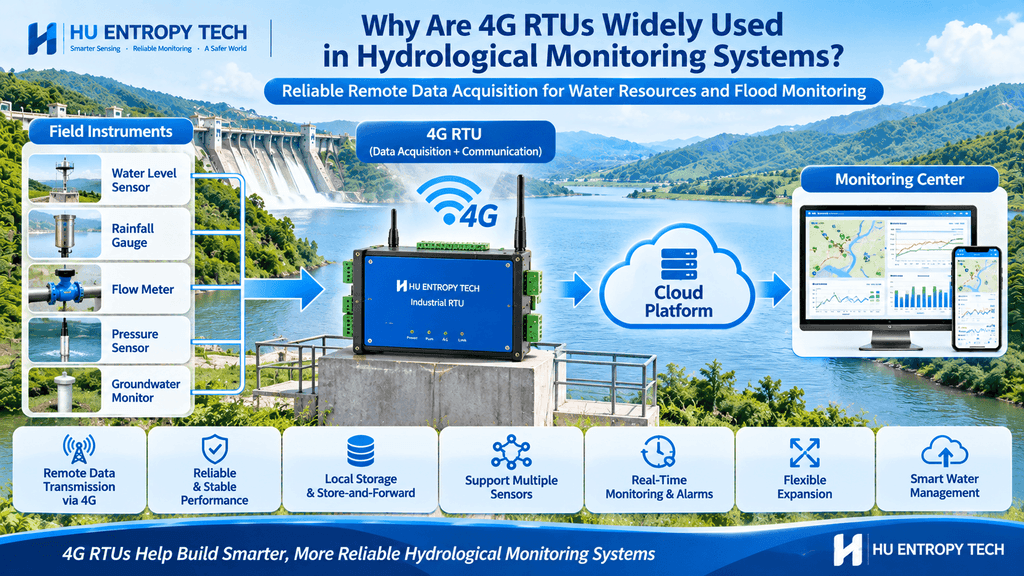
Reliable Remote Data Acquisition for Water Resources, Flood Monitoring, and Smart Hydrology
Water is one of the most important resources to monitor and manage.
From rivers and reservoirs to dams, irrigation channels, groundwater systems, and urban drainage networks, hydrological monitoring provides essential information for water resource management, flood prevention, infrastructure safety, and environmental protection.
However, many monitoring points are located far away from offices, control centers, and communication infrastructure.
Some stations are installed along remote rivers. Others are located in mountainous areas, reservoirs, flood control facilities, or unattended water conservancy sites.
In these environments, collecting measurement data is only part of the challenge. The system must also transmit data reliably, operate with limited on-site maintenance, and remain functional under changing field conditions.
This is one reason why 4G RTUs (Remote Terminal Units) have become widely used in modern hydrological monitoring systems.
But what makes 4G RTUs suitable for these applications?
1. Hydrological Monitoring Stations Are Often Widely Distributed
Unlike monitoring systems installed inside a single building or factory, hydrological monitoring stations are frequently distributed across large geographical areas.
A typical monitoring network may include:
- River water level monitoring stations
- Reservoir and dam monitoring points
- Rainfall monitoring stations
- Flood warning stations
- Groundwater monitoring wells
- Irrigation and water distribution facilities
- Drainage and water conservancy infrastructure
These stations may be separated by considerable distances.
Building wired communication infrastructure between every monitoring point and a central control room can be expensive and time-consuming.
In locations with existing cellular coverage, 4G communication offers a practical alternative.
A 4G RTU can collect data from connected field instruments and transmit it to a remote monitoring platform through a cellular network.
This allows monitoring networks to be deployed without requiring a dedicated communication cable between every station and the control center.
2. 4G Reduces Dependence on Wired Communication Infrastructure
One of the main advantages of 4G RTUs is their ability to use existing mobile network infrastructure.
For a remote monitoring station, the basic architecture may look like this:
Field Sensors → 4G RTU → Cellular Network → Cloud Platform → Monitoring Center
The RTU collects data from field instruments and sends it to the monitoring platform through a 4G connection.
Compared with installing dedicated communication cables, this architecture may offer several advantages:
- Reduced communication infrastructure investment
- Faster deployment of remote monitoring points
- Easier expansion of distributed monitoring networks
- Flexible station installation
- Centralized data access
For example, a river basin management project may need to monitor dozens or hundreds of locations.
With suitable 4G coverage and properly configured field equipment, each station can transmit its measurements to a centralized platform.
The actual deployment cost still depends on cellular coverage, SIM and data plans, power infrastructure, installation conditions, and the number of monitoring points.
3. One RTU Can Connect Different Types of Hydrological Instruments
Hydrological monitoring systems do not rely on only one type of sensor.
Depending on the project, a station may need to collect:
- Water level
- Rainfall
- Flow rate or velocity
- Water pressure
- Groundwater level
- Gate position
- Temperature
- Other environmental or process parameters
Different instruments may use different output interfaces.
Common examples include:
- RS485
- RS232
- Analog 4–20 mA
- Pulse or frequency signals
- Digital inputs
An industrial RTU with suitable interfaces can integrate multiple field instruments into one monitoring station.
This reduces the need to deploy a separate communication device for every sensor type.
However, engineers should verify electrical compatibility, input ranges, signal conditioning requirements, and communication protocols before connecting instruments.
For example, two devices may both use RS485 but still require different protocol configurations.
A suitable RTU should be selected according to the actual sensor specifications and project requirements.
4. Real-Time Remote Monitoring Supports Faster Response
Traditional hydrological monitoring may rely on manual inspection and periodic data collection.
This approach can be sufficient for some applications, but it has limitations when conditions change rapidly.
During heavy rainfall, rising river levels, or potential flood events, delayed information can affect the ability of management teams to respond.
With a 4G RTU connected to a monitoring platform, measurement data can be transmitted remotely according to the configured acquisition and reporting intervals.
The platform can then provide functions such as:
- Real-time or scheduled data monitoring
- Historical trend analysis
- Threshold-based alarms
- Remote station status monitoring
- Data visualization
- Reports and data export
For example, when a river water level approaches a predefined warning threshold, the monitoring platform can trigger an alarm according to the project’s configured rules.
It is important to distinguish between monitoring and automatic control. An RTU can support data acquisition and alarm transmission, while automatic gate operation or other control actions require suitable control hardware, logic, interlocks, and safety design.
5. Local Data Storage Helps Protect Measurement Records
Cellular communication is convenient, but it is not always available.
A monitoring station may temporarily lose its connection because of:
- Weak cellular signal
- Network maintenance
- Severe weather
- Power interruptions
- SIM or carrier network problems
If the system depends entirely on continuous transmission, communication interruptions may create gaps in the central database.
For long-term hydrological monitoring, this can affect historical analysis and operational decisions.
An RTU with suitable local storage and data recovery functions can help address this problem.
A typical Store-and-Forward workflow is:
- The RTU collects measurement data from connected instruments.
- The data is stored locally with timestamps.
- The 4G connection becomes unavailable.
- The RTU continues recording data, subject to its power and storage capacity.
- The cellular connection is restored.
- Previously stored records are transmitted to the platform.
This helps maintain a more complete monitoring dataset even when communication is temporarily interrupted.
Engineers should confirm the actual storage capacity, retention period, retransmission behavior, and power backup requirements of the selected device.
6. Low-Power Design Is Important for Remote Hydrological Stations
Many hydrological monitoring points are installed in locations without convenient access to mains electricity.
Some stations use solar panels and batteries to operate independently.
In these applications, power consumption becomes a key selection factor.
The overall energy budget should consider:
- RTU standby consumption
- Cellular communication power
- Sensor power requirements
- Acquisition frequency
- Data transmission frequency
- Startup and peak current
- Solar panel capacity
- Battery capacity and autonomy
For example, a system that transmits data every few minutes may have different energy requirements from one that reports only a few times per day.
A carefully designed acquisition and transmission schedule can help reduce unnecessary energy consumption.
However, engineers should evaluate the complete system rather than looking only at the RTU’s nominal power consumption.
The sensors, communication signal strength, battery characteristics, and local weather conditions all influence actual operating time.
7. 4G RTUs Simplify the Expansion of Hydrological Monitoring Networks
Water resource management projects often develop in stages.
An initial deployment may include several river monitoring stations. Later phases may add rainfall stations, reservoir monitoring points, groundwater monitoring wells, and additional water conservancy facilities.
A distributed 4G RTU architecture can make this expansion easier.
Each new monitoring point can be configured as an independent field station and connected to the same central monitoring platform.
This provides several practical benefits:
- Flexible station expansion
- Centralized data management
- Consistent communication architecture
- Reduced dependence on dedicated communication cables
- Easier integration of new monitoring locations
The platform can combine data from different stations to support regional analysis and water resource management.
For large projects, engineers should also consider network security, device authentication, communication costs, platform capacity, and long-term maintenance.
8. 4G RTU vs. Traditional Wired Monitoring Architecture
Both wired and wireless communication have important roles in hydrological monitoring.
The choice depends on site conditions, communication availability, project scale, and operational requirements.
| Evaluation Factor | Wired Communication | 4G RTU |
|---|---|---|
| Communication infrastructure | Requires cables or existing wired networks | Uses available cellular networks |
| Remote deployment | Cable installation may be difficult | Flexible where cellular coverage exists |
| Installation | May require more civil and cabling work | Can simplify communication deployment |
| Network coverage | Depends on cable or network infrastructure | Depends on cellular coverage |
| Expansion | May require additional cabling | New stations can often be added independently |
| Communication cost | Infrastructure and maintenance costs | SIM and data service costs |
| Power requirements | Depends on field equipment | RTU and cellular communication need suitable power |
A 4G RTU is not automatically the right choice for every location.
Where cellular coverage is weak or unavailable, other communication methods—such as Ethernet, radio, LoRa, satellite communication, or dedicated wired networks—may be more appropriate.
The best solution is the one that matches the real conditions of the monitoring site.
9. What Should Engineers Consider When Selecting a 4G RTU?
Before choosing a 4G RTU for a hydrological monitoring project, engineers should evaluate several key factors.
1. Sensor compatibility
Does the RTU support the electrical interfaces and communication protocols required by the connected instruments?
2. Channel capacity
How many sensors need to be connected at each monitoring station?
3. Cellular communication
Does the device support the required cellular bands and network services in the deployment country or region?
4. Data storage
Can the device store measurement records locally when the network is unavailable?
5. Power consumption
Is the device suitable for the station’s mains, battery, or solar power arrangement?
6. Platform integration
Can the RTU communicate with the existing monitoring platform through supported protocols such as MQTT, Modbus TCP, or other configured interfaces?
7. Environmental suitability
Can the device operate within the site’s temperature, humidity, electrical, and installation conditions?
8. Long-term support
Are technical documentation, firmware maintenance, replacement units, and after-sales support available?
These questions help ensure that the selected RTU is suitable for the complete monitoring application—not just the communication requirement.

10. HU ENTROPY TECH Solutions for Remote Monitoring
At HU ENTROPY TECH, we provide vibrating wire data acquisition hardware, industrial RTUs, and OEM/ODM services for engineering monitoring applications.
Our product portfolio includes different options for remote acquisition and industrial communication.
RTU-800H-4G
A compact industrial 4G RTU option for remote monitoring applications.
RTU-900H and RTU-900H-TFT
Industrial RTU options for field data acquisition and monitoring system integration, with the TFT version providing a local display option.
RTU-901H
An industrial RTU option for remote monitoring and data integration applications, including configured solutions involving sensor data and video integration.
VW-402, VW-802, and VW-1602
4G hybrid vibrating wire acquisition RTU options with 4-channel, 8-channel, and 16-channel configurations respectively.
These products serve different application requirements. Their supported interfaces, protocols, power specifications, storage functions, and communication capabilities vary by model.
For hydrological monitoring projects, the appropriate product should be selected according to the sensors, station architecture, communication conditions, and platform requirements.
We also support OEM/ODM cooperation for customers who need customized hardware solutions or their own product configurations.
Explore our products and services:
Conclusion: 4G RTUs Connect Remote Hydrological Stations to Smarter Water Management
Modern hydrological monitoring is moving beyond periodic manual data collection.
Water resource managers increasingly need distributed monitoring stations, remote data access, historical records, and timely warning information.
A 4G RTU can help connect remote field instruments to centralized monitoring platforms without requiring dedicated communication cables at every location.
When combined with compatible sensors, suitable power systems, local data storage, and reliable platform integration, it becomes an important component of modern hydrological monitoring infrastructure.
The real value of a 4G RTU is not simply that it connects a device to the internet.
It helps turn a remote monitoring point into part of a connected water management system.
Question for engineers and water management professionals:
In your hydrological monitoring projects, what is the biggest challenge: cellular coverage, power supply, sensor integration, data reliability, or real-time flood warning?
#HydrologicalMonitoring #4GRTU #WaterManagement #FloodMonitoring #WaterResources #IndustrialIoT #RemoteMonitoring #DataAcquisition #SmartWater
