
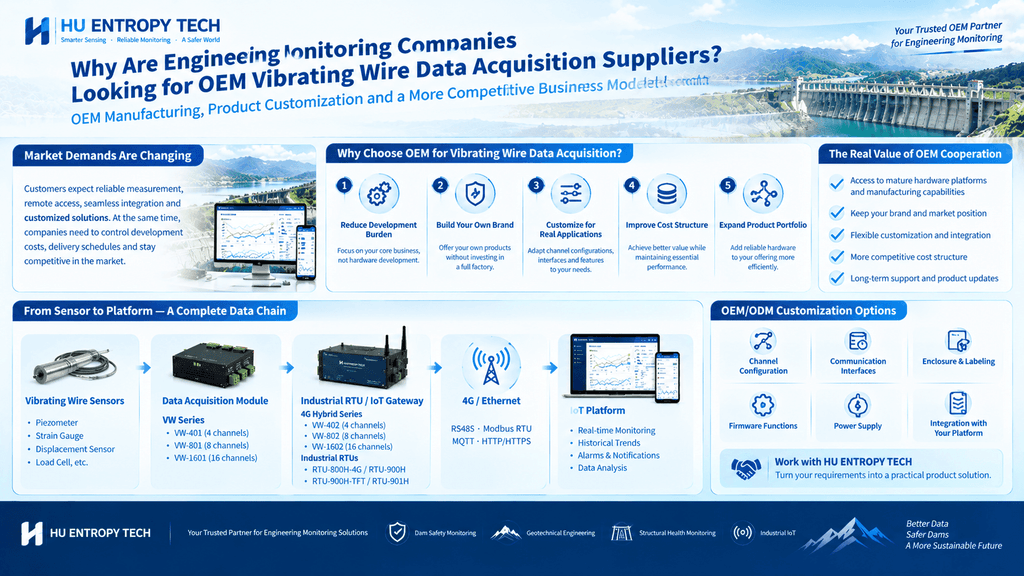
OEM Manufacturing, Product Customization, and a More Competitive Business Model
Engineering monitoring companies are facing a changing market.
Customers increasingly expect reliable measurement, remote data access, seamless integration with monitoring platforms, and solutions tailored to specific projects. At the same time, equipment suppliers must manage development costs, delivery schedules, technical support, and price competition.
For many monitoring companies, developing every piece of hardware in-house is no longer the only option.
This is one reason why more companies are exploring OEM vibrating wire data acquisition suppliers.
OEM cooperation allows a company to focus on its core strengths—engineering expertise, software, system integration, project delivery, and customer relationships—while working with a specialized manufacturer to supply the required hardware.
But what makes this business model attractive, and what should companies consider before choosing an OEM partner?
1. Reduce the Burden of Hardware Development
Developing a vibrating wire data acquisition instrument involves more than designing a circuit board.
It may require measurement algorithms, signal processing, hardware design, firmware development, communication interfaces, environmental testing, manufacturing, and ongoing technical maintenance.
For a company whose core business is engineering monitoring or system integration, building and maintaining all these capabilities internally can consume substantial resources.
Working with an OEM supplier can provide access to existing hardware platforms and established manufacturing capabilities.
Instead of starting every project from scratch, companies may be able to adapt an existing product to their application requirements.
This can help them allocate more resources to system design, software development, project implementation, and market expansion.
2. Build Your Own Brand Without Building an Entire Factory
Many monitoring companies want to establish their own equipment brands.
A proprietary brand can help a company strengthen customer recognition, maintain a consistent product portfolio, and develop long-term commercial relationships.
However, owning a brand does not necessarily require owning the entire manufacturing operation.
Through an appropriate OEM arrangement, a company may be able to offer products under its own brand, subject to agreed specifications, labeling requirements, intellectual property arrangements, and applicable regulatory obligations.
The OEM partner may provide the hardware platform and manufacturing services, while the customer manages branding, sales channels, application engineering, and customer support.
For companies that want to expand their product portfolios without making a major investment in manufacturing infrastructure, this can be a practical option.
3. Customize Hardware for Real Engineering Applications
Engineering monitoring projects are rarely identical.
A dam safety project may require a different channel capacity and installation arrangement from a foundation pit, tunnel, slope, bridge, or mining monitoring project.
Some applications prioritize multi-channel acquisition. Others require remote connectivity, integration with existing equipment, or compatibility with a customer’s monitoring architecture.
An OEM supplier may support customization in areas such as:
- Channel configuration and product variants
- Communication interfaces and supported protocols
- Power supply and installation requirements
- Firmware behavior and data acquisition settings
- Enclosure, connectors, labeling, and branding
- Integration with customer-developed software or gateways
The actual scope depends on the supplier’s engineering capabilities and the agreed project requirements.
The key is to identify which requirements can be met by an existing product and which genuinely require customization.
A good OEM partner does not simply sell hardware. It helps translate application requirements into a practical product configuration.
4. Improve Cost Structure Without Compromising Essential Performance
For many international monitoring companies, the cost of hardware directly affects project competitiveness.
Manufacturing in China can offer access to an established electronics supply chain and competitive production resources. When a suitable manufacturer is selected, this may help reduce hardware costs compared with developing and manufacturing an equivalent solution independently.
However, the lowest purchase price does not automatically produce the lowest total cost.
Engineering companies should also evaluate:
- Measurement performance and repeatability
- Product consistency between batches
- Integration and commissioning effort
- Firmware maintenance and technical support
- Spare parts and replacement arrangements
- Delivery lead times and minimum order quantities
- Long-term product availability
A more useful comparison considers the total cost of delivering and maintaining a working monitoring system—not just the price of one acquisition unit.
The objective is to achieve a competitive cost structure while maintaining the performance and reliability required by the application.
5. Expand Product Portfolios More Efficiently
A monitoring company may already have strong capabilities in sensors, software, engineering services, or project integration but lack a complete range of acquisition hardware.
OEM cooperation can help fill this gap.
For example, a company may want to offer:
- Compact vibrating wire data acquisition units
- Multi-channel acquisition instruments
- 4G-enabled acquisition RTUs
- Industrial RTUs for remote monitoring
- Hardware configured for specific integration requirements
Working with a supplier that offers multiple product configurations can simplify product selection and portfolio expansion.
At HU ENTROPY TECH, our portfolio includes the VW series of vibrating wire data acquisition units, 4G hybrid acquisition RTUs, and industrial RTUs. Depending on the model, these products can serve different acquisition and remote monitoring requirements.
Examples include:
- VW-401, VW-801, and VW-1601: 4-channel, 8-channel, and 16-channel vibrating wire data acquisition units with RS485 interfaces.
- VW-402, VW-802, and VW-1602: 4G hybrid acquisition RTU variants in 4-channel, 8-channel, and 16-channel configurations.
- RTU-800H-4G, RTU-900H, RTU-900H-TFT, and RTU-901H: industrial RTU options for different remote monitoring and integration requirements.
Interface availability, communication functions, and other specifications vary by model and should be confirmed against the relevant technical documentation.

6. Integrate Hardware With Existing Software and IoT Platforms
Hardware alone is rarely the complete solution.
Many engineering monitoring companies already operate their own cloud platforms, dashboards, alarm systems, databases, or project management software.
Their priority is not simply to purchase an acquisition instrument. It is to make the instrument work within an existing technical ecosystem.
Before choosing an OEM supplier, companies should clarify:
- Which field interfaces are supported?
- Which communication protocols are available?
- How are measurement values represented and transmitted?
- Can the equipment work with the existing gateway or platform?
- How are communication failures and missing data handled?
- Which integration tasks require additional development?
For example, RS485 is a physical communication interface, while Modbus RTU is a communication protocol commonly used over serial links. MQTT and HTTP/HTTPS may be relevant to platform-side integration when supported by the selected device or gateway architecture.
These technologies serve different purposes and should not be treated as interchangeable features that every product automatically supports.
Early technical discussions can prevent costly integration problems later.
7. Access Manufacturing Expertise While Retaining Market Knowledge
An international monitoring company may understand its customers, local regulations, project conditions, and application requirements better than a hardware manufacturer serving multiple markets.
A specialized OEM supplier, meanwhile, may have deeper experience in hardware development, manufacturing processes, and product configuration.
The two sides can complement each other.
The customer contributes application knowledge, market access, and product positioning. The manufacturer contributes hardware engineering and production capabilities.
A successful partnership depends on clearly defining responsibilities, including:
- Product specifications and acceptance criteria
- Branding and labeling requirements
- Firmware changes and customization costs
- Quality control and production consistency
- Technical documentation and after-sales support
- Intellectual property and confidentiality
- Warranty terms and future product revisions
These details should be agreed upon before commercial commitments are made.
8. How to Evaluate an OEM Vibrating Wire Data Acquisition Supplier
Not every hardware supplier is suitable for long-term OEM cooperation.
A supplier may offer competitive pricing but have limited engineering support. Another may have strong technical capabilities but be unable to meet the required production volume or customization schedule.
A structured evaluation should cover at least five areas.
Measurement capability: Can the hardware meet the required sensor compatibility, measurement range, resolution, and performance requirements?
Product and interface options: Are the channel configurations, interfaces, and communication methods suitable for the intended application?
Customization capability: Can the supplier support the required firmware, hardware, enclosure, branding, or integration changes?
Manufacturing and quality management: Can the supplier maintain consistent quality, traceability, and delivery performance?
Long-term cooperation: Is there a clear process for technical communication, product updates, spare parts, and after-sales support?
Requesting technical documentation, sample units, and a practical integration evaluation can help establish whether the partnership is suitable before scaling up orders.
Why HU ENTROPY TECH?
At HU ENTROPY TECH, we provide vibrating wire data acquisition hardware, industrial RTUs, and OEM/ODM services for engineering monitoring applications.
Our product portfolio supports different channel configurations and monitoring architectures, helping customers evaluate hardware options based on their actual project requirements.
For international equipment brands, distributors, monitoring companies, and system integrators, OEM/ODM cooperation can be an opportunity to expand a product portfolio without developing every hardware component independently.
We believe the right partnership should be built on more than price. It should combine practical engineering, product adaptability, reliable communication, and a clear understanding of each customer’s business model.
Explore our products and services:
If your company is evaluating OEM vibrating wire data acquisition hardware, we welcome technical discussions about your application, target specifications, and customization requirements.
Final Thoughts
OEM cooperation is not simply a way to purchase equipment at a lower price.
It is a business strategy that can help engineering monitoring companies balance product development, manufacturing investment, market positioning, and technical integration.
The most suitable partner is one that understands both the hardware requirements and the commercial objectives behind the product.
For engineering monitoring companies, the real question is not whether to manufacture everything in-house. It is which capabilities should remain in-house—and which can be developed more efficiently through the right manufacturing partnership.
Question for engineers and business owners: When evaluating an OEM data acquisition supplier, which factor matters most to your company: measurement performance, customization, integration capability, delivery reliability, or total cost of ownership?
#OEM #ODM #VibratingWire #DataAcquisition #EngineeringMonitoring #IndustrialIoT #StructuralHealthMonitoring #GeotechnicalEngineering #HardwareManufacturing
