
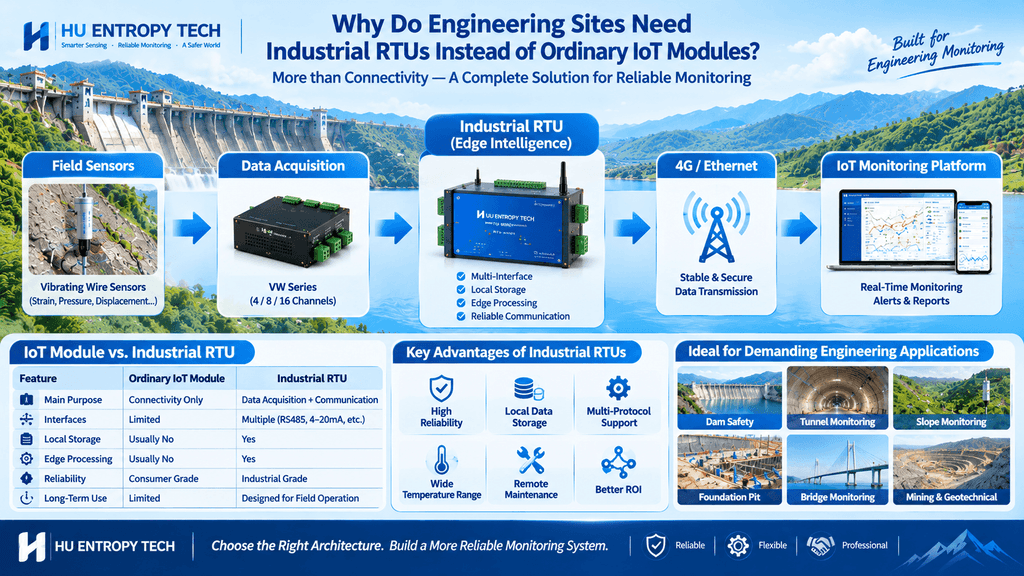
Understanding the Differences in Reliability, Data Acquisition, Communication, and Field Operations
In modern engineering monitoring projects, collecting data is only the beginning.
A monitoring system may need to operate continuously at a dam, tunnel, bridge, mining site, foundation pit, or remote slope. It may need to collect data from multiple types of sensors, communicate with different field devices, transmit information to a remote platform, and recover data after network interruptions.
In these environments, the hardware responsible for data acquisition and communication plays a critical role.
Some projects use ordinary IoT communication modules to connect sensors or devices to the internet. These modules can be suitable for simple applications. However, when monitoring requirements become more complex, an industrial RTU (Remote Terminal Unit) may provide a more appropriate architecture.
So, what is the difference between an ordinary IoT module and an industrial RTU? And why do engineering monitoring projects often require more than basic connectivity?
1. Connectivity Is Not the Same as Industrial Data Acquisition
An ordinary IoT module is generally designed to provide a particular communication function.
Depending on its design, it may provide 4G, Wi-Fi, Bluetooth, LoRa, or another communication interface. It can connect a device to a network and transfer data.
An industrial RTU, however, is typically designed to perform several functions within a remote monitoring system:
- Collect data from connected sensors and instruments
- Interface with different field devices
- Process and organize measurement data
- Communicate with remote monitoring platforms
- Manage local data storage
- Support remote configuration and maintenance
- Operate as part of a distributed monitoring architecture
The distinction is not simply whether a device supports 4G or Ethernet.
It is about what the device can do between the sensor and the monitoring platform.
A communication module may provide the connection, while an RTU can serve as a more complete field-level data acquisition and control unit.
Of course, some advanced IoT gateways also provide RTU-like functions. The actual comparison should always be based on product specifications rather than product names alone.
2. Engineering Sites Require Multiple Interface Options
Engineering monitoring systems often contain different types of sensors and instruments.
For example:
- Vibrating wire piezometers
- Strain gauges
- Displacement sensors
- Water level sensors
- Temperature sensors
- Pressure transmitters
- Flow monitoring instruments
- Digital field devices
These devices may use different electrical interfaces and communication methods.
Common examples include:
- RS485
- RS232
- TTL
- Analog 4–20 mA
- Digital inputs and outputs
- Relay interfaces
A simple communication module may only support a limited set of interfaces.
An industrial RTU designed for monitoring applications may offer a broader range of interfaces, depending on its model and configuration.
This flexibility is particularly useful when integrating different instruments into one monitoring system.
Before selecting an RTU, engineers should confirm the sensor output type, electrical specifications, communication protocol, channel requirements, and wiring arrangement.
The objective is to build a compatible acquisition architecture—not simply to choose a device with the largest number of interfaces.
3. Long-Term Field Operation Requires Hardware Reliability
An engineering monitoring system may be installed in locations that are difficult to access.
Examples include:
- Dam galleries and reservoir facilities
- Remote mountain slopes
- Underground tunnels
- Mining areas
- Large construction sites
- Remote water conservancy facilities
Once equipment has been installed, frequent maintenance can be expensive and inconvenient.
Industrial RTUs are generally designed with field operation in mind. Depending on the product, important design considerations may include:
- Operating temperature range
- Power supply stability
- Electrical protection
- Enclosure and installation requirements
- Communication stability
- Long-term component availability
- Environmental and electromagnetic compatibility
However, the term “industrial grade” should not be treated as an automatic guarantee of reliability.
Engineers should check the actual operating temperature range, protection rating, electrical specifications, certifications, and environmental test information of the selected product.
A device that works well in an office or laboratory environment may not necessarily be suitable for continuous operation in a remote engineering installation.
4. Network Interruptions Must Not Mean Data Loss
One of the most important challenges in remote monitoring is unstable communication.
A monitoring station may rely on 4G or Ethernet to transmit measurement data. However, network interruptions can occur because of poor signal coverage, equipment maintenance, power interruptions, or temporary carrier network problems.
If the field device only forwards data in real time without local storage, measurement records may be lost when communication fails.
For long-term engineering monitoring, this can create gaps in the historical dataset.
A suitable RTU architecture may support:
- Local data storage
- Timestamped measurement records
- Automatic reconnection
- Data retransmission after communication recovery
- Configurable acquisition and transmission intervals
This approach is commonly known as Store-and-Forward.
A simplified workflow is:
- The RTU collects measurement data.
- Data is stored locally.
- The communication network becomes unavailable.
- The RTU continues recording data, subject to its storage and power capabilities.
- The network connection is restored.
- Stored records are transmitted to the monitoring platform.
The availability of these functions depends on the specific RTU model and its firmware configuration.
For dam safety, tunnel monitoring, and other long-term projects, engineers should consider data recovery as part of the original system design rather than as an optional feature added later.
5. Edge Processing Can Reduce Communication Complexity
Not every measurement needs to be processed entirely in the cloud.
In some applications, field devices need to perform basic processing before transmitting data.
Depending on the device’s capabilities, edge functions may include:
- Data filtering and formatting
- Protocol conversion
- Threshold comparison
- Event detection
- Data packaging
- Scheduled acquisition and transmission
- Basic local logic
For example, a monitoring station may collect sensor measurements at regular intervals but transmit aggregated or formatted records to the cloud according to a different schedule.
This can help manage communication costs and reduce unnecessary data transmission.
It is important to distinguish between basic edge processing and advanced analytics. Complex modeling and large-scale data analysis may still be better handled by a dedicated platform or server.
The appropriate division of work depends on project requirements and device capabilities.
6. Protocol Compatibility Matters More Than the Number of Communication Ports
A monitoring system may contain equipment from different manufacturers.
Even when two devices both support RS485, they may use different communication protocols or data formats.
For example:
- Modbus RTU is commonly used for serial field communication.
- Modbus TCP is used in Ethernet-based industrial communication.
- MQTT is commonly used for messaging between devices, gateways, and IoT platforms.
- HTTP/HTTPS can support API-based data exchange.
It is important to understand that RS485 is an electrical communication interface, not a protocol.
An RTU’s ability to communicate with another device depends on both interface compatibility and protocol implementation.
Before purchasing equipment, confirm:
- Supported protocols
- Communication parameters
- Register maps or data formats
- Data transmission methods
- Platform integration requirements
- Whether additional firmware development is necessary
A well-planned communication architecture can reduce integration work and simplify future system expansion.
7. Power Management and Remote Maintenance Are Important in Field Applications
Many engineering monitoring stations are installed far from permanent infrastructure.
Some locations have limited access to electrical power, while others require stable operation over long periods.
When evaluating an RTU, engineers should consider:
- Input voltage range
- Power consumption
- Startup current
- Power supply protection
- Whether backup power is required
- Remote configuration capabilities
- Device status monitoring
- Firmware update and maintenance arrangements
For remote installations, the ability to diagnose equipment without repeatedly sending technicians to the site can significantly improve operational efficiency.
The RTU should therefore be considered part of the overall maintenance strategy, not merely a communication component.
8. Industrial RTU vs. Ordinary IoT Module: A Practical Comparison
The following table summarizes typical differences. Actual capabilities vary by product.
| Evaluation Factor | Ordinary IoT Module | Industrial RTU |
|---|---|---|
| Main purpose | Connectivity | Field acquisition and remote monitoring |
| Sensor interfaces | Often limited or application-specific | Multiple interface options, model-dependent |
| Data acquisition | May require external controller | Often integrated |
| Data processing | Usually basic | May support local processing |
| Local storage | Depends on the module | Often available on monitoring-oriented models |
| Protocol support | Depends on firmware | May support multiple industrial protocols |
| Remote management | Varies | Often designed for field device management |
| Application | Simple connected devices | Distributed industrial and engineering monitoring |
An ordinary IoT module may be sufficient for a simple sensor that only needs to transmit a small amount of data.
An industrial RTU becomes more relevant when the project requires multiple interfaces, independent field acquisition, local data management, protocol integration, and long-term remote operation.
The right choice depends on the actual system architecture, not on the product category alone.
9. Where HU ENTROPY TECH Industrial RTUs Fit In
At HU ENTROPY TECH, we provide vibrating wire data acquisition hardware, industrial RTUs, and OEM/ODM services for engineering monitoring applications.
Our product portfolio includes several RTU and acquisition options for different monitoring requirements.
RTU-800H-4G
A compact industrial 4G RTU option for remote monitoring applications.
RTU-900H and RTU-900H-TFT
Industrial RTU options for field data acquisition and monitoring system integration. The TFT version provides a display option for applications where local status and information viewing are required.
RTU-901H
An industrial RTU option for remote monitoring and data integration applications. It can also support application scenarios involving sensor data and video integration, subject to the system configuration.
VW Series Vibrating Wire Acquisition Units
For projects that specifically require vibrating wire sensor measurement, the VW series provides different channel configurations:
- VW-401: 4 channels
- VW-801: 8 channels
- VW-1601: 16 channels
For projects requiring 4G connectivity, the corresponding hybrid acquisition RTU options include:
- VW-402: 4 channels
- VW-802: 8 channels
- VW-1602: 16 channels
These products address different acquisition and communication requirements. Interface availability, protocols, storage functions, and other specifications are model-dependent and should be confirmed using the relevant product documentation.
10. How to Select the Right Device for an Engineering Project
Before choosing between an IoT module and an industrial RTU, engineers should answer several practical questions:
- How many sensors or field devices need to be connected?
- What electrical interfaces and protocols do they use?
- Is local data storage required?
- What happens when the communication network is interrupted?
- Does the system require edge processing or protocol conversion?
- Which communication method is available at the site?
- How will the equipment be configured, maintained, and upgraded?
- What are the environmental and power supply conditions?
If the application only requires basic wireless transmission, a communication module may be sufficient.
If the application requires a complete field-level acquisition and remote monitoring solution, an industrial RTU may be more appropriate.
The most important principle is to select hardware based on the entire monitoring workflow—from the sensor to the platform and from normal operation to fault recovery.
Conclusion: Choose Hardware for the Real Conditions of the Field
Engineering monitoring equipment is expected to work beyond controlled laboratory conditions.
It must deal with different sensors, complex communication environments, limited site access, unstable networks, and long operating cycles.
An ordinary IoT module can solve a connectivity problem.
An industrial RTU can provide a broader field-level solution when the application requires integrated data acquisition, processing, communication, and remote management.
For engineering monitoring companies, system integrators, and equipment manufacturers, selecting the right architecture at the beginning can reduce integration complexity and improve the maintainability of the entire system.
At HU ENTROPY TECH, we believe reliable monitoring starts with understanding the real conditions of the field.
Question for engineers and system integrators:
When selecting remote monitoring hardware, which factor is most important in your projects: interface flexibility, local data storage, communication reliability, edge processing, or long-term maintenance?
#IndustrialRTU #IndustrialIoT #RemoteMonitoring #EngineeringMonitoring #DataAcquisition #VibratingWire #DamSafety #StructuralHealthMonitoring #GeotechnicalEngineering
